 bearboiblake
fighting evil by moonlight
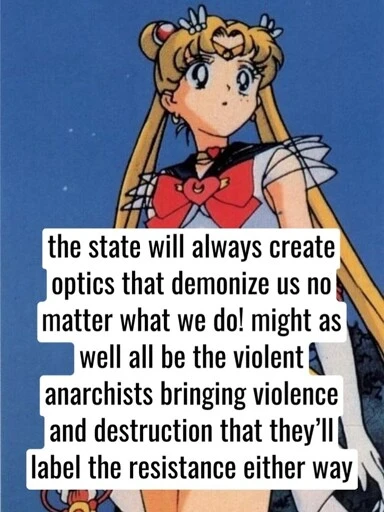
I agree, but every non-violent movement needs an underlying threat of the willingness to escalate and ultimately become violent to succeed. We need people who are willing to use violence.
Non-violent resistance is yin, violent resistance is yang. They need to be in balance.
The new regime faced extreme economic isolation and was forced to pay massive reparations to France, which crippled its development for generations.
“Faced” “was forced to” why the passive language? Yes, France indefensibly forced Haiti to pay reparations for Haitians “stealing their property” (freeing themselves from slavery), a debt which it still, unbelievably, upholds.
I’m not sure how it’s discrediting for a revolution to be crushed by an overwhelmingly powerful outside source. It kinda seems like you’re just trying to intimidate people into falling in line at that point.
Of course, we should also look at what happens to peaceful reformers who achieve some degree of success at decolonization. Mohammad Mossadegh of Iran, for example, is the perfect example of the approach people like you advocate. Peaceful, democratically elected, didn’t crackdown on anyone’s rights. Guess what happened? He faced, as you put it, “economic isolation” as the British blockaded them in retaliation for exerting control over his own country’s oil. Then he was overthrown by the CIA. Shit like that is exactly why anybody with any sense who gets in a position like that does the sort of thing that makes you denounce them as “totalitarian.”
Convenient, isn’t it? The peaceful people who oppose colonialism get quietly deposed or exterminated, while the violent ones get condemned and economically isolated. Almost as if you don’t want anything to change at all.
Result: Communist State: The creation of the Soviet Union (USSR). A single-party, totalitarian state that was characterized by extreme political repression and state-controlled social life.
Result: Socialist Republic: Cuba transitioned into a one-party totalitarian Marxist-Leninist state ruled by the Castro family for 60 years.
Both of which were clearly and unambiguously better than the states that preceded them.
My point in the Haiti point is that you ended up with an Emperor for life, as in all the other cases where you ended up with kings or single party systems. And yes, I can accept that from the very poor starting points of many of these countries, maybe the shakeup at least loosened something that could have opened up improvements in the next century or something.
But the USA is not at that kind of starting point yet. They still have an (admittedly flawed and likely compromised) democracy with a strong economy and still very high living standards, even if they aren’t evenly distributed. They do still have some checks and balances and rule of law that has not yet been subverted. Moving from this to a full autocracy, single party system, theocracy, military state or monarchy would not be a step up by any stretch of the imagination. It would be a disaster that would take decades if not a century or more to recover from.
So yes, sometimes things get so bad that you really
It’s funny to me how most of your examples involved the USSR peacefully ceding power. If you’re up against someone with a conscience, sure.
I don’t deny that peaceful movements can be effective (especially when backed with an implicit threat of force). I do deny that they are consistently effective, as proven by Mossadegh and countless similar stories around the world. From The Jakarta Method:
This was another very difficult question I had to ask my interview subjects, especially the leftists from Southeast Asia and Latin America. When we would get to discussing the old debates between peaceful and armed revolution; between hardline Marxism and democratic socialism, I would ask: Who was right?
In Guatemala, was it Arbenz or Che who had the right approach? Or in Indonesia, when Mao warned Aidit that the PKI should arm themselves, and they did not? In Chile, was it the young revolutionaries in the MIR who were right in those college debates, or the more disciplined, moderate Chilean Communist Party?
Most of the people I spoke with who were politically involved back then believed fervently in a nonviolent approach, in gradual, peaceful, democratic change. They often had no love for the systems set up by people like Mao. But they knew that their side had lost the debate, because so many of their friends were dead. They often admitted, without hesitation or pleasure, that the hardliners had been right. Aidit’s unarmed party didn’t survive. Allende’s democratic socialism was not allowed, regardless of the d’etente between the Soviets and Washington.
Looking at it this way, the major losers of the twentieth century were those who believed too sincerely in the existence of a liberal international order, those who trusted too much in democracy, or too much in what the United States said it supported, rather than what it really supported – what the rich countries said, rather than what they did.
That group was annihilated.
Peaceful movements that challenge Western economic interests in regions remote enough for the Western public to not care get massacred. Meanwhile, violent revolutions have provided massive increases in quality of life in many countries, including China, Vietnam, and Cuba. If you want to argue that peaceful methods are more likely to be successful within the imperial core that’s one thing, but if you want to lay it down as though it’s some universal law that violence never works, I’m going to call that out as absurd.
they did it because they collapsed under their own incompetence.
Huh, and here I thought they did it because peaceful protests were just so darn effective.
And if Cuba is the standard you have for quality of life, I feel sorry for you.
First off, Cuba’s quality of life is greatly impacted by the US embargo. Secondly, even with the embargo Cuba’s quality of life greatly improved compared to what it had before. If the standard you have for quality of life is the Batista gangster state, I feel sorry for you.
Funny how you chauvanists always try to compare the quality of life in former colonies to that of the imperial core as if it’s some kind of point in your favor. If you do an actually fair comparison by looking at what came before, Castro was a massive improvement over Batista, the PRC was a massive improvement over the ROC, and the USSR was a massive improvement over the tsar.
“Violent revolutions” like when Mossadegh was democratically elected? Or Jacobo Árbenz, again, being democratically elected?
You are making my point for me. Westerners are so ignorant of the histories of these countries that it doesn’t matter how peaceful they are. You’ll just assume that they’re violent based on nothing. How are you supposed to win public support when the public doesn’t know you exist, and doesn’t care if you live or die?
Either you’re just ignorant and doubling down to try to cover for that, or you have an incredibly low standard for what counts as “violent revolution” to the point that there’s no reason to listen to anything you say, because evidently voting for a peaceful leader is a “violent revolution.”
Not sure who you’re trying to fool, or if you’re just utterly delusional. Par for the course for an anti-communist either way tbh.
 realitista
 OBJECTION!