Kaushambi, c. 2500 BCE.

A bronze figure.
A woman seated above two bulls.

Not worshipping.
Controlling.

Two animals in perfect symmetry. Horns raised. Bodies angled outward like a traction pair.

Now jump 4,500 years forward.

A bull race in India.

The driver balances above the animals. Standing on a plank. Controlling speed and direction through the yoke.

Different era.
Same mechanics.

Human above the bulls. Balance over brute force.
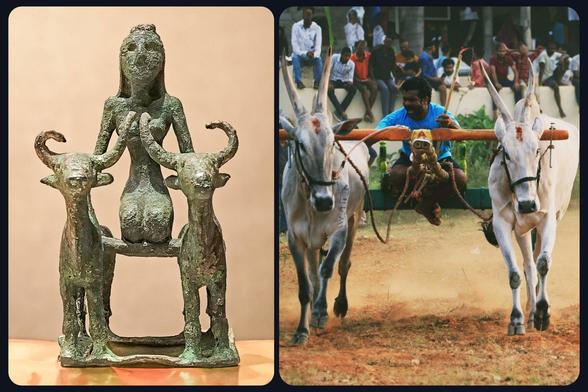
Yet museums tell us the Harappan figure is a “Mother Goddess”.

Because that is the easiest label when the past refuses to explain itself.

But look carefully.

The figure is seated between two powerful animals in a configuration that resembles draft control. Not prayer. Not fertility symbolism. Control.

And the controller is a woman.

Our textbooks quietly assume that animal handling, traction, and racing traditions were always male spaces.

But archaeology does not confirm that assumption.

Instead it shows a human — possibly female — dominating two bulls in a posture strikingly close to modern bull racing drivers.

So here is the uncomfortable question.

Did Harappan artists freeze a **moment of animal control** that still survives in Indian rural sport?

Or did we spend a century calling every unknown female figure a “goddess” because that felt safer than admitting we did not understand the scene?

Four thousand years apart.

Bronze in a museum.
Dust on a racing field.

Same animals. Same balance. Same tension. 🐂

Maybe the tradition survived.

Maybe the interpretation didn’t.

And if we misread something this visible…

what else are we confidently misreading in Indian archaeology today?

#UncropTheTruth
#Decolonisation