 Glyph
GlyphMacbook Neo Hot Take™, take 2. Earlier I was annoyed at tech reviewers who should *really* know better giving a *really* myopic assessment of its gaming potential. Now I'm seeing another bad take on Fedi, which is "all you Apple shills love this stupid thing, but a cheap Linux laptop would work better, don't buy it". I am much more sympathetic to this but it appears to be missing what is interesting about this device and why people are talking about it at all.
What is interesting about the device is not that you *should* buy it—the whole value proposition is that it is a very cheap, but also kinda bad, MacBook—it's that people *will* buy it. A lot. It fills a market gap. The only products that this is positioned against are Chromebooks and iPads; cheap refurb Linux machines are not in the same product category for most potential buyers, and I think the fact that Linux fans do not understand the different categories are endemic to why Linux struggles.
Potential customers for this fall into a few categories, including:
1. Parents who don't know a lot about tech, but whose kids need "a laptop" for school.
2. Kids & young adults who want a macbook to run something like GarageBand but have a very limited budget *and* also don't otherwise know much about tech.
3. Schools.
4. School-like programs, like software dev clubs & summer camps.
These customer types need a low price, but they also need A LOT of *support*. The support is the product here.
Out of all of these I have the most experience with category 4. I have set up labs full of Linux computers on many occasions. I've also done the same for macs. I won't say that macs are universally superior but there are TONS of things about imaging, configuring, provisioning, and authenticating macs that are vastly superior to Linux. If it's to teach a topic that isn't programming or sysadmin, like say graphic design, macOS has huge, huge advantages for legibility to the instructor.
Yes, you could personally get a more powerful computer by getting a refurb 16GB M1 MacBook Air somewhere by bargain hunting. But you will need to hunt; right now on the official refurb store the cheapest MacBook Air is $929. If you're shopping on eBay, now you've got a machine with a ton of wear cycles on the SSD, and dubious amounts of damage.
If you, personally, have the time & energy for that, it *IS* a better choice.
But if you're trying to source a 50-machine bulk order for a CS extracurricular program, with a uniform hardware profile so that students have a consistent experience, then no, you cannot reliably do that by going around to garage sales and rummaging through bargain bins. You cannot afford to repair all of these units (which WILL have a failure rate several times the average for a new machine) yourself. You can't even afford to troubleshoot them and manage the RMA process.
This problem is magnified for institutional buyers, but for folks without a ton of tech experience it's the same. The 1-year manufacturer warranty for new-in-store models is a big deal. The implicit promise of several years of software support is really important. Apple stores run free trainings you can go to. They have a business support program where you can talk to someone about fleet management problems for free. They have 24/7 chat support on the web if you have software issues.
If you think that you can compete with this with a bespoke Linux installation on a few old ThinkPads, you need to figure out a way to provide *all that other stuff* to the people who will be using them. And I wish you would! If you ran a charity campaign to raise money to scale up such an effort for a few local school districts in a particular region, I'd probably donate to it!
But if you have people with zero tech experience in your life, who have a kid who doesn't really know what kind of computer they need… I'm not going to tell you that you should never recommend Linux to such a person. But at the *very least* you cannot be recommending that they go bargain hunting for mystery-meat laptops that will "probably work with Linux". You need to find a company like System76 or Framework that will actually help them out if the dang thing breaks.
Telling someone to get an old Linux machine when they don't know anything about Linux yet, and then sending them off to college only for them to fail out of their first literature seminar because when they needed to submit their homework their wifi suddenly stopped working, and that "shouldn't be a big deal because you can get a more reliable driver on github" or some other kind of "fuck you" like that, you're turning other people into grist for your ideological project.
If you really want to help them save money, step zero is you have to volunteer to be 24/7 on-call tech support, be responsible for the decision, and help them out every step of the way. I have done this! It's a TON of work! It can be very rewarding when you help people build the relevant skills to use a computer like that. Personally, I have a kid now and I could not handle it today myself, but if you can do it you probably *should*, but it's important that you recognize you *need to*.
So, back to the MacBook Neo and why it is interesting.
If you're reading this, you probably shouldn't buy it. But you should be aware that so many people *are* going to buy it, that it's going to set a consistent new minimum standard for software. For one thing, lots of apps are going to want to start targeting "fits into a MacBook Neo's memory envelope", which is to say, 8GB minus macOS overhead. Cheap hardware exists now, but not enough of it deployed consistently enough for app devs to care.
It's also going to give a TON more kids access to things like "a terminal". Kids will be encountering MacBook Neos in places where they've previously seen Chromebooks or iPads, devices which either cannot be used to write software at all, or implicitly have locks that most people will not bother to remove. This will not be 100% consistent (some schools will wall off MacBook Neo dev tools for "security", I'm sure) but it will still be a big enough population that it will be *interesting*.
 JP
JP@glyph I read through this thread and I do want to highlight that it is _extremely_ US/affluence-coded, even as I suspect that may not have been your intention
while I follow the majority of your argument, I think it would fall apart quite rapidly outside of some specific locales simply on economic terms. I don’t see it flying in e.g. ZA, much less any number of other countries (KE/NG/ID/IN/etc)
@glyph Also I pick up a trace of geologist-xkcd here? I’m not coming swinging: I think your theses about fleet management are directionally accurate (certainly as a thing to want), but I don’t know if it holds up in as many places. I have seen maaaaaaaaaaaany places that trade human labour for MDM, and don’t think that’s about to stop any time soon
Also, idly: I had *absolutely* no idea about those free training supports. And I’ve looked into this before! Quite surprised
@froztbyte Yes, this is all very much from an explicitly US perspective, I know zero about what schools are like elsewhere. Some of this is just "affluence" but other parts of it are just specific requirements; for example, school IT is often *brutally* underfunded here, and teachers are stretched to the breaking point, so the idea of trading "human labor for MDM" is pretty impractical in a lot of places; the MDM either needs to be automated or it won't happen and there won't be computers at all
@froztbyte I strongly suspect that the Neo's success in other places will depend heavily on education/volume/regional discounts and I have zero idea what Apple is going to do in that regard. I don't think ZA is at the top of their list but who knows, maybe they make a concentrated push globally. I certainly suspect their margins on this thing will be healthy enough that they can cut deep in some cases.
@glyph They’d have to sell it at 40~50% of (indicated US) price[0] to even get any takers, I think. And unless they could do critical mass in low weeks, I suspect may also run into major theft problems
Over and above that, connectivity and software demands also stand a strong chance to just completely exclude it as a contender, from early in eval
[0] apple shit is much more expensive here, because of Core Group (importer with weird rights; we don’t have Apple here Officially)
@glyph Also fwiw, I put out some of my own thoughts (prompted by reflecting on your thread): https://mastodon.social/@froztbyte/116237457920466241
RE: https://mastodon.social/@glyph/116234465610992425
@froztbyte the subthread that ends here covers the "devs need to use these to optimize" thing, which I think is just straightforwardly false
@froztbyte execs need to prioritize and measure performance, devs using underspecced devices just makes the devs even less productive
@glyph I agree on the former, but disagree on the latter (although perhaps in a matter of quibbling on details)
To pick an obvious and easy example: js-world stuff, which is an ocean of waste. If they actually had to care about download time (or even better, *cost*), you’d see some bundle optimisation and improvements within days!
Dev culture is steered from the top, but also afforded shape by environmental pressures. I argue you need to account for both
@glyph A secondary part to my argument is perhaps a bit reductionist: _why_ would it make them less productive? If it’s because they can’t run their 24GB stack with 3 replicas locally all at once, I’m actually gonna say “tooling failure” tbh
In a world with people drooling about k8s & hyperscaler instances everywhere, scratch space is easy. Don’t want to incur costs (I often don’t, and rage against their prices), k3s et al exist too. Ergonomics suck? Tooling failure!
Also to blame: monoculture
@froztbyte Regarding the machine-provisioning step: let me put it this way: I've been in environments where devs *did* get shit machines (because leadership held this religious belief about devs needing to "suffer for the users"), and it absolutely did not improve the quality of the resulting software whatsoever. Everyone was miserable and everything ran poorly but the schedule did not allocate time for optimization and so no optimization happened.
@froztbyte Regarding tools: the 24GB stack is not JS technology, but VMs running multiple operating systems, which necessarily has a bunch of overhead. Sure, npm isn't the most svelte thing in the world, but that's not what's driving dev tooling performance overall. In frontend roles where the software runs on end-user machines, you need those VMs to contain different versions of whole GUI operating systems. Different dev teams have different perf requirements but it's rarely just one thing.
@glyph the 24GB value specifically was said partly in jest, but please remember that I _do_ in fact know this space about as well as you do :)
in recent years I've gone down the rabbithole of android and some webshit: it *can* be slimmed down quite a bit, I *have* done this on a number of toolchains/builds
I still don't think there's a strong argument for "local GUI VM" that isn't as easily answered by "remote GUI VM", especially for web-class shit. doubly so on other resource use
@froztbyte you should tune in to one of my streams sometime 🙃
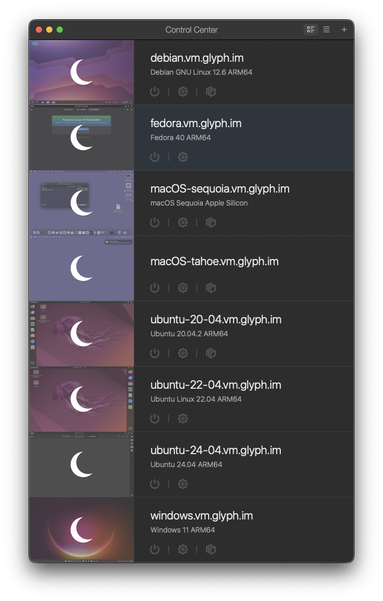
@glyph yes I've seen this before, and I know a bit about your workflow (ito what you've posted about it before, as well as what you've debugged with it)
(one of those differences is that my style is very explicitly almost the direct and quite possibly extreme opposite of that - I make disposable VMs so heavily they're like mayflies)
@glyph I have really wanted to, but time-wise it simply hasn't been a good reality the last couple of years (for life reasons)
a co-hack session of some stuff might one day be an interesting experiment, because I think we come at similar targets from workstyles that differ in some interestingly notable ways
 morgan
@glyph
@froztbyte unless something changes radically here (France), the thing is no school or university is going to buy a fleet of laptops, we have really cheap desktop computers in some classrooms and they get updated in small batches when they break and not before
@froztbyte unless something changes radically here (France), the thing is no school or university is going to buy a fleet of laptops, we have really cheap desktop computers in some classrooms and they get updated in small batches when they break and not before
@glyph @froztbyte sometimes local institutions (the regional governments etc) will give out some devices to students at like grad level, usually the absolute cheapest they can find that runs windows, i could be mistaken but I don't see what you're describing happening
@glyph @froztbyte will this lead to more students buying their own macs? possibly yeah, but i really wouldn't bet on anything massive and institution-driven (especially since the new motto everyone here as is "get the fuck away from anything that makes us dependent or vulnerable to the usa")
@fay @froztbyte thanks this is a really interesting perspective! having seen how classrooms are set up in the US, I cannot imagine what you're describing — the last time I saw a school with enough space for dedicated desktop computers in a classroom in the USA was probably my own high school in the 1990s. This is possibly a regional thing though, I have mostly been in places where real estate is pretty expensive so price of more space >>> price of fancier computers
@fay @froztbyte and yeah on the "dependence on the US" thing. possibly apple is pricing it with an eye entirely to the US because the rest of the world hates us and they know they're going to have a hard time selling them elsewhere
@glyph @fay too add an anecdote around this as well: the way I've seen a lot of local shops operate is closely similar (with "rent/lease-buy bunch of boxes" and "single pass refresh of bulk dells/similar" as other models)
at software level, disks with a CoW-style revert-changes-at-reboot operating style is somewhat-often seen. "a minion with more time than anything" is another common support approach. the latter is very much because of our fucked labour market
@glyph I don’t mean it as competition but you should go read about what some ZA schools deal with
It’s pretty grim :|
(and ofc there are places worse off; I’m just making this reference because it’s the one I know best)
@froztbyte the US is not uniformly "affluent" either. schools in Appalachia probably have more in common with ZA than they do anywhere in Europe, for example. But I do live in California and most of my network is either here or in New York.