 Gollum
The radical left
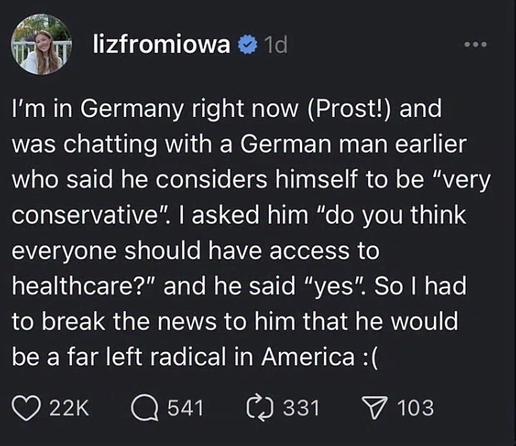
That’s because “conservative” isn’t an ideology, and it never has been. Conservativism has two core beliefs: “conservatives” refers to a specific group of people defined by common traits, and those are the good people. Each tranche of conservatives defines their own identity, and then they define whatever they want as “conservative values.”
This German guy on the train probably is very conservative. He is not more progressive than an American conservative. He has simply defined his group of conservatives to include the people who benefit from universal healthcare. He sees the value to his own group, and so he supports it.
I really don’t think this is an accurate description of what an average aging conservative German is.
Conservative means what it means - people who want to conserve rather than change, and are comfortable with how things are and, in their opinion, have always been. It’s a naïve world view based on a lacking understanding of how society changes. The people who hold it tend to be of privileged groups who can afford to be blind to injustice. That doesn’t mean they are fans of it - their privilege has just left them with a blind spot, and when injustice is pointed out to them they tend to blame those showing it to them for creating it in the first place. Again, they are not brilliant people, but they’re generally not evil, just a bit dumb.
When American self-proclaimed conservatives storm the Capitol building and make an active effort to fuck up their country as much as humanly possible they are not conservative in the same way some Günther riding the Deutsche Bahn considers himself conservative. Similarly, I’m a socialist in the same way Pol Pot was a socialist.
American fascists have intentionally stripped the word “conservative” of meaning, and if we accept their narrative we allow them to make us dumber.
I’m not saying CDU and CSU are brilliant parties, but the fundamental idea of German conservitivism is not the idea of “conservatives” as a select group of people for which society should work. If anything this is a description of populism.
I feel like this is a good attempt at a description of what conservatism is, but I’d like to share my own - conservatism is the natural political philosophy of people living in danger and scarcity.
Hence -
And of course, the conservative response is driven by belief, not reality. So if someone believes that the world is dangerous and their way of life is precarious, they will quickly adopt conservative attitudes. So it doesn’t matter if you yourself are actually safe and your way of life is quite robust - if you get sucked into a fearmongering news cycle, you can become conservative.
Interesting thoughts. Though I’d be curious whether its just an ebb and flow of economic cycles that change peoples political leanings. Such as large government debts and debt crisis from a progressive government lead to the pendulum swinging right, and then a period of muted growth and feelings of inequality lead to the pendulum swinging left.
What happened in the 60s and 70s to turn a large number of “great society” voters towards Reaganomics?
I don’t think things like debt actually make people more conservative. I think that effect has to flow from things which actually impact peoples lives - so if the government takes on too much debt, and then cuts public services to manage that debt, which makes people feel more economically precarious, then people will statistically become more conservative. But if the debt isn’t impacting people directly, then it isn’t increasing conservatism. Instead, existing conservatives are predisposed to care about increasing public debt and see it (rightly or wrongly) as a threat to their way of life. But if conservatives constantly talk on the internet about how increasing debt is going to collapse the government, then more neutral people might feel threatened, and will start adopting more conservative stances.
As for what caused the shift towards Reaganomics - I’m sure we could come up with a just-so story. But I don’t know if I’m the one to do it
 themeatbridge
 cabbage