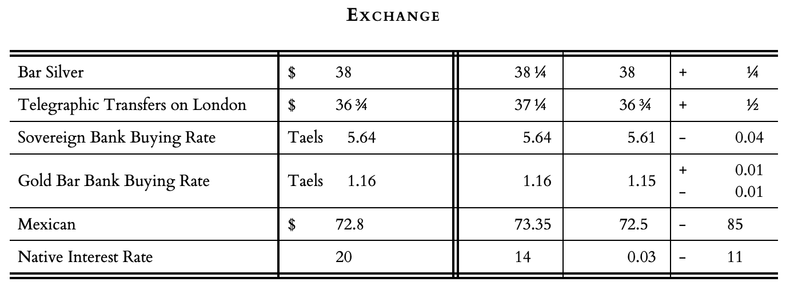
Any historic finance people out there? I'm trying to determine what the abbreviated text in this chart means. It's from a 1917 magazine.

I figured out "T.T. in London" is "Telegraph Transfers in London". I think "Sov. Bnk. Buy. Rate" is "Sovereign Bank Buy Rate", though I'm not positive since there's a period after "Buy." in the original and I don't know what it would actually mean anyway. And the "Buy" in "Gold Bnk. Buy. Rt." also has the period.

"Tis." and "Mative Int." still completely elude me.

#finance #history #Shanghai #ChinaHistory #InvestmentHistory
Ooooo I found something about the financial markets during the Treaty Port Era of Shanghai!

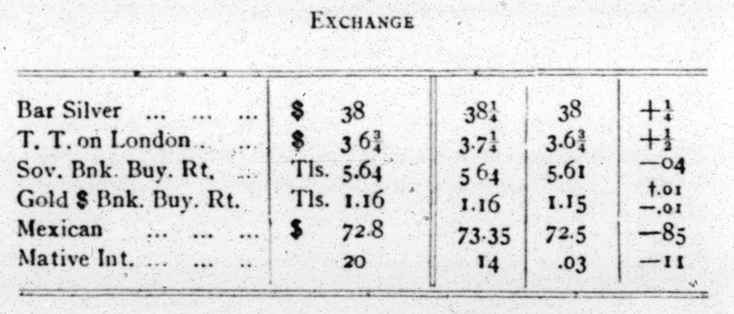
Sovereign Bank Buying Rate
Gold Bar Bank Buying Rate

Tls. = Taels, apparently a weight-based unit of silver for accounting purposes. Specifically, Shanghai Taels in this context since the tael measurement was different throughout China!

Mative Int. = Native Interest Rate
This was interesting, it's actually a mis-print in this issue! I found another issue to verify it's supposed to be "Native Int."!

Wow, and "Mexican" in this context actually means a specific grade of silver dollar coins, common in China at the time.

Apparently I just needed to ask the fediverse and help the universe direct me to the answers. Thanks for all of the boosts!

This was the source I found and parsed quickly:

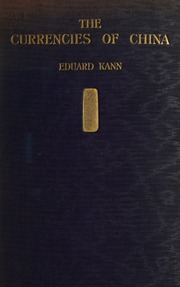
The Currencies Of China: An Investigation Of Silver & Gold Transactions Affecting China. With A Section On Copper

https://archive.org/details/currenciesofchin00kann_0

Just a little light reading! 🙂

The Currencies Of China: An Investigation Of Silver & Gold Transactions Affecting China. With A Section On Copper : Kann, Eduard : Free Download, Borrow, and Streaming : Internet Archive

First edition. Tall 8vo, original blue cloth, gilt. xviii, (2), 540, (xxi)-xlviii pages; color frontispiece; folding table; text tables; 2 plates of sycee...

Internet Archive
Here's a screenshot of my HTML version of that same table, spelling out the full abbreviations and adding some "modern" styling.