I'm going to the Great Northern Viking Festival this June, and I thought it might be handy to have a few #OldNorse phrases to toss around. Even if no one speaks it, it might add to the atmosphere.

Stress the first syllable of any word.

In "drykk" the Y is pronounced like the German Ü, an OO at the lips with an EE in the back of your mouth. Roll your R's.

In "hvat," aspirate the H in front. The V at the start of words is pronounced V, but in the middle of words it sounds like W.
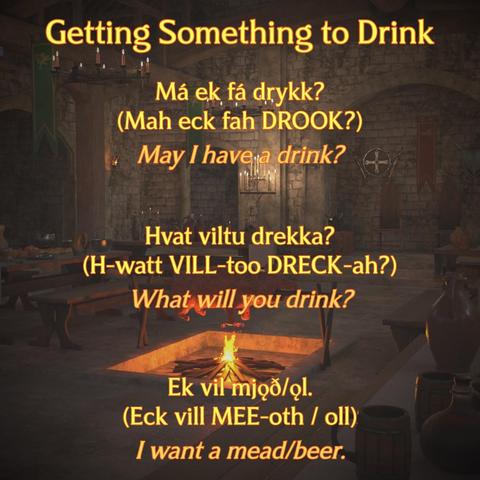
Try to say "mjǫð" all in one syllable—the European J sounds like a Y to Americans; the Ǫ sounds like the O in "storm" (with just a hint of the following R), and the ð is a vocalized TH, like in "other/those."

I don't think these are too inaccurate; anyone who knows better has been dead for a millennium. Pronunciation varied by region and era. #OldNorse isn't intended to be pronounced like modern Icelandic. Watch Dr Jackson Crawford's videos for better tutelage.
https://youtu.be/FJd_eOzgbgg

Old Norse "Class," pt. 1: Pronunciation, Vital Vocabulary

YouTube

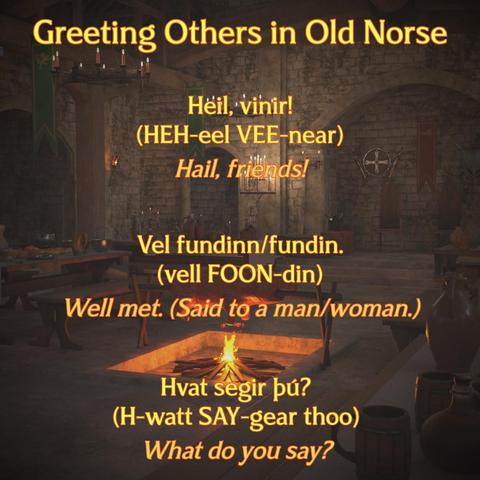
Here are some ideas for meeting Vikings and shield-maidens in #OldNorse

The /ei/ sound in "heil" starts with "heh" and curls quickly up to "eel," as close as you can get to one syllable.

The V at the start is still pronounced like /v/ (AmE), not like a W.

The difference between "fundinn" and "fundin" is subtle: hold the double-N a little longer.

In "hvat," the /h/ is aspirated and the V becomes /w/, inside the word.

The Þ is an aspirated /th/ like in "think" and "thistle."