 MTZ
MTZUnconventional strategy.
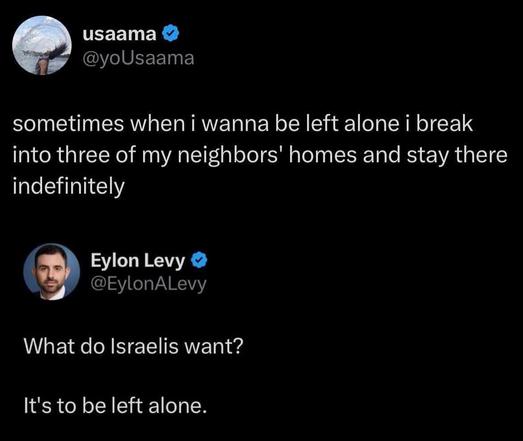
It’s … wild because this is part of the roots of the Jewish people being chased from their lands.
In a world where folks accepted other peoples gods but revered their own … the monotheistic Abrahamic religions fucked all that up.
I think you’ve just talked yourself into a circle. You can’t both believe something and doubt it. Doubt is the opposite of belief.
What you’re talking about is possibly belief in belief. That’s the belief that you should believe, or belief that you do believe. That is not the same as actual belief.
If your bar for believing something is that you’re 100% certain that it is true (i.e., a complete lack of doubt), then you’ve rendered the whole concept of belief useless as there is no proposition this applies to.
Me, if I see a cat sitting on a mat, I will believe there is a cat on the mat. But it might be that it’s a capybara wearing an incredibly convincing cat costume. Very low odds, but the possibility is there. It could also be that I was a bit careless in looking, and the cat is actually sitting on an especially mat-like section of the newspaper. There is always doubt. Sometimes there’s more (maybe the lights were off), sometimes there’s less (I spend a good hour examining the cat-mat situation, consulting biologists and mat experts), but there is always doubt.
Asserting you have no doubt is asserting you made no mistake in assessing reality, i.e., that you’re perfect. And call me a dick, but I don’t think you are.
There’s a big difference between having no doubt, and thinking you’re infallible.
I believe if I drop something it will fall to the ground because objects with mass produce gravity. It may be that some other completely different force is at work, besides gravity. But I don’t believe that to be true. But if there is evidence that it is true, I will change my mind.
A good way to check if you believe something is to look at how you act. You see the cat, you act like. It’s a cat, you believe it’s a cat. If you see the cat, and hesitate and doubt, then you don’t believe it’s a cat. You may do some thinking and then determine it is a cat, and start believing it. And then you will act accordingly.
And that’s why funerals disprove religious belief. If people truly believed in their religion, and believed in the afterlife, funerals would be happy not sad. But they don’t believe in their religion. They hope that they’re right. But they don’t believe it.
Ok, so I think our wires cross regarding terminology here. We’re roughly on the same page. So, when you believe something, you can put some probability on how likely it is to be true. I think we both agree that putting probability 1 is either mistaken or a lie. It is asserting that you’re infallible. And I think we both agree that asserting your infallibility is silly. So, to every belief you have you put some probability. If I look at the cat on the mat in broad daylight I will put 0.999, and I’ll put 0.99 if it’s a dimly lit room or whatever. In any case, despite believing the cat to be on the mat, I admit that I am human, therefore fallible, and I will assign some non-zero probability to the negation, namely 0.001 or 0.01. And here I think we’re still on the same page.
Here I think we diverge, and it’s just a matter of definition. I’ve been referring to that small sliver of probability of the negation of my belief being true as “doubt”. So with my definition of doubt, you will agree, there is always some doubt. Sometimes more, sometimes less, but it is always there. Let’s refer to my definition of doubt as “schmoubt”.
If feel like your conception of doubt is basically when schmoubt reaches a certain threshold, namely where you’re no longer comfortable saying you believe the proposition. So for example, we might dim the lights quite a lot, and maybe my schmoubt goes all the way up to 0.4 or whatever, and I no longer believe there is a cat on the mat. I’m pretty sure there’s something sitting on something, but my schmoubt for the statement “the cat is on the mat” is too high for me to justify my belief to myself. So clearly you believe schmoubt is real, but you wouldn’t call it doubt. What do you call it?
Regarding the funeral thing, I think you need to be a bit more critical of your analysis. It is perfectly consistent to believe in an afterlife but also be sad when someone passes. Because for the time being, you will be separated from them. You will be going at it alone, for quite some time in some cases. It’s the same as being sad your significant other will work abroad for a while. You will see them again, and this is temporary, but you are sad because you will not be able to enjoy their physical presence for a while.
 FiniteBanjo
 prettybunnys
 MinnesotaGoddam