 Gollum
The radical left
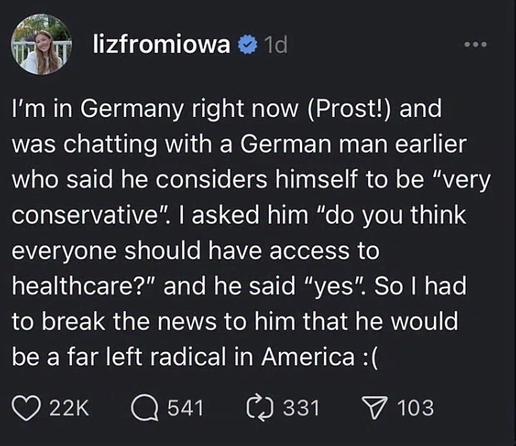
Now ask him if Christianity should play an official role in the German government. Or if he objects to people practicing cultures other than German in Germany. Both of those would be radically far-right in North America, but are pretty standard in Europe.
What’s going on here is that people tend to arrange themselves along a left-to-right line, but where exactly in the multidimensional space of viewpoints that line cuts through varies dramatically between times and places. It even inverts - your Prussian conservative would have taken a much dimmer view of free markets than a contemporary to their political left.
My mental model of the right-left dichotomy:
Anything more complex and the labels hit their limits.
I think a better one is acceptance of change.
Sometimes change is good, sometimes the world is not ready. I think this aligns closely with “cynical” and “naïve” but just makes it more abstract.
Not bad but might apply more to liberalism IMO. I think the word “accepting” (of change) is doing a lot of work when you consider revolutionary communism, whose whole mission is to force change at any cost.
The left-right dichotomy is almost completely useless IMO. It’s more about identity than anything else. Football teams.
The trouble being that this possibly makes the Nazis left wing, which nobody contemporary with them saw them as.
In school this was taught to me as reactionary-conservative-progressive-radical and contrasted with left vs. right.
Right seems more tribal
Left seems more accepting of outgroup, people who are different
 CanadaPlus
 Samskara