I have a new queen. Lasius brevicornis. The queen is about 9mm Her nanitics are so tiny I'm going to cry. They are 1.5mm and transparent yellow.

They are smaller than the antennae on my Camponotus pennsylvanicus queen. Nanitics are the first workers in a colony and they are often smaller than the workers produced later when the colony is better established. But this is out of control. They are just so small.

They would make a fruit fly look like an elephant.
They still have six legs, tiny mandibles and tiny ant intentions and projects they are working on with their mother.

What do they have in their legs? One muscle fiber per joint?

They are so complex and tiny it's breaking my brain a little.

I don't understand why people aren't freaked about about this more often.

@futurebird Insect brains seem like a very obvious place to start when studying intelligence - the fact that a few hundred thousand neurons can manifest such a widely varied responsiveness to their environment could tell us a lot about how to build machines that work effectively.

@emeb

They dig and maintain the nest.
They forage for food and lay trails.
They defend each other and the queen from threats.
They find and farm scale insects for nectar.
They stop and greet each other and check if anyone who wants to enter is from the colony.

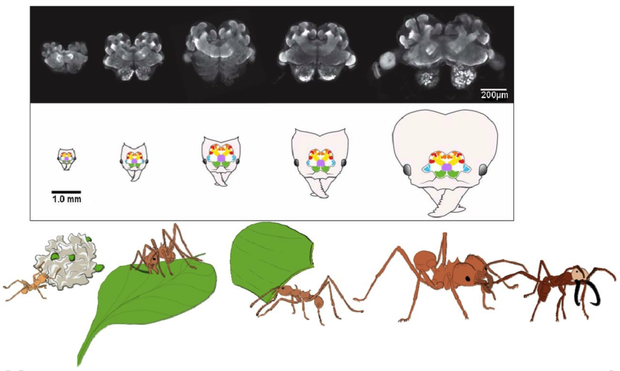
So much complexity and you have one of the smallest ant brains. They do vary in size a lot, and ants have relatively large brains for their size as insects (bees do too)

But when you look at the smallest ants it's kind of shocking.

@futurebird @emeb based on this diagram, I conjecture that brain size is a limiting factor in ant miniaturization.

@llewelly @emeb

You know they'd have ants small enough to manipulate cells if they could get away with it. The tiny nurse ants do work on the hyphae of fungi that's like delicate surgery as it is.

@llewelly @emeb

In terms of evolution the wasp-like ancestors we have from amber were mostly on the larger size, the smaller ants are a later specialization.

@emeb

I kind of worry that the graphic might give the impression that each size of ant can only do the job she's shown doing.

It doesn't work this way at all. Every ant is able to do every job in the nest... but they will specialize to doing jobs they are physically better suited for (and better suited for in terms of age and other factors.)

@emeb

So, it's not like you can say the problem is solved by each ant brain only knowing how to do one job. The big solider can care for eggs if there is no one else to do it... the tiny nurse ant *will* fight if she's the only one left to fight.

@emeb

I'm imagining a tiny ant in a tee that says "born to bite enemies, forced to weed fungi"

@futurebird @emeb I seem to recall that some tiny spiders have brains that squish down into their legs, because there's no more space in the thorax, but they need the neurons to remember how to spin webs.

@futurebird @emeb

One thing about mammal brains is they don't just think, they are also glands, producing various substances that effect the entire body.

My theory is that this is why mammal brains have to get bigger as the animal increases size.

I'm wondering if Insect species, on the other hand, may use a higher percent of their brain for thinking.