That’s just regular capitalism? Labour is cheaper in Asia. Even then the US still maintains a tight hold on the aerospace, armaments and tech industries and still reversed some off-shoring; most notably the semiconductor industry.
You’ve almost got it, as capitalism progresses it turns into imperialism, which itself is self-defeating. The US Empire is also short on what it needs to keep producing arms, due to tight controls on rare Earths and other raw materials from China. This is why Lenin’s analysis of imperialism is useful, we see how imperialism causes de-industrialization and undermines itself.
The US also redeployed forces stationed in Europe deterring the USSR during the Gulf War, and yet it’s still standing strong 35 years later. They also did this during the Iraq war and Vietnam war. The real question is, “Are the US going to be overextended if China, Russia or the DPRK start escalating tensions elsewhere?” Even at that point nukes enter the conversation and it stops being predictable.
Yes, the US of 35 years ago had a stronger millitary. The US Empire has fancier tools, but cannot produce them at the same scale they once could. Quantitative buildup results in qualitative changes, this is why dialectics are necessary, not just metaphysical materialism. Materialism must be dialectical.
That’s not how dialectics works. You’re going too far and into economic determinism. Austerity policies aren’t always pursued for economic ends; they can also be done in pursuit of ideological ends.
It is how dialectics works. History is not a series of snapshots, but something that unfolds and changes over time as internal contradictions result in development and change. I’m not going into economic determinism, ideology itself has a material basis. You’re trying to hide idealist analysis behind materialist phrasing, but by treating the ongoing problems with the US Empire as a result of Trump alone you’re literally ascribing to Great Man Theory.
It changes it, but not damningly so. At best this shows contempt towards the current administration and not to the US Empire as a whole.
Sure, my point here is that the US Empire’s ability to wage war is hindered. Iran will not fall no matter how much the US bombs it, they need boots on the ground to do so and the Statesian public has no appetite for this.
If you haven’t already, I suggest you look into Louis Althusser’s idea of “Relative Autonomy” in texts like For Marx and Ideology and Ideological State Apparatuses. Trump is not the cause yes, but his actions still have real world effects that are not immediately tied to economic considerations. Similarly, fascism is a very specific thing. You can at best argue for general authoritarian outcomes due to the class conflict, but not fascism, as it is a specific ideology that can exist somewhat autonomously from the contradiction between capitalists and workers.
Fascism is simply capitalism defending itself from decay. It has material conditions that drive it forward. I’m aware that actions have real effects, but you need to connect it to historical trends. Development happens in spirals, not just because of the actions. Actions create new conditions, but the material conditions impact what ideas are had and what actions people take. As people shape the material conditions around them, their ideas are re-shaped, in an endless process.
Your own argument just proved why the US Empire is not in its dying stages. Europe is completely dependent on the US and their influence geopolitically has only seemed to increase since their increased alliance and integration with Israel in attempts to tie down the Middle East as well. Ask yourself this question: If the US was well and truly close to its end, why didn’t EU members end up selling US bonds when Trump threatened Greenland? That’s because they’d end up tanking their own economies in the process. US debt is the backbone of the entire global financial system.
Europe is imperialist too, and utterly subservient to the US. However, the imperislist system both depend on is weakening. Europe has practically no hard power, and the US Empire’s hard power is a shadow of its former self. Both are going down in a sinking ship.
I can concede to you that the US isn’t as dominant as it once was since the fall of the USSR and that things are more multipolar now, but the current argument is about whether the US is close to its fall, and i just don’t see enough evidence supporting this claim. Don’t get me wrong, the US empire will fall at some point, but you make it sound like it’s imminent.
The US Empire isn’t falling tomorrow, but it isn’t going to take a century either. In the grand scheme of things, the fall of the world’s largest empire is quickly approaching and will likely happen within our lifetimes.
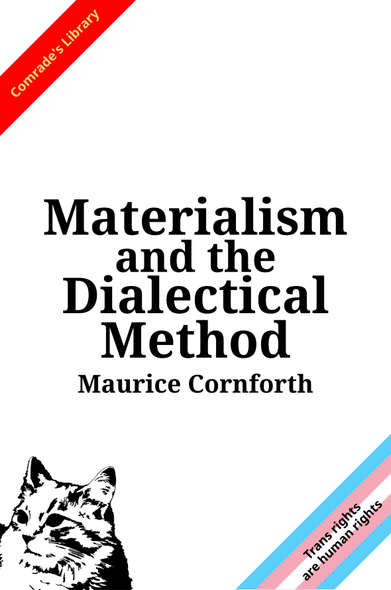
I think you should probably brush up on dialectics, I recently read through Materialism and the Dialectical Method by Maurice Cornforth, and if you ignore the Lysenkoist views of genetics (taken out once the gene was proven, but this is based on an earlier edition), it’s really a fantastic overview. The four basic principles of dialectical materialism are as follows:
Dialectics does not regard nature as a collection of static, isolated objects, but as connected, dependent, and determined by each other.
Dialectics considers everything as in a state of continuous movement and change, of renewal and development, where something is always rising and something is always dying away.
Dialectics is not a simple process of growth, but where quantitative buildup results in qualitative change, and qualitative change result in quantitative outcomes, as a leap in state from one to the other, the lower to the higher, the simple to the complex.
Dialectics holds that the process of development from lower to higher takes place as a struggle of opposite tendencies that forms the basis of their contradictions.
When you pin the current downfall of the US Empire on Trump’s actions, you miss the context of why those actions came to be, and why Trump’s strategy isn’t nearly as effective at securing imperialist gains as Reagan’s was. The US Empire of today is not the same as the US Empire of 30-50 years ago, and the biggest changes between then and now are that the US Empire has offshored most of its production, and the global south now has far more south-south trade and can escape the exploitative north-south trade by which unequal exchange functions. This results in development, and decreased superprofits.
 reddit_sux
 Cowbee [he/they]