 Andy Wingo
me: i wish we could have tail calls in c
gcc: we have tail calls at home
the tail calls:
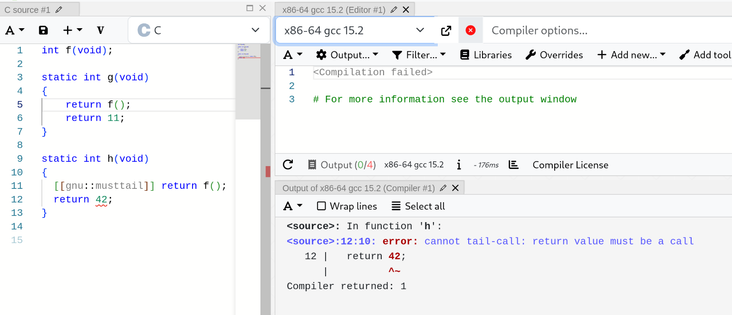
me: i wish we could have tail calls in c
gcc: we have tail calls at home
the tail calls:
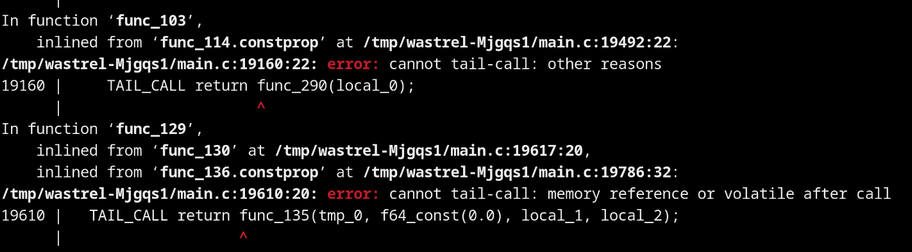
@wingo I had patches to improve the error message here. I cant remember what happened to them though.
Oh now I remember it was stage4 last year and I forgot to submit them during stage 1 because I was busy trying to get other tail calls working. And other optimizations happening .
Let me see if I can dig them up again and submit them for gcc 17 when stage1 opens up again.
@wingo also we fixed a lot of musttail issues during stage4 for gcc 15.
Please file a bug since it does not get tracked otherwise. Also note which target you are doing it on. Since tail calls are target dependent.
Gcc tries it's hardest at -O0 for musttail but -O0 really falls the most too.
https://gcc.gnu.org/bugzilla/show_bug.cgi?id=115979
is recording at least one example of musttail error message being "other reasons". I have not looked if this is your case though.
@wingo Thanks again for the bug reports.
The fix for the musttail on the second return (first reported here in the original thread) should be easy to fix; it looks like an oversight really. There has been more testing with the C++ front-end than the C front-end when it comes to musttail due to the usage in open source has been with C++ code. (GCC's C and C++ front-end share some code but a lot of is not; this is different from clang where the parsers are even shared).
The fix for the inlining case is harder but I know what is causing it at least. I have some ideas on fixing it in a reasonable and quick fashion; as I mentioned in the bug report -fno-tree-sra is a decent workaround for now.
Note my name is different between GCC bugzilla and here.

 Andrea (Drea) Tamar Pinski