
Google Mail / "GMail" has no fewer than nine settings for "Smart Features and Personalization", e.g., Gemini. I have these all turned off in order to prevent Gemini ingesting my emails. To do this, you now have to opt out of benign machine-learning or even pattern-matching-based features, like sorting promotional emails from regular ones or spellcheck.

Despite this, as of today, Google is offering a Gemini smart compose feature on all my emails, despite me having turned off smart compose.

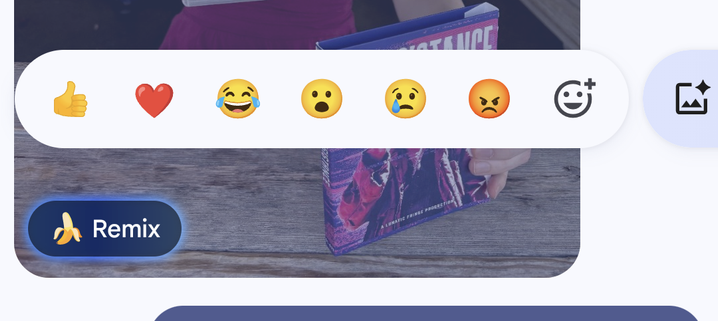
Related, consider the Android "Messages" app. This has checkbox settings for "Smart Reply"; two additional checkboxes for "suggestions" of stickers and "actions"; and a fourth checkbox, "Gemini in Messages", for explicitly turning off Gemini. I have turned off all of these. Despite this, this week I discovered that if I long-press or open ANY image in Messages, there are two buttons, "Remix" and "Create", which Google's documentation explicitly says network-sends the image to, quote, "Gemini".

Now one *assumes* these buttons don't activate unless pressed, but there's a problem. First, the checkbox to disable "Gemini" in Messages itself only turned off an activate-on-select button. Second, on a phone— where "scroll" and "tap" are both taps— accidental activation of buttons is a part of life.

This happens to me again and again, with Google, with Copilot in VS Code, with everything. A company adds an "AI"-branded feature with an off switch, you turn it off, they later enable it anyway.

The repeated lesson here is that a company, organization, computer program, or person who uses the privacy, environmental, and trust disaster sold as "generative AI" for one thing, can no longer be trusted for any thing. If it is tolerated for one thing, it will eventually be used for all things. If a program adds an optional "AI"-branded feature you *have* to stop using that program completely, because if (when) the company feels the use metrics are too low they will stop making it optional.
@mcc I am struggling to cope with the intersection of this true thing that you have said, and the other true fact that this phenomenon is engulfing all software at breathtaking speed https://floss.social/@soller/116217334800540296
Jeremy Soller 🦀 (@[email protected])

LLM slop is just one part of the broader systemd/Linux sloperating system. https://github.com/systemd/systemd/blob/main/AGENTS.md

FLOSS.social

@glyph It is at the moment my sincere opinion that it is no longer possible to coexist with Linux, except by forking both the kernel and systemd from last December and maintaining them independently. I do not know how to organize a community effort of that scale. I guess I am looking into FreeBSD as soon as I'm no longer in surgery recovery.

I am using Linux because, only because, of LLMs in Windows. If LKML is using LLMs, then there is literally no point.

@mcc @glyph Did FreeBSD ever settle on an LLM/AI code policy? Last I looked they were intending to write/release one, but, I haven't been able to... actually find it written anywhere? (I know netBSD has an explicit no-LLM-code policy)
@miss_rodent @glyph then most likely I am confusing netbsd and freebsd.
@mcc @glyph Ah okay, freeBSD seemed to be erring against LLM code, but considering allowing it for documentation, but, looking again, I can't find a specific policy about it, so, maybe it's still an ongoing argument.

@miss_rodent @mcc @glyph

Even FreeBSD is concerned by slop, as you can find Claude code (or at least code where Claude was used as an assistant) in LLVM

@vmignot @miss_rodent @glyph nightmare scenario where I have to get gcc working on freebsd so I can use the unslopped rustc
@mcc @vmignot @miss_rodent @glyph Is Rust still slop-free? The available language options are dwindling fast.

@sabrina @vmignot @miss_rodent @glyph i have no evidence and no time right now to investigate but multiple people I understand to be high level influential in the rust community have shown themselves to become actively angry and defensive at the mere suggestion users might object to slop code, so I'm worried, if I look, what I'll find

Which is why I spoke of potentially having to use the Rust frontend for GCC