I just finished doing my 2025 taxes

https://sh.itjust.works/post/56745869

I just finished doing my 2025 taxes - sh.itjust.works

Spent 10 minutes with my SO, moving our shared deductions between us to see which distribution resulted in the lowest amount of taxes. Turns out that the tax authorities are pretty good at what they do, as the best distribution was what they’d already prefilled. Despite having very different income, no matter how we moved the numbers, the numbers at the bottom didn’t change in a manner where the total would result in a higher refund. So we both ended up filing our taxes with no changes to the prefilled values.

Since we’re on the topic, this year I quit using turbo tax, and tried freetaxusa. It’s just as easy, they found me a bigger refund, and it’s a LOT less expensive to file.

I never quite understood wtf is up with how the US tax system somehow includes a filing cost. I’d love to learn more, but I suspect it’d get me way too excited for this community, and not even in a good way.

All the relevant numbers should already be registered somewhere. Pulling them into a prefilled form should be trivial.

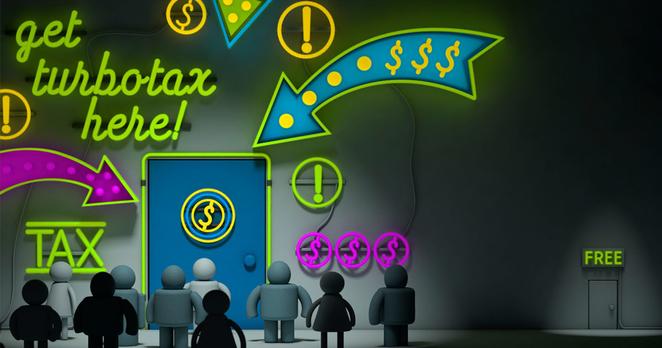
You would think that’d be the case… The tax system doesn’t include the filing cost, private companies charge the fees and lobby the IRS to intentionally not make the process simple and free for Americans.

Further reading: www.propublica.org/series/the-turbotax-trap

The TurboTax Trap

ProPublica has long detailed how Intuit, the maker of TurboTax, and other companies have worked against making tax preparation easier and less costly.

ProPublica

That triggered me enough to attempt proper use of emojis: 🤯

I would show a screenshot of how I do my taxes, but then I’d doxx myself, my family, and my employer.

But as an American we’re free to decide which tax company is going to take our money, and also free to not have an accounting degree and mess up some math and then get audited. You can’t put a price on freedom. /s

Bamboo is right, you could do it all for the price of a stamp if you grabbed the paper forms and filled them out, but you risk missing deductions that you don’t know to look for, or making an error that gets you on legal trouble.

Taxes were easy when I was a young broke adult, and I would do them myself on paper, but once I started owning things and having kids, the extra refund money that a professional or software would find was worth more than the cost to get their help.

I haven’t done my taxes on paper in over 20 years.

The USA system – both federal and state-level – is a bungled attempt at doing all of these things simultaneously: revenue collection, grant issuance, welfare, equity, economic incentives, and monetary penalties. And the results show: it’s woefully unfit at any of these objectives, and the agencies responsible for administering this convoluted mess are left to divine the intended objective and hopefully reach some sort of sane conclusion.

As a reference for fellow Americans, the idea that child welfare is administered through the tax system is not common through the world. That is to say, a “child tax credit” would just be a issued directly from a government agency, with maybe one form to set up direct deposit. Same with economic incentives: rather than a “refundable heat pump tax credit”, other countries just give out grants when you show that you’ve met the qualifications. Remarkably, the USA already have such a system, in the form of municipalities or local utilities that either issue these grants themselves, or work with local suppliers to implement point-of-sale discounts (eg LED light bulbs).

Separating such concerns from the taxation system means that people who don’t file taxes – usually because they’re below the 0% tax rate, which would be the standard deduction at the USA federal level – can still get the full benefit of welfare and grants.

It also avoids the absurd result where the tax authorities have to figure out whether a particular piece of HVAC equipment meets the qualifications set out in the tax code. The IRS (federal) or equivalent state agency does not specialize in such determinations, so there will inevitably be mistakes if they have to do this. Instead, an agency like the USA Dept of Energy would be much more qualified to administer that task.

Finally, because of the litany of such “elective” tax credits or deductions – meaning that whether they apply or not is highly dependent on preconditions – it makes it functionally impossible for the tax agency to give taxpayers a prefilled tax return form. How can the IRS know if you bought a heat pump this year? Or had a child? Or paid points on a home mortgage loan?

Simplifying the tax code is a prerequisite for prefilled tax forms, but not by the typical neoliberal nonsense of flat-tax rates or whatever. Instead, it comes when the tax agency can focus on doing a single job – revenue collection – and work towards doing that task well.