Most autistic people and many ADHD'ers are highly impacted by our sensory world, although usually in different ways.
Autistic folks may be highly, sometimes painfully, sensitive to sights, sounds, and so on. We react strongly to these sensations, and these sensations can have a huge impact on our mood and ability to function.
For ADHD'ers, our senses can be a major source of distraction. We often have trouble filtering relevant sensations from non-relevant ones and, combined with our impulsive minds, often find our attention switching to distracting or unhelpful sensory input.
This impacts our focus, sure, but also our mood and energy levels
However, being highly sensitive or responsive to sensations isn't always only a bad thing.
Often, if some sensations are painful, uncomfortable, or unpleasant, there are also sensations that are soothing, comforting, or joyful. If some distract us, others sometimes might lock us in.
So let's find those together!
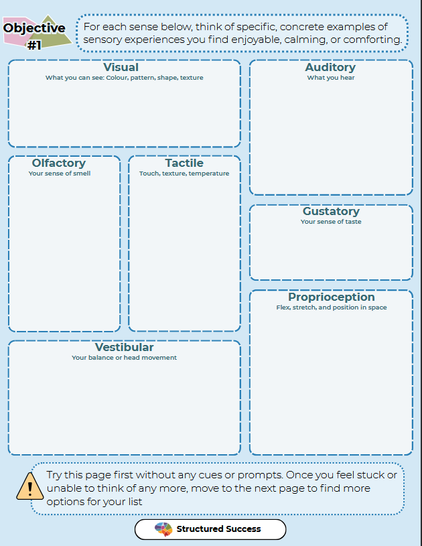
First, think about soothing, comforting, or regulating sensations that you already know and might already be using! Write these down. (4/12)
Specifically, think of sensations you keep coming back to or ones you enjoy. They could be anything, such as running your hand on a cool wall, listening to thrash metal, or kaleidoscopic light patterns.
While brainstorming, remember to include sensations that come from body position, closeness to objects, movement, or balance, as well as the traditional senses of sound, sight, smell, taste, and touch. This is crucial because these non-traditional senses are often the basis for our stims (5/12)
Stims are essentially what we're looking for here.
Often, stims, or self-stimulating behaviours, are subconcious or learned ways of using movement and sensations to self-soothe. They often pop up in stressful, understimulating, or dysregulating situations and are most common amongst autistic people, but everyone stims.
The fact that everyone stims also means that everybody can benefit from being aware of which sensations bring them joy and peace... and which ones don't (6/12)
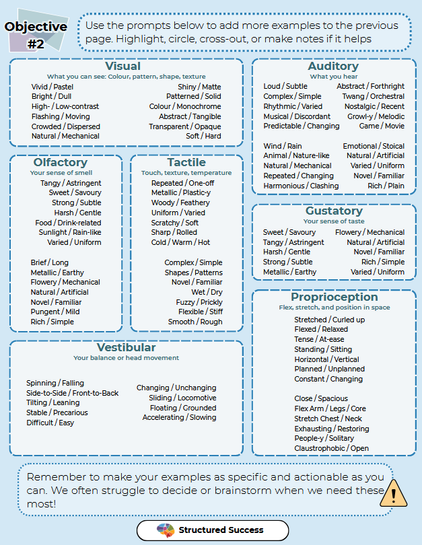
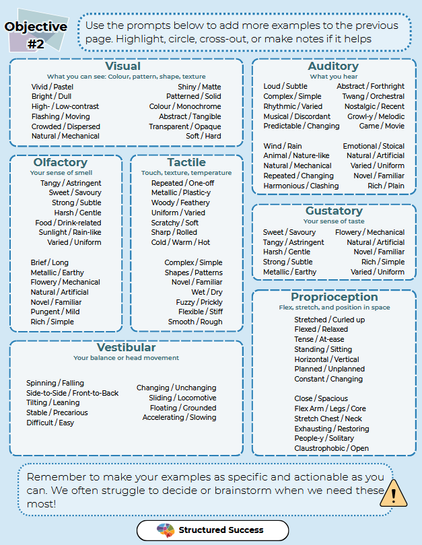
With that said, the second step is to use prompts on the page below to help fill in any gaps.
For example, do you prefer vivid colours or pastels? Shiny things or matte finishes? In this step make sure to only write down examples that you actually find soothing or regulating.
After all, we aren't looking for the lesser of two evils here (7/12)
Once we have a list that we can work with, it's time to tackle the biggest barrier to using any strategy: accessibility.
We often have the least ability to remember strategies, or make decisions, when we actually need to use them. Making those decisions now will make it as easier to remember and access these strategies later on.
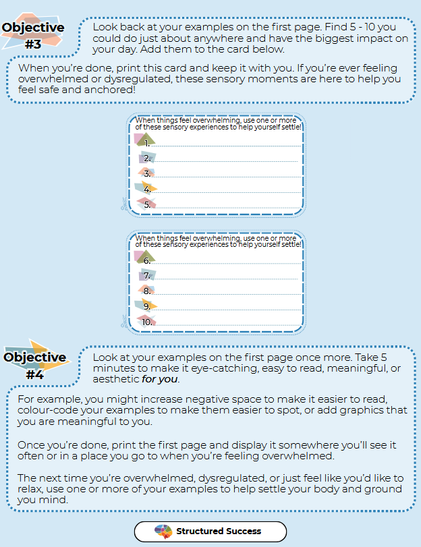
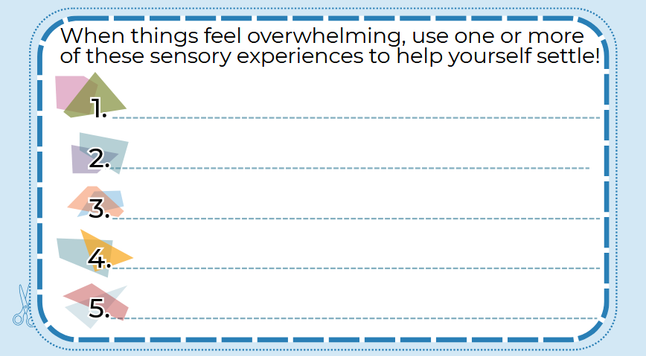
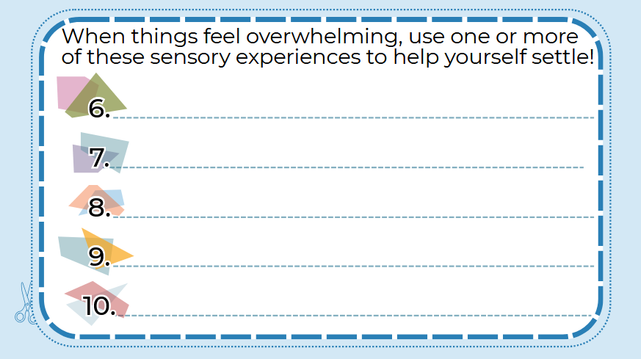
So, for the third step, find 5-10 examples from your list that are easy to use and accessible most places you go (8/12)
Take a moment to make these examples as clear and action-focused as you can, so that when you're dysregulated, you need to decode as little as possible.
Write these on a business card or piece of paper you can keep with you. (I've included some templates below if you'd like to use those) (9/12)
For places where you spend the most time, make these 5-10 examples eye-catching, easy-to-read, and aesthetic.
Include graphics or designs that speak to you or feel meaningful, and place them in a visible spot where they easy to find, even when you're feeling utterly awful. Taking time now to make sure our strategies are accessible, and as free of barriers as possible, will make it more likely that we use them when we need them. (10/12)
The next time that you're starting to feel overwhelmed, or even when you just don't feel right, using one or more of these examples might be able to help you settle.
I've attached the full worksheet to this thread, and if you'd like a print-ready version, I'm making that available too on my Patreon: patreon.com/structuredsuccess
If you're looking for an unrolled thread, you can find it on my tumblr: https://www.tumblr.com/structuredsucc/810916043313823744/sensory-issues-suck-but-we-use-them-to-self-sooth?source=share
Or my website: https://www.structuredsuccess.ca/post/sensory-issues-suck-but-we-use-them-to-self-sooth-and-self-regulate
But, speaking of those great souls who help support this work, thank you to each and every one of you:
J, Emily Faalasli, Meghan Premo-Hopkins, Anne Lee Landry, & Calle Englund