Sigh.

So it turns out we've mapped the neural connectome of Drosophila *and simulated it in silico*.

https://flywire.ai/

Pop-sci explainer here:

https://www.rathbiotaclan.com/whole-brain-emulation-achieved-scientists-run-a-fruit-fly-brain-in-simulation/

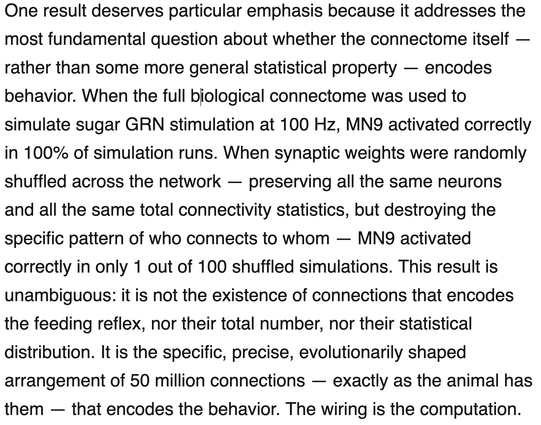
Key quote: "The step from a complete connectome to a working computational brain model is not trivial." And there's an even more important finding in this screenshot (alt text via OCR):

"The wiring is the computation".

/1
The experimenters then went on to hook up their Drosophila connectome to an anatomically detailed Drosophila body model within an open-source physics engine that "uses generalized coordinates and constraint-based contact dynamics to simulate rigid-body systems with high fidelity" including joint and antennae modeling and accurate modeling of surface adhesion—and compound eye simulation.

Lots of *really* interesting insights here.

/2

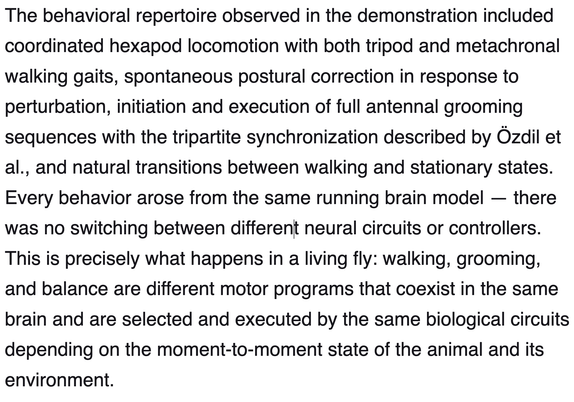
They managed to run a feedback loop between the full 127,400 neuron network in the biological connectome to the physical simulation, with feedback from proprioceptive signals received by the model "fly" in the simulation producing feedback spile trains in the simulation, and THEY GOT RESULTS (again, see alt text of screencap: it's too verbose for a toot):

/3

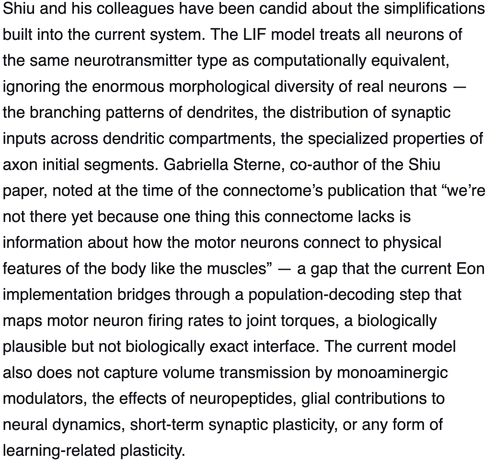
There is stuff missing, of course (alt text for screencap contains about 3 toots' worth of text explaining this): information about how the motor neurons connect to physical features of the body like the muscles, information on morphologically divergent neurons and fine detail on dendritic branching and synaptic inputs across dendritic compartments:

/4

... The next step on from Drosophila, the mouse brain, is 560 times larger—never mind a vastly more complex human brain. And to get the murine connectome we'll have to chop up *a lot* of brains: a human upload won't pass any kind of medical ethics review at this point!

But near-term, it's expected to yield "fundamentally new architectural principles for AI systems that are more sample-efficient, more robust, and more capable of behavioral generalization than current approaches"

/5

But I'm REALLY HAPPY right now because this kinda-sorta validates the key premise of the SF novel I just handed in last month (which involves serial reincarnation via destructive brain-slicing-and-imaging then imprinting onto an immature cortex, and then explores its disastrous societal failure modes).

... And it also hints that artificial consciousness might, eventually, be possible, if only via the hard path of doing it the same way we do it, only in simulation in silico.

/6 (ends)

@cstross
Welp. More evidence for the "we don't know when to stop" hypothesis. It may take a while but I find it very hard to imagine a good outcome from that research path for society. It even scares me when people say stuff like this is "cool" or "interesting". To me, it's like, yes of course it is theoretically possible therefore we should not be trying to do it!

Profoundly depressing, in all honesty. I cannot get excited about this stuff.

@cstross
In some ways researching this kind of thing represents a really bad inclination we have as a species. We are so clever we forget to be human. We forget to treat each other as living beings, because we get too caught up in the details. We invent super clever ways of surveilling each other and forget to be nice and caring to our neighbours. We research how our brains work so we can build robot humans at some future point, rather than enjoying the magic of being alive.
@cstross
The two ways of thinking are not compatible for me. I know not everyone thinks that way, but I just can't combine the two mindsets and the further we move down these paths the bigger the divide seems.

@cstross
But I suppose I'm talking about myself really. I don't mean that a scientist researching this stuff can't be kind. I mean that to me, going down the rabbit hole of the technical details of how a creature's mind works is not compatible with treating the creature as a being.

I rescue flies if they get stuck in water. I hate this research.

@krnlg I get what you're saying here, treating all creatures as the ends rather than the means.

But consider how happy you'd be in a world full of the suffering that we've learned how to prevent.

I don't like it, but I accept the trade-off within ethical guidelines.

@cstross

@solitha @cstross I don't expect ethical guidelines to do very much, I suppose. Not ultimately, anyway. You can only prevent so much suffering by curing illness - after all, we all die eventually. I reckon we could prevent more suffering by having a humane and warm attitude to each other and to other creatures. I do accept that research in general has given us many good things. But.. well I think there's a limit to the benefits of certain paths of research, simply due to how we operate as humans

@solitha @cstross Like, I don't think that being able to work out how certain things work is necessarily good for *us humans* to understand, because I think we're not good at foreseeing complex consequences and have a strong tendency towards using powerful technology against ourselves. At least as our society is.

I know there are benefits of research in general, I'll not deny that!

@solitha @cstross But I'm reminded of a frankly disturbing project that used a cockroach like a robot by cutting off and replacing its antennae. Sometimes science is bad and leads to us doing bad things.

I dunno. Its probably genuinely interesting to think about these things but I struggle to handle the doomerism it awakens in me.

I'll keep rescuing the flies.

@krnlg @solitha That's not science: that's applied engineering. Different thing entirely.

@cstross To get to applied engineering, though, one has to do the study that shows how to apply it. In this case, cockroach anatomy and function.

@krnlg When I talk about ethical guidelines, it's not about the application so much. It's more about how we treat the creatures we study. Just in my lifetime we've improved ethics in that area immensely.

I disagree that kindness alone would be as good for suffering as medicine, but that is a matter of differing opinions.

@solitha
We have the wrong balance, is all I'm saying. Not that science is wrong, far from it. Not that we should sit in caves loving each other while we die young either! 🙂

We're an immature civilisation flailing around with power we don't know how to handle. Our philosophy is way behind our science, and we're ruled by bad people who take our science and use it to ruin everything.

Feels like we're already living in sci-fi but I guess that's the power and purpose of fiction!
@cstross

@cstross
If you're researching something, think who the engineers will be who apply your research, I guess. And what they'll use it for. Sometimes I think it's pretty obvious and screams "best avoided". Not everything, obviously. Science is great, mostly..!
@solitha
@krnlg @solitha You seem to have forgotten that actual mature engineering disciplines have codes of conduct, oversight bodies, and ethics exams. A lot of what passes for engineering in silicon valley, though, ignores all that. Software engineering in particular simply isn't a serious discipline yet.

@cstross
All I'm saying is, we engineered nukes and machine guns, napalm and white phosphorus and ethics exams never stopped us. I know it's easy to group all that as Military but it's pretty cross-discipline I think.

I do agree about software eng, Therac 25 comes to mind.
@solitha

@cstross
Mind you at this point I don't even really know what I'm trying to say any more, it's more a primal scream in elongated word form. I didn't mean to spam you folks notifications quite this much, sorry.
@solitha

@krnlg I would reply that the only way we *can* mature as a civilization, and figure out how to handle this power ethically, is through practice and self-reflection.

And that maturing is helped immensely by those like you with a strong sense of the inherent worth of all life. It drives us to honor the sacrifices we make, and to seek advances that no longer require such sacrifice.

@cstross

@krnlg @solitha Therac-25[1] predated most of the problems: the problem is that Therac-25 isn't universally taught in CS classes!

[1] the accidents happened from 1985, but the Therac-25 dates to 1975 and the software was written by one dude using PDP-11 assembler who may well not have understood race conditions.