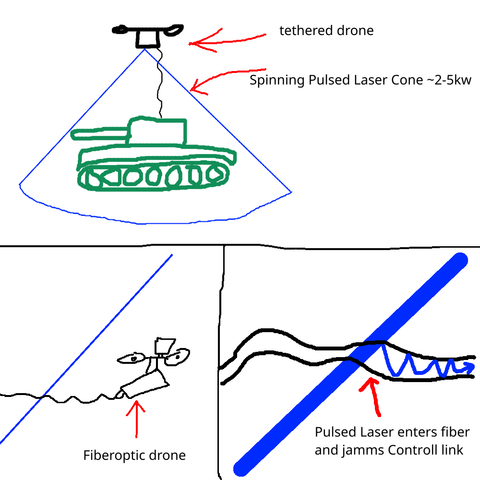
Apparently this was too credible....

https://sh.itjust.works/post/56593505

Well done.

I didn’t think fibre optic cable worked like that.

On the case of the real drone, the laser is destroying the cable.

On the OP’s case, yes a laser can interrupt the communication. But the drone needs to keep sending it, or the drone will just continue after it’s gone. On the other hand, you need less power.

But the drone needs to keep sending it, or the drone will just continue after it’s gone.

unless it injects a detonation command

If you can inject commands into a communication line, somebody was really stupid while designing it.
Well those fiber optic line end points are not exactly encrypted, they use off the shelf components like HDMI over Fiber adapters, and serial over fiber for control link. In rare cases they could maybe use a actual IP connection over fiber but i doubt that since, it would add overhead, latency and make the hardware setup a lot more complex and expensive (if would be able to encrypt tho).
Wouldn’t any civilian endpoint they’re buying be designed to use IP?
no, because often its not “internet/network over fiber” stuff but HDMI over fiber no ip there. HDMI cables have very limited lenght due to high frequency beeing used in em, so if you have a media production company and a few spread out cameras HDMI over fiber is kinda common
Which happens, but then a different idiot tends to fix it. See what happened with the Starlink-controlled drones.
The fibre that’s carried by combat drones is uncoated, so with the right angle it’s possible to inject another signal.
We still don’t know the full story, it was probably a drone flying rounds trying to detect fiber optic and something else cut the cable, there’s no way you’re powering a 5kW laser off a quad
Now try to fit enough batteries to power that laser on a drone lol (spoiler: you can’t)
does it destroy the actual glass cable, or does it get inside and travel along the optic path and burn out the transceiver? burning the glass to breaking point seems like it would take a heck of a lot of energy, so i assumed it was attacking the light sensors at each end of the line, but people keep saying it’s actually breaking the glass.

thats a very good question, let me suggest 2 more options:

  • It injects laser into the fiber, coded identical to the command that would be used to detonate the drone.

  • It dosent need to fully burn thru the whole fiber, just melt it a tiny bit to increase fiber losses to a point where the connection fails

  • The actual power to cut the fibre would be a lot lower than you think.

    Assuming a 100um thick fibre, ant heating a 5cm length, it’s a volume mass of around 10e-7kg. That would take about 1.5J (not kJ) to melt.

    The catch is whether you can find an efficient enough laser, that outputs at a frequency the glass is opaque to.

    And it needs to be accurate enough to focus on an unsecured clear cable in uncontrollable weather conditions for a long enough time. You’d need a lot more power than what the basic physics in an ideal scenario would suggest.

    You would still have that issue when trying to inject commands into the fibre.

    You also don’t need to target the fibre directly. Just sweep the area with enough focused power to burn one out.

    Defocusing would be the biggest range limiter. You could likely get 100m+ with the right setup, and keep it drone mountable. Not ideal, but potentially viable.