 Jona 🐳
 Kim Scheinberg
@kjhealy
Okay, I let myself fall into the rabbit hole and this made me genuinely lol several times.Not sure how I missed this last year
https://kieranhealy.org/blog/archives/2025/02/06/kerning-and-kerning-in-a-widening-gyre/
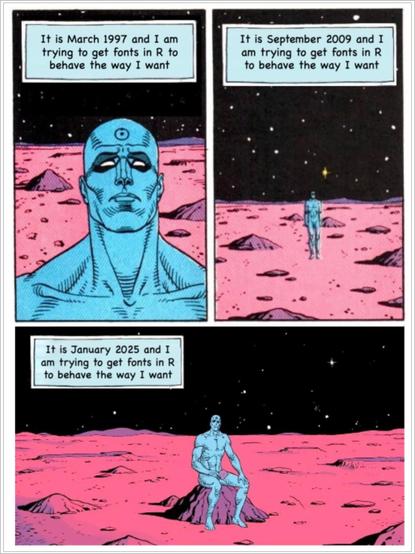
Kerning and Kerning in a Widening Gyre
This post summarizes an extended period of deep annoyance. I have tried to solve the problem it describes more than once before and not quite done it. This has, in fact, happened again. I have still not satisfactorily solved the problem. But this time I know why I can’t solve it in a civilized manner. My goal is simple, and reasonable. I want to produce more or less identical plots in both PNG and PDF formats. PNG is a raster format. PDF is a vector format and also the Devil Incarnate. Sometimes you want one format, sometimes the other. Raster formats color in pixels on a grid of some fixed resolution. They are efficient when you need to plot a lot of elements, but you can’t zoom in on them without loss. When you make one, any as it were “structural” information about plot elements is lost. A line or a shape no longer exists as an editable line or shape. It’s just pixels. Vector formats can be easily resized up or down without loss of fidelity and keep more of the structural information used to make the plot to begin with. Lines and shapes remain lines and shapes. But vector formats get big real fast when you have a lot of objects to show, because each one is drawn separately. Also they are the Devil Incarnate. Especially when it comes to one special subset of lines and shapes: fonts.