
No. You (generic you) do not want a return to the past and to the resource-constrained computing environments of the past, and to the high-cognitive-burden programming environments of the past. You don't actually want to go back.

You're complaining about something real, but it's not that.

The kids are different from you, not wrong.

@ceejbot corollary: you do not want to see a new generation walk into a blade runner future.
@ceejbot actually our environment is by definition resource-constrained therefore also our computing environments is resource-constrained.
Dealing with resource constraints does not mean avoid to use the increased computing resources we have today, it means avoid to waste them. And AFAICS too many use-case of #AI, i.e. #VibeCoding are sheer wasting of resources.
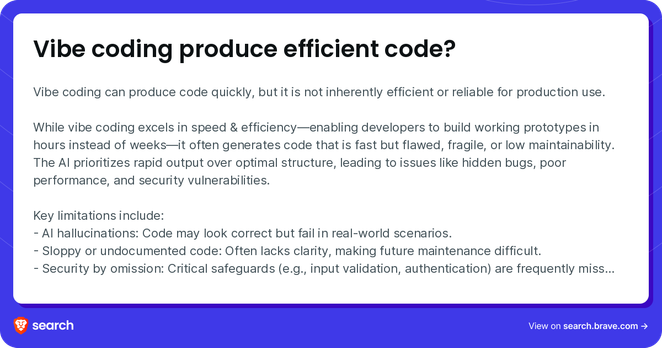
@ceejbot I thinkered a little about my previous comment and I realized I have not checked how efficient and "well written" is the code produced by #VibeCoding. According to https://search.brave.com/search?q=vibecoding+produce+efficient+code%3F&summary=1&conversation=08d518070c52f18a7ed34de823520c1eb9f2 it's fast but flawed, fragile, or low maintainability with hidden bugs, poor performance, and security vulnerabilities:
- Sloppy or undocumented code,
- input validation, authentication are frequently missing.
Therefore #DesignByContract and testing are still required.
Vibe coding produce efficient code?

Vibe coding can produce code quickly, but it is not inherently efficient or reliable for production use. While vibe coding excels in speed & efficiency—enabling developers to build working prototypes in hours instead of weeks—it often generates code that is fast but flawed, fragile, or low maintainability. The AI prioritizes rapid output over optimal structure, leading to issues like hidden bugs,…

Brave Search
@ceejbot it still does not answer the question: "is the correct algorithm chosen?"