Using Quarto to Write a Book

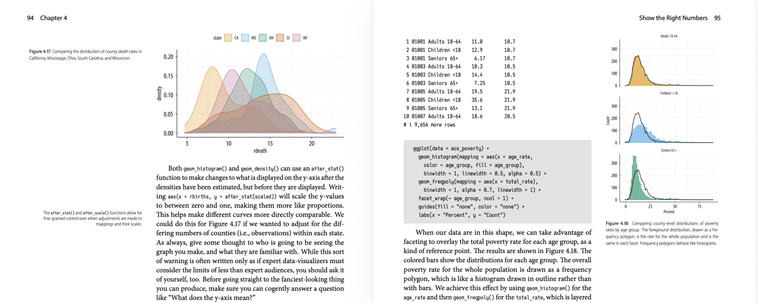
I’ve spent the last couple of months revising my Data Visualization book for a second edition that, ideally, will appear some time in the next twelve months. As with the first edition, I’ve posted a complete draft of the book at its website. The production process hasn’t started yet, so it’s not ready to pre-order or anything, but the site has a one-question form you can fill out that asks for your email address if you’d like to be notified with one (and only one) email when it’s available. A lot has changed since the first edition, reflecting changes both in R and ggplot specifically, and in the world of coding generally. I may end up highlighting some of those new elements in other posts. But here, I want to focus on some nerdy details involved in getting the book to its final draft. I’ll discuss Quarto, the publishing system I used, its many advantages, and its current limits with respect to the demands I made of it.
@kjhealy Yeah but the really important question is: do you write your markdown in Emacs, the one true editor?!

@kjhealy
Okay, I let myself fall into the rabbit hole and this made me genuinely lol several times.Not sure how I missed this last year

https://kieranhealy.org/blog/archives/2025/02/06/kerning-and-kerning-in-a-widening-gyre/

Kerning and Kerning in a Widening Gyre

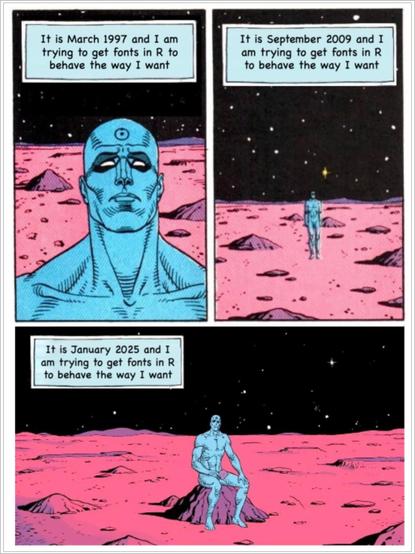
This post summarizes an extended period of deep annoyance. I have tried to solve the problem it describes more than once before and not quite done it. This has, in fact, happened again. I have still not satisfactorily solved the problem. But this time I know why I can’t solve it in a civilized manner. My goal is simple, and reasonable. I want to produce more or less identical plots in both PNG and PDF formats. PNG is a raster format. PDF is a vector format and also the Devil Incarnate. Sometimes you want one format, sometimes the other. Raster formats color in pixels on a grid of some fixed resolution. They are efficient when you need to plot a lot of elements, but you can’t zoom in on them without loss. When you make one, any as it were “structural” information about plot elements is lost. A line or a shape no longer exists as an editable line or shape. It’s just pixels. Vector formats can be easily resized up or down without loss of fidelity and keep more of the structural information used to make the plot to begin with. Lines and shapes remain lines and shapes. But vector formats get big real fast when you have a lot of objects to show, because each one is drawn separately. Also they are the Devil Incarnate. Especially when it comes to one special subset of lines and shapes: fonts.

@kims ahaha yes that one was born out of considerable frustration