 Adrianna Tan
For all the Proton fans
@skinnylatte I think a lot of people who say privacy isn't anonymity forgets that legality isn't morality.
[Edit: also this, https://kolektiva.social/@COSAntiFascists/116179413535729303]
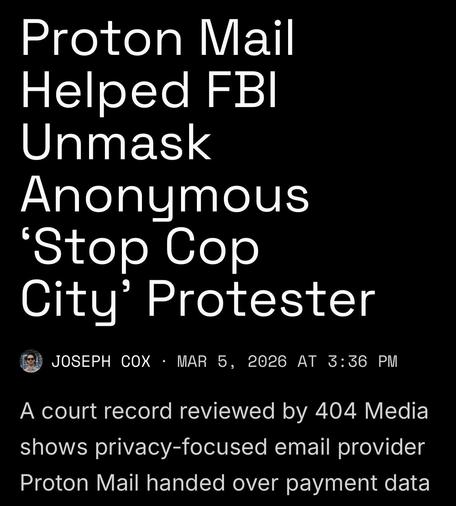
A lot of people talking about dumping Proton right now are misunderstanding what actually happened. Feds were able to coerce the Swiss government to coerce Proton to hand over whatever data they had on an anonymous Stop Cop City email address, that was being investigated for terrorism. That metadata included credit card details information for the account, which is very difficult to anonymize. Proton offers cash payments to work around this obvious security flaw. If you must pay for a Proton account for a radical project, pay with cash (you can mail it) or washed crypto (Monero -> Bitcoin). All credit card payments are traceable, even to a privacy-focused company. Your security model should not rely on a business to fight the state on your behalf. Your email or VPN provider is not going to risk prison time for your $5/mo. It's just not going to happen, at least for anything commercial. Tuta and every other email privacy-focused email company will comply with court orders. Trying to find the perfect email provider is a fool's errand. It doesn't exist. You can however anonymize your useage of privacy friendly services like Proton, Tuta, or Mailbox by not entering your credit card number, phone number, name, personal email, or IP to that account.
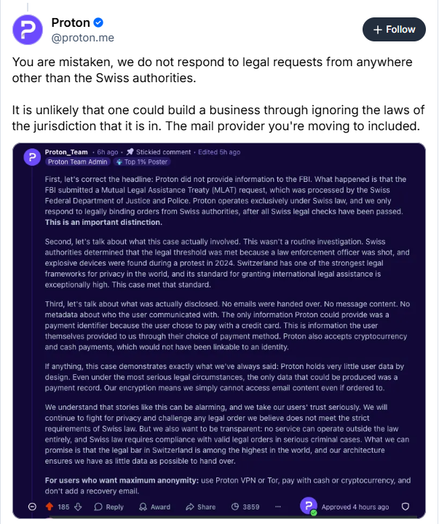
Attached: 1 image It feels like Proton are being intentionally misleading in their statements. They know that most of their customers aren't familiar with how legal process actually works, so are happy to spread half-truths. Under US law, a US law enforcement agency (LEA) typically has to apply for a subpoena or search warrant with a US court. The court is then responsible for deciding if the legal bar for search a request has been met, then either grants or denies it. The problem is, if a company has no real US footprint (no US corporate entity, offices, servers, etc.), then a US court typically doesn't have the jurisdiction to compel the company to hand over customer data (except in some rare circumstances). Even if the court approved the warrant anyway, it wouldn't really be legally binding. Which is why the Mutual Legal Assistance Treaty (MLAT) exists. MLAT enables law enforcement agencies in one company to send requests for information to law enforcement agencies in another. Switzerland has such a treaty with the US. This means that the FBI can request that Swiss authorities hand over a Swiss company's data on their behalf. Any country requesting information held by a company in a foreign jurisdiction would typically do so via MLAT. Which means from Proton's perspective, the legal request would appear to originate from their local law enforcement, not the FBI. Which they clearly understand based on their Reddit post. Saying "we don't respond to legal requests from anywhere other than Swiss authorities" seems very intentionally worded to give the impression that the company does not cooperate with foreign law enforcement. But since it'd be the Swiss authorities handling any such requests, they'd have to comply, since as they admitted, they have to comply with local laws. There is, however, some useful (but more nuanced) information here: Firstly, MLAT requests are handled by local law enforcement according to local law. So if there is a difference between the law of the sending and recipient country, that might mean the MLAT request is denied. That probably doesn't mean much, because if you're on the FBI's radar, the chances are you did something that is also massively illegal in Switzerland too. Secondly, they are 100% correct in saying that no other service provider is going to do any better. They're all beholden to local laws, and the ones that think they're not tend to get their doors blown off by SWAT like CyberBunker did. The only exception is if the company resides in a country which does not cooperate with US law enforcement (which Proton does not). But the part that's extremely disingenuous is that the "we only respond to requests from the Swiss authorities". That statement is likely intended to imply they don't cooperate with law enforcement in any other countries, which is simply not true. Switzerland has MLAT agreements with over 30 counties. People really need to understand that no company is going to shield you from the FBI (or any reputable law enforcement agency). They'll use misleading statements to make it sounds like they don't cooperate with law enforcement, but they do. They have to.
TL;DR
Fact: Proton does not work with foreign governments.
Opinion: Proton assertion thereof is a ruse to deceive.
That write up is guilting of everything they espouse Proton of: being disengenuous about the facts.
Proton does not work with foreign governments. That’s just a truth. Anyone can then inject their opinion about their intentions, though they have nothing to back that up.
The FBI got the information because the US Government and Swiss Government have an agreement. Sure, I could argue Proton then works the FBI by proxy, but I’d be simply making assumptions and assertions based on opinion.
No company has an obligation explain all the minutia in the implications of their statements. In the minutia of exactly all possible outcomes for every country across the world in relation to their statements.
At the end of the day, they are a company trying to also make profits. They are still capitalist, and all the bullshit that comes with that. Still does not mean that they are intentionally being misleading.
People will see what they want to see. You could argue that’s true for me even, I don’t want to see a monster, perhaps.
¯\_(ツ)_/¯
 Patric Nordbeck
 Jeff Codes