 Don_Dickle
We all grew up with In Space No One Can Hear You Scream...is this true? Is there any should out there without picking it up on an electronic device?
Sound is caused by vibrations in a medium. Common mediums we experience sound in is air and water. You can hear how the difference in sound mediums affect how you perceive the sound.
Space has no medium for sound to travel it is a near perfect vacuum. There would be nothing to vibrate to produce sound.
 Eldritch
There’s a medium even in interstellar space. But the pressure is low, so transmission is as well. There is no hard boundary on ‘atmosphere’. Just smooth gradients of density across the universe
Particle’s still collide in space. There’s nothing keeping them from doing that. Collisions simply increase due to increased pressure. It’s not really technical, just true. If anything it’s a misunderstanding to imply otherwise or that empty space exists. If you want to distinguish human audible. Then certainly it isn’t that. But then neither are infrasound or ultrasound.
Technically and extremely fascinating is that “space itself” not just the baryons inside it, is still a medium. Its literally how LIGO functions. And if that’s not mind blowing enough, there actually are massive structures in space caused by pressure waves that we can detect. Those are technical. And another fun fact, if the atmospheric pressure at sea level extended all the way to the sun. We would be able to perceive the sound of the sun. Millions of miles away. Everywhere across the surface of the earth a constant 100 Dba roar. A bit quieter than standing close to a jet engine.
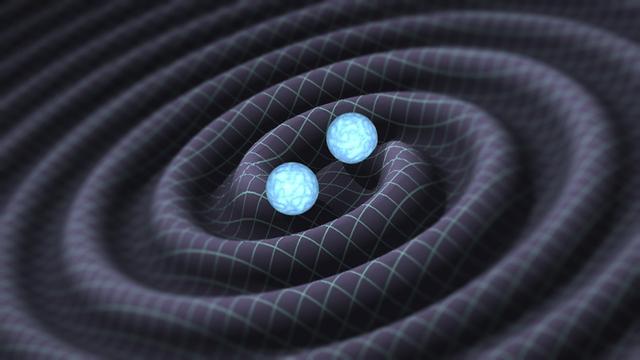
LIGO Lab | Caltech | MIT
The Laser Interferometer Gravitational-Wave Observatory (LIGO) consists of two widely separated installations within the United States — one in Hanford Washington and the other in Livingston, Louisiana — operated in unison as a single observatory. LIGO is operated by the LIGO Laboratory, a consortium of the California Institute of Technology (Caltech) and the Massachusetts Institute of Technology (MIT). Funded by the National Science Foundation, LIGO is an international resource for both physics and astrophysics.
I’m surprised the sun would fall so neatly in our hearing range. Seems like the odds of it instantly shredding our eardrums, or being too faint to perceive were much higher.
Remember that dB is a logarithmic scale. Each 10 is 10x bigger than the 1 before. We talk at around 60dB, so 10,000x quieter. We can hear from around -9dB to 90dB (into hearing damage territory) that’s a 10,000,000,000x range. If you allow for hearing damage, a gunshot is around 140dB. So add 5 extra zeros to that.
Human hearing is insane.
Aha and you hearing people told us the sun wasn’t loud!