 bazzett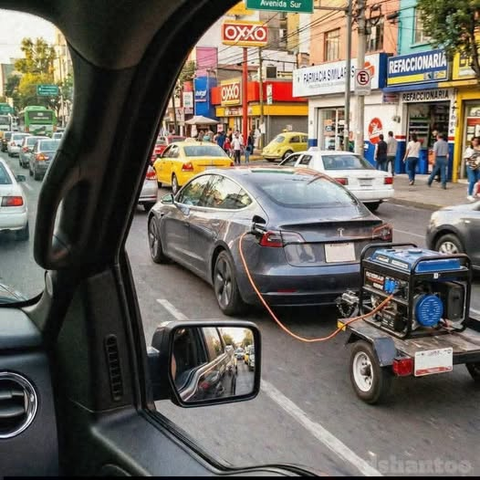
 Hubi
Hubi TheDemonBuer
This is basically what every EREV is. The generator is just integrated into the car, otherwise it’s essentially the same thing.
 dejected_warp_core
At the same time, I’ve wondered if it would be helpful for EVs on some long-distance road trips to tow/stow a generator for overnight and emergency charging. Charging stations are popping up more and more, but if you’re saddled with an obsolete or under-served charging port type (e.g. Nissan Leaf), having a generator would be valuable insurance.
 𝕲𝖑𝖎𝖙𝖈𝖍🔻𝕯𝖃 (he/him)
damn, nissan leaf is under served? I guess that product placement in sim city whichever fucking year glass box was didn’t pay off
 entropicdrift
The new ones have the standard fast charging ports, but before the 2026 model year they’re stuck on an old DC fast charging standard that’s only available at a fraction of all charging stations.
 brap
brapI’m not sure about this, surely an EV wouldn’t allow charging while in motion as a safety measure against driving off while plugged in?
But then, there’s this photo right here unless I’ve been suckered into believing AI edits again.
Yeah, that’s supposed to be impossible. Either they’re not moving and it’s a staged shot (unlikely, since they’re in the middle of traffic and there appears to be motion blur), or they’ve fiddled with the car to make it think the charging door is closed, or it’s an edit.
I’m suspicious of the motion blur, personally, because the traffic looks too tight to be moving much, so I suspect an edit
 Sundray
Giving the photo the benefit of the doubt, it’s also possible that this Tesla owner had to bring a generator somewhere for unrelated reasons, and thought it would be “funny” to hook it up to the charge port on his car as a joke.
My point is that wouldn’t work, unless the car was in park. A Tesla will simply refuse to move if a charger is connected
I am totally ignorant and this is baseless, but wouldn’t that charge the battery to go like 300 feet or something?
 TrackinDaKraken
“I bought this Tesla, but there’s no place to charge it, do you want it?”
“Sure.”
There is a huge missed opportunity of having modular battery packs that you can load into EVs.
You don’t need a huge battery for everyday, in fact it makes your drive less efficient.
What if there were standards and you could go to a gas station and rent some packs. Put them in the trunk (there would be slots and/or standard connectors), and then drive off.
Once road trip is over you return the packs (or you could buy instead of rent).
You can also just swap the packs in gas stations with fully charged equivalent, making long trips more flexible.
I think china did something like that with scooters.
 Natanox
There were attempts, but suvh a system just doesn’t work reliably. The pack has to be replaced by robots since it’s under your car (has to be due to space constrains and more importantly weight), and the amount of moving parts, reliability and safety concerns were a constant issue.
For scooters it’s no problem given the way smaller size and optimal position inside the chassis, but for cars this concept hardly works properly.
 Blackmist
This is a good idea, though.
Piston engines are way, way, way more efficient (and cheaper to make) when optimized for one RPM and a static load (like a generator). They can be tiny if running at 100% throttle all the time; a few horsepower is enough. Excluding the transmission saves weight/cost, and a generator for a few horsepower isn’t that big.
Yeah, you get electrical loss, but everything else more than makes up for it.
I heard of hybrid cars working like that. I wonder why it never really became a thing.
I suspect “tiny battery+generator” EVs aren’t a thing in the US because:
-
It doesn’t sound or drive like an ICE car. It still has a battery, so gets all that range/durability “anxiety” associated with being an EV.
-
It’s associated with all the issues of ICE-based hybrids.
-
It’s not “all-electric,” not quiet, so it’s not percieved as a luxury car like pure EVs generally are.
-
The cars that do implement this tend to be smaller, so not marketable here in the US, apparently.
-
Factories are still tooled to make ICE cars en masse, not EV drivetrains.
In other words, it’s all perception and marketing. And I think, sadly, it’s true: people wouldn’t buy them here in the US.
You do see them outside the US though.
Would some sort of solar panel + battery array combo work in a similar way?