 DJ Putler
"look! the #signalapp income and salaries report for 2024 dropped!" #startpocketwatching #opentechnologyfund #usgovernmentsponsored
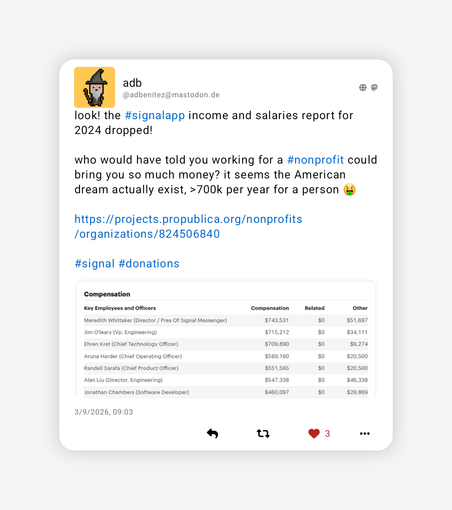
"look! the #signalapp income and salaries report for 2024 dropped!" #startpocketwatching #opentechnologyfund #usgovernmentsponsored
The conventional answer is that there would be much less incentive to fund new ones.
Some things need a large investment to start: power plants, cities, factories, space stations, etc. Sometimes more money than the people involved can afford, and you need to ask someone to front the money, they typically get paid with a share of the profits.
It would collapse on itself, unable to carry its own weight, heating up massively. I consider superheated pudding volcanos something of a downside, personally. I cannot reasonably estimate what might happen in the centre of the world, supercritical fluid doesn’t seem enough. Perhaps nanodiamond crystallisation from the organic parts of the pudding? Also lots of hydrogen release, I’d guess.
My suggestions involves only change of the legal framework. Besides, there are non-profit companies. I’m not sure about details, but for example Velux (windows manufacturer) and Carl Zeiss (optics) are supposed to be non-profits, and Anthropic could say no to the DoD because it’s some sort of not-just-for-profit company.
 lemming