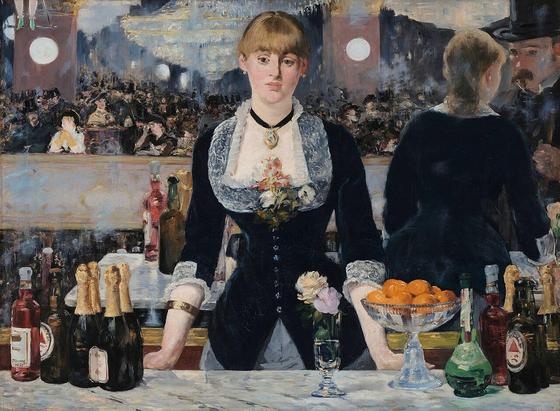
Manet's famous painting Un Bar aux Folies-Bergère never appealed to me. But now I realize its genius, and my spine tingles every time I see it.

The perspective looks all wrong. You're staring straight at this barmaid, but her reflection in the mirror is way off to right. Even worse, her reflection is facing a guy who doesn't appear in the main view!

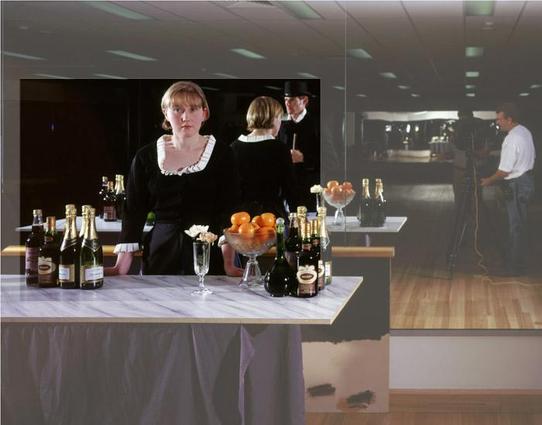
But in 2000, a researcher showed this perspective is actually possible!!! To prove it, he did a photographic reconstruction of this scene. Check it out in my next post.

This blows my mind.

(1/3)

Here is Malcolm Park's reconstruction of the scene in Manet's painting. How does it work? In fact the woman is viewed not head-on, but from an angle! While the man cannot be seen directly, his reflection is visible!

In my next post, I'll show you a diagram that explains how this works. For more, go here:

https://www.getty.edu/art/exhibitions/manet_bar/looking_glass.html

(2/3)

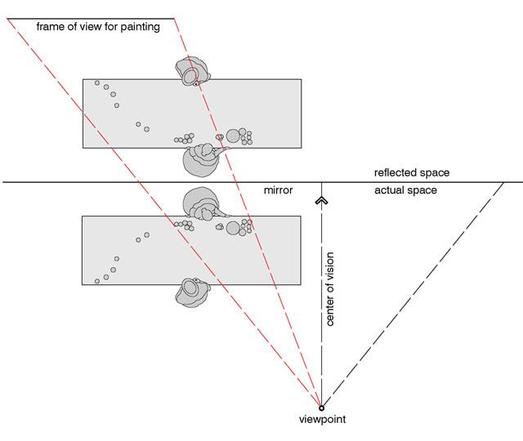
This diagram shows how the perspective works in Manet's famous painting Un bar aux Folies Bergère. We are viewing the woman at an angle, and while the man is outside our field of view, his reflection can be seen.

Astounding! But it's not just a technical feat. It allowed Manet to make a deep point. While the woman is busy serving her customer, she is internally completely detached - perhaps bored, perhaps introspective. She is SPLIT.

To fully understand the painting you also need to know that many of the barmaids at the Folies Bergère also served as prostitutes. Standing behind the oranges, the champagne and a bottle of Bass ale, the woman is just as much a commodity as these other things. But she is coldly detached from her objectification.

The woman in the painting was actually a real person, known as Suzon, who worked at the Folies-Bergère in the early 1880s. For his painting, Manet posed her in his studio.

Before I understood this painting, I wasn't really looking at it - I didn't see it. I didn't even see the green shoes of the trapeze artist. I can often grasp music quite quickly. But paintings often fail to move me until someone explains them.

When Manet came out with this painting in 1882, some critics mocked him for his poor understanding of perspective. Some said he was going senile. It was, in fact, his last major painting. But he was a genius, and he was going... whoosh... over their heads, just like he went over mine.

This diagram was created by Malcolm Park with help from Darren McKimm. For more details go here:

https://www.getty.edu/art/exhibitions/manet_bar/looking_glass.html

(3/3)
@johncarlosbaez important point here is that in real space, the barmaid and customer are looking past each other. The reflection suggests otherwise.
@ojs @johncarlosbaez I would in fact say she doesn’t seem to be serving the man. A more plausible version is that she served the man already and she is looking at the next customer, the viewer/painter/photographer.

@antopatriarca @ojs - It's so thought-provoking!

Here's my impression of the painting. In the reflection she seems to be serving the man. In the direct view, she seems to be facing me. And this adds an excellent extra layer to the overall symbolism. The barmaid is forced to be "two-faced": to be a good barmaid, she has to make every customer feel special, as if she's only serving them.

In *reality*, for this scene to be possible, she must be no longer serving the man, and already facing the next customer (the painter/photographer).

@ojs @johncarlosbaez @antopatriarca

I don’t see it as first customer and second customer, it’s not a functional transaction: I think he’s using this visual perspective to invert real and imaginary. Her inner reality is presented as factual, and the factual is presented as a fiction both literally and figuratively by relegating it to the reflected world.
In ‘reality’ she stands alone in her internal existence - isolated, disconnected - from events around her, offering a “fourth wall” breaking gaze to the viewer, inviting us to truly see her.

@DavidM_yeg - That's a nice interpretation! A truly great work of art admits multiple interpretations, and this was one of Manet's last paintings. @ojs @antopatriarca