 Dr. Dan Killam
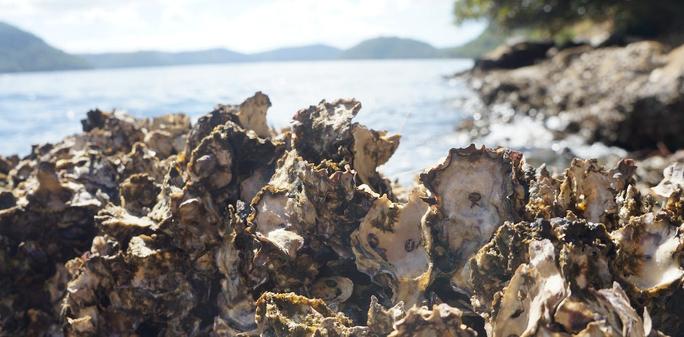
While oysters lack ears, they still can hear, using statocysts, their balance organ. Researchers have found playing the soundscape from a healthy oyster reef attracts larvae to settle! They have evolved to settle on their ancestors to build reefs, and sound is a useful cue of a good spot! https://phys.org/news/2022-10-sea-soundscapes-summon-thousands-baby.html #clamFacts
 shom
shom@dantheclamman that's really neat that the larvae vibe to good sounds. I do wonder though, oysters don't have ears but use their balance organs for hearing and we use our ears as balancing organs, is this a coincidence? Or are balancing and hearing linked functions?!
@shom yes, I don't think they're always linked, but in this case it's convergent! Our liquid filled inner ear and the statocyst, a rolling little ball in a pouch, are both good at the double purpose of detecting gravity and sound :)
@dantheclamman that's so neat (and squishy), thank you.
You go you little ball in goopy pouch, thanks for the beats and balance!
You go you little ball in goopy pouch, thanks for the beats and balance!
 tiny_m
@dantheclamman @shom this is so cool. thanks for sharing
 Wharrrrrrgarbl
@dantheclamman @shom you might be interested to know that the human utricle and saccule are organs that use otoliths to detect gravity and linear acceleration. The mechanoreceptive hair cells in the semicircular canals, the utricles, and the saccules are homologous to those in fish ears and lateral lines, if I understand correctly, but I've never been able to find data on whether that's true of mollusk statocysts.
@Wharrrrrrgarbl @shom yes hearing is a real mess of homologous and analogous traits! Really fascinating how many layers of adaptation happened over the eras. https://pmc.ncbi.nlm.nih.gov/articles/PMC6766920/

The vertebrate middle and inner ear: A short overview
The evolution of the various hearing adaptations is connected to major structural changes in nearly all groups of vertebrates. Besides hearing, the detection of acceleration and orientation in space are key functions of this mechanosensory system. ...
 Eljorgeabides
Can this be used to remove invasive mussels and the like?
I know mussels and oysters are different just curious
@eljorgeabides noise does stress invasive mussels out! People have experimented with noise treatments and it does reduce their survivorship. Sadly the treatments they describe are likely stressful to most aquatic animals, but could be good in aqueducts and other non-habitat water infrastructure https://www.pjoes.com/Biofouling-Control-of-Invasive-Zebra-Mussel-n-Dreissena-polymorpha-Using-Acoustic,146470,0,2.html
Biofouling Control of Invasive Zebra Mussel (<i>Dreissena polymorpha</i>) Using Acoustic Energy
Effects of increasing levels of audible sound energy (500, 1000, 5000 Hz frequency) on attachment strength and mortality rates of zebra mussels were investigated in a long-term study for the control and deterrence of zebra mussel infestation. All groups exposed to sound treatments presented...
 Dagnabbit, Pascaline! 💥
The replies are so good, it's so wonderful to have scientists here qho actually engage instead of just sharing stuff 🩷
 QuokkaMocha 🏳️🌈🏴🇺🇦🇬🇱🇵🇸
@dantheclamman So long as no-one tells any walruses or carpenters about the discovery.
 NZChineseGenealogy
@dantheclamman Waiting for my Bluff Oysters to arrive in Auckland. Haven't had any in the last 3 years.
 Alistair K
@NZChineseGenealogy @dantheclamman If you can get as far as Nelson, they appear annually at the local fish and chip shops. Occasionally muttonbirds, too, if you're into those, but they're in plastic buckets these days rather than kelp sacs.
@libroraptor @dantheclamman I remember mutton-birds in tin cans - mid 1950s. My Mum used to hold her nose, as she removed it from the tin can for her customers. Boy, they sure had a strong smell.
 FediThing
ASMR for oysters? 🤯
The image of these oysters is strangely moving, for some reason it's so endearing to see all these shells, knowing they created them themselves, adapting to what happened to them, and that they are highly personal. And to see them, realising they are gone but left there shells behind.
@pascaline well said, I agree! They make rock out of salts floating around in the water, putting a new line in every tide, a diary that could be around in millions or billions of years!
It's so moving, and it reminds me of the tree rings 💗