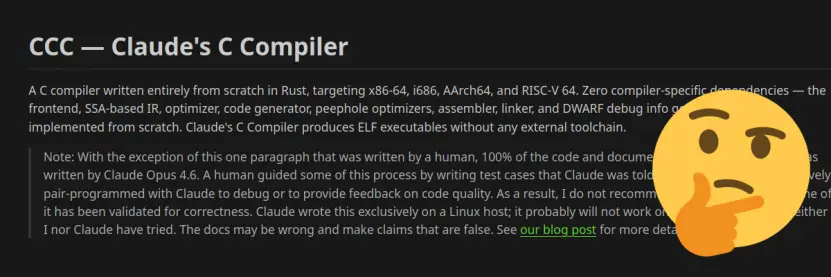
Anthropic used Claude to write a C compiler in Rust (CCC). I've really enjoyed following the discussion.

The initial post shows how they wrote the harness with GCC as an oracle and a prompt specifying a design using SSA. The author has clear domain expertise.

https://www.anthropic.com/engineering/building-c-compiler

Building a C compiler with a team of parallel Claudes

Anthropic is an AI safety and research company that's working to build reliable, interpretable, and steerable AI systems.

Later testing showed some overfitting to the test harness: it can compile Linux, but not hello world!

https://github.com/anthropics/claudes-c-compiler/issues/1

Hello world does not compile · Issue #1 · anthropics/claudes-c-compiler

Tested inside fedora 43 container, ubuntu 26.04 container and on regular fedora 42 installation, same error Took example directly from README.md GCC is present and can compile code just fine: root:...

GitHub

Benchmarking showed that CCC has much worse performance in terms of both compile time and runtime.

Since it was designed to match gcc flags, it supports both -O0 and -O2, but the output is identical. It produces working code, but it doesn't optimise.

https://harshanu.space/en/tech/ccc-vs-gcc/

CCC vs GCC

A Guide to comparing Claude Code Compiler with GCC

Harshanu

Others observed that diagnostics aren't great. It has off-by-one in line numbers and invalid C programs are accepted.

Verifying input correctness was out-of-scope for CCC, so I think this is reasonable. I know mrustc is also doesn't check validity.

https://voxelmanip.se/2026/02/06/trying-out-claudes-c-compiler/

Trying Out Claude's C Compiler

On the 5th of February Anthrophic published an article on their engineering blog detailing the creation of a C compiler using a team of parallel Claude agents over the course of two weeks. The compiler in question is called Claude’s C Compiler (ccc for short) and is a ~180k line Rust codebase that they published onto GitHub. Of course, this announcement raised a lot of questions about the accuracy of their claims and the usability of the compiler, as well as the implications of a swarm of AI agents allegedly being able to write a full C compiler. It claims to be able to compile the Linux kernel, along with many other high profile C projects, but does it actually work? I became intrigued, and decided to try compiling a Hello World program, my game Tensy, ClassiCube, and finally the Linux kernel.

ROllerozxa

Chris Lattner (the creator of LLVM) reviewed the code, and noted how similar the structure is to clang/LLVM and GCC.

Even though other C compilers are not written in Rust, Claude seems to show knowledge transfer from its knowledge of existing compilers.

https://www.modular.com/blog/the-claude-c-compiler-what-it-reveals-about-the-future-of-software

Modular: The Claude C Compiler: What It Reveals About the Future of Software

Compilers occupy a special place in computer science. They're a canonical course in computer science education. Building one is a rite of passage. It forces you to confront how software actually works, by examining languages, abstractions, hardware, and the boundary between human intent and machine execution.

John Regehr (a compiler verification expert) looked at CCC and discussed how production compilers differ.

He also fuzzed the compiler, found bugs, and managed to fix them by just prompting! John has years of experience with UB validity though.

https://john.regehr.org/writing/claude_c_compiler.html

claude_c_compiler