https://www.cs.princeton.edu/~ad4048/pdfs/latte-2026-submission-14.pdf

@CanLehmann hmmm interesting, thanks for the pointer! Glancing at it, it seems quite interesting but also like they're trying to encode a different set of constructs, and don't seem to mention recursion or adts anywhere, so it's unclear how it could model something like Haskell?
There are a couple of dialects that attempted to encode something close to lambda calculus in mlir, most notable one that actually partially upstreamed is `rise`, but they tended to not want to deal with recursion of higher order functions and their design was really focused around making it easier to target llvm ir, so that's why we opted for making a more recursion focused, hardware oriented one.
It's a very fun space to work it because so many people have different views of what is important to keep in the ir to make the lowering easier, I'm excited to see how much we'll have to change `lc` when we try to upstream it 😅
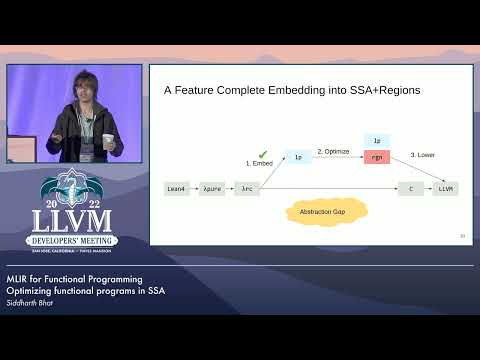
@miado I am sadly not very familiar with their work either, it just came to mind while reading through your paper. There is a talk about it here https://www.youtube.com/watch?v=cyMQbZ0B84Q
They mention algebraic data types at 7:00, but don't expand on it. Maybe we would have to look at the code to find out how they handle this. I get the feeling that they are somewhat lower level than your IR though. So in that way it probably mirrors what you say about existing dialects mainly targeting LLVM.

@miado It would be really cool to be able to lower to both LLVM and CIRCT Core dialects from a single lambda calculus IR though.
I am not involved with CIRCT though, the last time I experimented with it it still seemed a bit too early for my applications, so 🤷