AI is not inevitable. Nothing in human societies is inevitable because we design them. Healthcare can be free for the public. Books can be bought instead of bombs. Universities can be free for students, and they can even receive a stipend to live off. Don't let companies dictate the future.

Read more in section 3.2 here https://doi.org/10.5281/zenodo.17065099
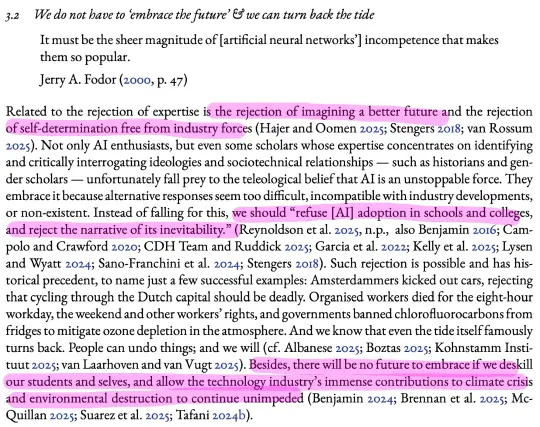
@olivia Olivia, what would it mean for me to “refuse adoption” in universities when it is students who are the drivers for my courses and they are widely using AI in ways that are already forbidden?

I feel like the “resistance” and critique of inevitability talk isn’t quite connecting with my reality on the ground

@UlrikeHahn @olivia

I glanced at your work on "Science communication as collective intelligence".

I think that we need to redesign university courses so that learning is communal for the solution of a specific goal.

I think though that Olivia's points are complementary to that goal. Universities should resist AI adoption as imposed by external economic forces.

@apostolis @olivia I’ve have already redesigned both my assessments and my teaching in response to students’ AI use, but that kind of adaptation feels like it conceptually falls more into “inevitability” than “resist”

right now, what’s most valuable to me personally (given the starting point that every single student in my courses has somehow used AI, and a good proportion uses it *a lot*) is advice from other academics on how exactly they are trying to change what they do in response.

telling me “I can resist” doesn’t feel helpful in that way

@UlrikeHahn @apostolis @olivia I think you’re conflating your agency with that of your students.

The students are people that have agency and can decide not to use AI.

You just have to design your course in such a way as to penalize them for lack of knowledge stemming from their reliance on AI.

For example, verbal pop quizzes are a good way to humble them live when they fail to understand the topic as they would with an AI doing their thinking.

@harryprayiv @apostolis @olivia

where I teach, “humble them live” is not something that would be considered an appropriate teaching device in the year 2026, nor do I think it’s helpful or productive.

I also don’t think I’m conflating my agency and that of my students: my whole point was that me wishing to “resist” AI in my context runs up against the agency of others:

I don’t use AI personally, but I am experiencing significant disruption, and there’s no easy path to addressing that disruption precisely because it rests on the independent choices of other people.

@UlrikeHahn @apostolis @olivia It’s not appropriate to randomly ask a student a question about the material?

I’m calling bullshit on that one.

Perhaps I characterized it too wildly for you to grasp that that’s what I’m proposing?

@harryprayiv @apostolis @olivia this may surprise you, but no it’s not where I teach

@UlrikeHahn @apostolis @olivia Hilariously backwards! I’d quit instantly if I couldn’t actually test my students’ knowledge.

Sorry to hear that. Somehow, I don’t think AI is the biggest problem with the curriculum where you teach. Good luck!

@harryprayiv @apostolis @olivia it’s not about curriculum, it’s about appropriate modes of interaction and putting students down in front of others is not one of them

I’m proud to work where I do - it’s a world class department in terms of research in an institution that was founded 200 years ago with the mission statement of providing education “for the working man”

https://www.bbk.ac.uk/about-us

About us - Birkbeck, University of London

We are experienced at providing a range of study options that fit around the needs of our students.

@UlrikeHahn @apostolis @olivia

Teaching students is not putting them down. I’m done with this weird conversation where I have to describe normal teaching to you. Thanks for the eye opening chat!