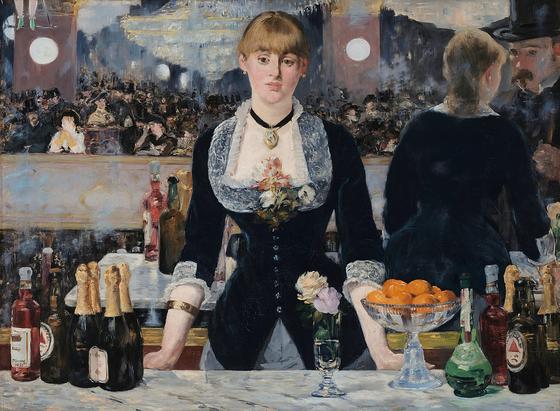
@bodhipaksa - I too had tried to rationalize it as two separate barmaids, but I felt uncomfortable about that.
I bet Manet guessed we would do that.
Some commenters have read a lot into the meaning of the mirror here, and I think they're right, though some intellectuals have a way of sounding so pompous you want to dismiss them:
"Asserting the presence of the mirror has been crucial for many modern interpreters. It provides a meaningful parallel with Las Meninas, a masterpiece by an artist Manet admired, Diego Velázquez. There has been a considerable development of this topic since Michel Foucault broached it in his book The Order of Things (1966).
The art historian Jeffrey Meyers describes the intentional play on perspective and the apparent violation of the operations of mirrors: "Behind her, and extending for the entire length of the four-and-a-quarter-foot painting, is the gold frame of an enormous mirror. The French philosopher Maurice Merleau-Ponty has called a mirror 'the instrument of a universal magic that changes things into spectacles, spectacles into things, me into others, and others into me.' We, the viewers, stand opposite the barmaid on the other side of the counter and, looking at the reflection in the mirror, see exactly what she sees... A critic has noted that Manet's 'preliminary study shows her placed off to the right, whereas in the finished canvas she is very much the centre of attention.' Though Manet shifted her from the right to the center, he kept her reflection on the right. Seen in the mirror, she seems engaged with a customer; in full face, she's self-protectively withdrawn and remote."
https://en.wikipedia.org/wiki/A_Bar_at_the_Folies-Berg%C3%A8re
 John Carlos Baez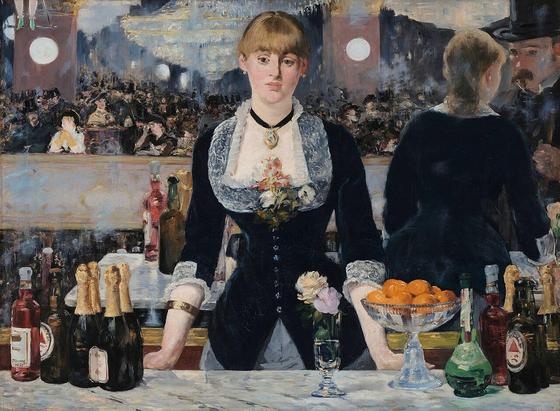
 Bodhipaksa