@GeorgWeissenbacher @[email protected] @jfdm @csgordon @lindsey @jeremysiek
Yes to most of that. I think it's not that hard to assess if that is what people were always assessing that.
I actually disagree w/ your opening comment. Most intro CS educators will say (and have said), "I don't teach programming, I teach *problem solving*" (whatever the fuck that is). My response is, "great, this should be your liberation! Programming got easy, what are your «problem solving» ideas?"

@shriramk @lindsey @tonyg @GeorgWeissenbacher @[email protected] @jfdm @csgordon @jeremysiek right, I hadn't realized how bottlenecked I was by lack of student + my own time. like I have one million ideas and now I can pursue 0.0007% of them instead of 0.0003%. or whatever.
LLM coding is perfect for profs-- we're time-limited experts and we're mostly not expected to produce really awesome code anyhow.
@regehr @lindsey @tonyg @GeorgWeissenbacher @[email protected] @jfdm @csgordon @jeremysiek
Papert, Kay, etc. used the phrase "tools for thought". (@tonofcrates is teaching a course by that name!)
This feels like a new tool-for-thought. Including exposing both the weakness and incompleteness of my thought, which is what a good tool ought to do.
As a PL person, I'm excited to be able to rapidly prototype a PL and actually *use* it, not just reason through calculi (a different tool for thought).
@jbigham @regehr @lindsey @tonyg @GeorgWeissenbacher @[email protected] @jfdm @csgordon @jeremysiek @tonofcrates
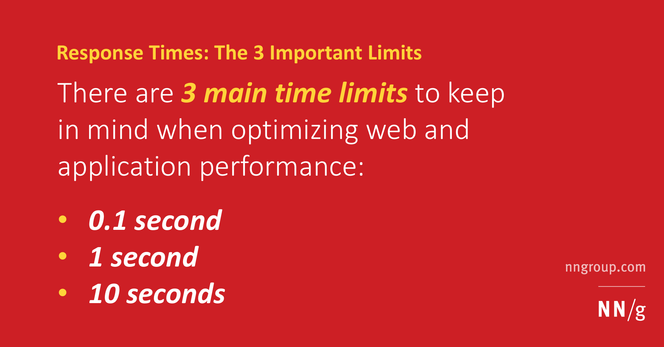
I really like Jakob Nielsen's summary of 30 years of UX research on 3 levels of interactivity:
0.1 second = instantaneous
1.0 second = uninterrupted
10 seconds = keeps attentionª
ª still true?
Anything beyond that, and your brain wanders. These things have the *worst* response time, returning in minutes rather than a day.
That's why we have *three* social media.
https://www.nngroup.com/articles/response-times-3-important-limits/
@shriramk @regehr @lindsey @tonyg @GeorgWeissenbacher @krismicinski @jfdm @csgordon @jeremysiek @tonofcrates
i think the big opportunity, which is hard, is how to usefully keep people attending with these things. i'm starting to see work where humans are still in the loop. but, that requires a lot more focus on updating the human's mental model (need way more than just following along the chat), and then how would you usefully intervene?
@jbigham @regehr @lindsey @tonyg @GeorgWeissenbacher @[email protected] @jfdm @csgordon @jeremysiek @tonofcrates
To me a really exciting open research question is how can we keep humans in the loop in a way that their work is
- minimal/moderate
- meaningful
Either one is easy. Security alerts were minimal, but useless because not meaningful. "Review all the generated code" is (maybe) meaningful, but not moderate.
In specialized sub-domains we have some answers. Don't yet know how to generalize.
@tonyg @shriramk @regehr @lindsey @GeorgWeissenbacher @jfdm @csgordon @jeremysiek
A simple, albeit terribly incomplete, analogy is that an LLM is a fancy search engine. Like any search engine, it can hinder thinking (e.g. searching for solutions to a homework problem, plagiarizing sources for an essay) or support thinking (e.g. facilitate debugging, surface unexpected sources).
@tonofcrates @tonyg @regehr @lindsey @GeorgWeissenbacher @jfdm @csgordon @jeremysiek
As someone who thinks about metaphorical and analogical thinking, I'd say this is a terrible analogy in general and a fantastic analogy in this specific case and for this audience. (-:
That is, it fails very badly as an analogy for understanding mechanism, but it works very well as an analogy for understanding use/effect. I hadn't really thought about that distinction before: analogies for purposes.