One thing I obsess a little bit over is the fact that it’s 2026, we pretend that Linux is a serious OS, but we‘re still losing your data on a regular basis.

Out of memory conditions (OOM) are one of our biggest pain points, so I just did a quick experiment with macOS to see how they are handling OOM.

I loaded about 200 memory heavy tabs in Firefox and kept a close look at memory usage.

(1/4)

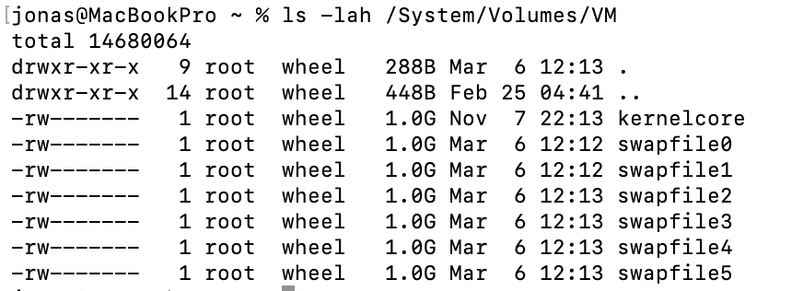
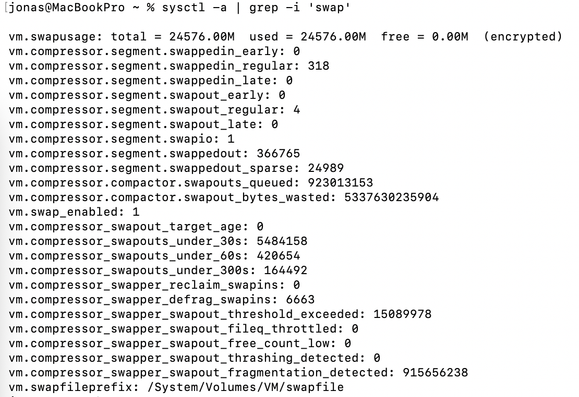
Once my 16 GB of memory were filled up, with a good extra amount saved thanks to compression, macOS just started creating swapfiles. Memory pressure went from the green to the yellow area, things got a little bit sluggish when switching to the oldest tabs, but no major slowdowns or freezes of multiple seconds.

The more tabs were open, the more swap files got created. At some point the disk would fill up though.

(2/4)

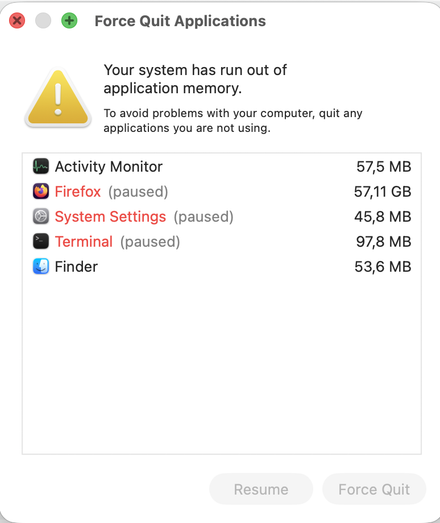
With about 200 MB of disk space left, Firefox froze completely, and at the same time a window popped up telling me that Firefox and a few other apps were frozen (not killed!!!) by the system.

The window prompted to either kill the app or resume it. Pressing resume, Firefox continued running smoothly for a few seconds, until it got frozen again. Pressing resume again, I could quickly close a few tabs, and things worked fine again.

(3/4)

All of this without one tab getting unloaded by Firefox, or one app getting killed without user consent.

So OOM conditions *can* be handled without losing people's data. Don't let kernel developers fool you into believing this is an impossible problem to solve.

(4/4)

@verdre I could not agree more, this really needs improvement on Linux.

There's another feature in macOS that saved me a ton of frustration while writing my thesis in 2019. I had forgotten to plug my MacBook Air in, and with LibreOffice maximized for focus, I must have missed notifications about my battery being empty and only noticed when the screen went black. I was afraid of hours of work being lost, but after plugging in and booting up, LibreOffice launched with my document all intact.

@1peter10 Yup, you're talking about hibernation (aka writing memory to disk and then shutting down).

Not exactly cutting edge technology, it even works on most linux devices if you set it up.

Unsurprisingly, Linux distros don't care enough to make hibernate work OOTB, I'm hoping we can figure it out for GNOME OS though.

@verdre Yes, it's often not set up. From my experience with having the same happen on Windows 10 (but with dataloss), this disregard may be inspired by Microslop.