One thing I obsess a little bit over is the fact that it’s 2026, we pretend that Linux is a serious OS, but we‘re still losing your data on a regular basis.

Out of memory conditions (OOM) are one of our biggest pain points, so I just did a quick experiment with macOS to see how they are handling OOM.

I loaded about 200 memory heavy tabs in Firefox and kept a close look at memory usage.

(1/4)

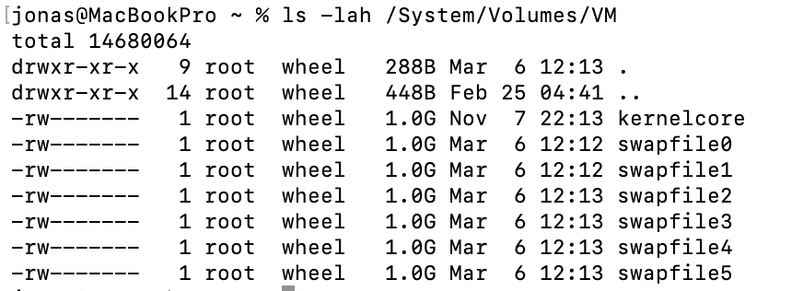
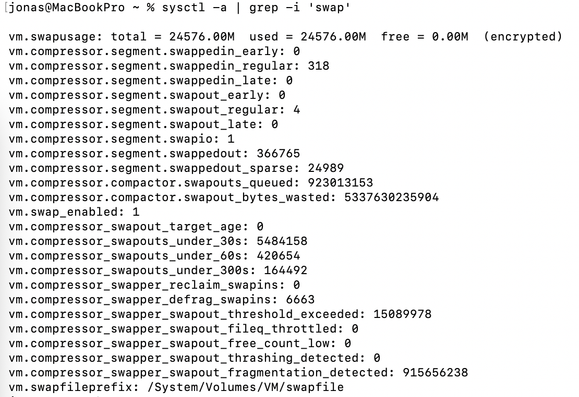
Once my 16 GB of memory were filled up, with a good extra amount saved thanks to compression, macOS just started creating swapfiles. Memory pressure went from the green to the yellow area, things got a little bit sluggish when switching to the oldest tabs, but no major slowdowns or freezes of multiple seconds.

The more tabs were open, the more swap files got created. At some point the disk would fill up though.

(2/4)

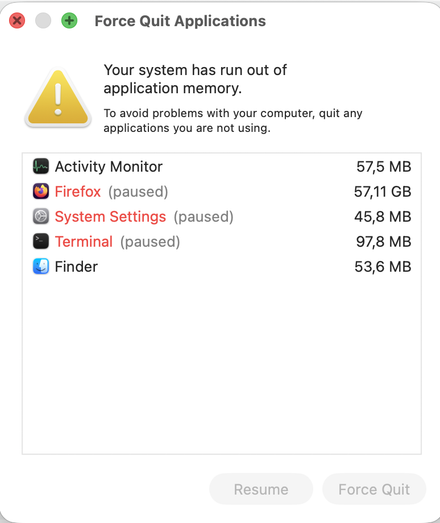
With about 200 MB of disk space left, Firefox froze completely, and at the same time a window popped up telling me that Firefox and a few other apps were frozen (not killed!!!) by the system.

The window prompted to either kill the app or resume it. Pressing resume, Firefox continued running smoothly for a few seconds, until it got frozen again. Pressing resume again, I could quickly close a few tabs, and things worked fine again.

(3/4)

All of this without one tab getting unloaded by Firefox, or one app getting killed without user consent.

So OOM conditions *can* be handled without losing people's data. Don't let kernel developers fool you into believing this is an impossible problem to solve.

(4/4)

@verdre Sorry for sounding like reply guy but this is just unfair comparison.
Kernel OOM is last resort thing, meant to prevent complete freezing of system, which both Linux and MacOS have. MacOS can handle this better because it uses also (partially, more on that later) userspace Jetsom (its not rly named that on MacOS but iOS, but its essentially the same system) handler which monitors memory usage and does actions to prevent memory from going critically high so to not trigger the OOM.
There are systems like that on linux, like systemd-oomd, tho it's done more poorly and those also just kill apps, but before they trigger the kernel OOM.
There are also dynamic swap solutions like swapd, which do more or less the exact same thing, but it's not part of the kernel, which means it has to be installed.
I am not saying that ur wrong about the handling of it on Linux (by default), it's mostly done poorly on most if not all distributions by default, and yeah sure distro's could allow to set it up easier so that they also have dynamic swap, but it's not just a Kernel thing and I dislike this "don't let kernel devs fool you".
It's an desktop implementation and usespace issue, not kernel.
Again sorry for long reply but you insulted ppl based on a fallacious comparison so like lol