
It was outside the United States that the dissonance struck most deeply.
I remember sitting on high-speed trains that glided so fast and silently they seemed to erase distance itself,
watching wind farms cross the horizon like silent fleets.
In country after country
— places far smaller and, on paper, far poorer than ours
— I kept asking the same question:
how could they manage to build what we could not?
Why did the richest nation on earth feel like it was living off the leftovers of its mid-twentieth century optimism? 

Conversations in Europe added another layer.
People spoke casually of health care as a right, not a privilege;
of sending their children to university without dread or debt;
of a shared obligation to slow the warming planet.
It was not utopia
— just an older, steadier faith in the public good.
The idea that freedom and mutual responsibility might coexist had not yet been driven out of their political imagination. 

Back home, the contrast was impossible to ignore.
We stumble on crumbling bridges and argue about the price of insulin
yet never question why nearly two-thirds of what Washington calls “discretionary spending” is locked inside the machinery of the National Security State.
In the 2026 budget,
-- 59.6 percent is marked for the Pentagon
(even more if Trump succeeds in getting an additional $600 billion),
-- another 6.4 percent for Homeland Security.

No other democracy has made such choices
— or lived so comfortably with their consequences. 
https://www.rollingstone.com/politics/political-commentary/trump-america-military-industrial-iran-war-1235524970/
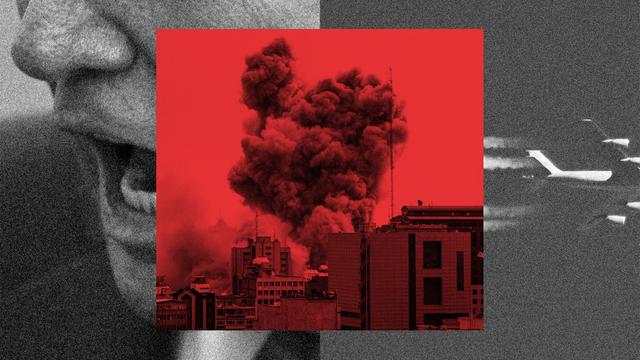

The Terrifying New Era of American Imperialism

Donald Trump's war against Iran is part of a terrifying new era of American imperialism, one in which the military budget never stops growing.

Rolling Stone

Trump campaigned on the promise that the United States would stop policing the world,
that the era of regime change and open‑ended intervention was over.

Now we have invaded Venezuela, kidnapped their president, and Trump tells us we “are going to run the country for a long time,”
as if Venezuela were a failed subsidiary being placed into receivership.

Next up was Iran, with a New York Times banner headline proclaiming, “Trump Calls for Overthrow of Government.”

The idea that the United States will “run” or administer another sovereign nation,
even “temporarily,”
ought to trigger every alarm that still works in Washington.

We are entering a new era of American imperialism.

Trump Deputy Chief of Staff Stephen Miller recently told CNN’s Jake Tapper,
“We live in a world, in the real world, Jake, that is governed by strength, that is governed by force, that is governed by power.
These are the iron laws of the world since the beginning of time.”

As Jonathan Last wrote in The Bulwark,
in both Venezuela and in Minneapolis,
“What we are seeing is a worldview for which the only value is the domination of enemies.

There is a name for that.

It is fascism.”
https://www.thebulwark.com/p/renee-good-ashli-babbitt-fascism

The Distance Between Renee Good and Ashli Babbitt Is Fascism

It’s not a hypocrisy. It’s a coherent worldview.

The Bulwark

American fascism,
to the extent that it exists as more than a slur,
expresses itself less in blackshirts than in the quiet normalization of permanent imperial management.

The classic fascist regimes insisted that a nation’s vitality depended on expansion
— that without new territories to subdue and administer, the social order would atrophy and turn inward on itself.

Contemporary American power dresses this same logic in the language of
“stability operations,”
“rules-based order,”
and “responsibility to protect,”
-- but the underlying premise is familiar:
the United States must supervise, discipline, and, when necessary, occupy other societies
in order to preserve its own sense of mission.

What Hitler called “Lebensraum”
and Mussolini cast as a “proletarian nation” bursting its confines
reappears in the Washington vernacular as
forward deployments,
security partnerships,
and transitional authorities that somehow never transition.

The point is not that today’s policymakers are closet Nazis,
but that a republic which comes to believe it cannot remain itself without governing other people’s territory
has already internalized a key article of the fascist creed:
that conquest is not an emergency measure
or tragic exception
but the normal condition of a serious country.

As Timothy Snyder, author of On Tyranny, noted,
“Fascism demands a major foreign war to kill one’s own people
and thereby generate a reservoir of meaning that could be used to justify indefinite rule and further oppression,
to make the world seem like an endless struggle and submission to hierarchy as the only kind of life.”

Trump is not wrong to demand that Europe shoulder more of its own defense.

In March of 2016 he told the New York Times’ David Sanger,
“at some point, we cannot be the policeman of the world.”

The irony, of course, is that under his watch American defense spending has only swelled
and America has assumed a belligerent stance towards both competitors and former allies.

No American troops have been withdrawn from Europe.

Trump’s new demand for a 50 percent jump in the Pentagon’s budget is not a policy so much as a symptom.

It reads less like a response to any discernible strategic assessment than as a sequel to the Maduro raid,
an attempt to convert one clean, televisable operation into a permanent line-item tribute to himself.

In that sense the proposal is pure Trump:
spontaneous, grandiose, and retroactively draped in the language of “long and difficult negotiations”
that plainly never occurred in any conventional budget process.

The point is not whether Congress ever enacts a $1.5 trillion authorization;

the point is to establish a new psychic baseline in which anything less than a “Dream Military” feels like an insult to the man who ordered Maduro’s capture.

Seen from the vantage of America after empire,
this is what late-imperial politics looks like
when the imperial story has outlived the material conditions that once sustained it.

The old language of sober responsibility and tragic necessity has given way
to the logic of the algorithmic feed:
each crisis, each boat bombing, each killing, each “decisive” show of force
must be instantly topped by something louder, costlier, more spectacular.

Trump is only the most garish embodiment of a broader political class
that long ago internalized the idea that military power is the last reliable currency of national meaning;

he simply strips away the last restraints and says the quiet part out loud,
equating the health of the republic with the size of his own arsenal.

The danger in such a politics is not just fiscal or geopolitical.

It is that, in a country willing to spend $1.5 trillion to feel invincible abroad
while treating the killings of Renée Good and Alex Pretti at home as collateral damage to be managed with fearmongering and lies about domestic terrorism,
the distinction between security and domination disappears entirely.

Adjusted for inflation,
the United States will spend in 2027 almost a trillion dollars more on the military than it did at the height of the Cold War.

The combined military budgets of China, Russia, Germany, India, United Kingdom, and France are only $786 Billion.

Yet for all that money,
the structure of the armed forces has been hollowed out:

we have roughly half as many active-duty service members,
half as many ships in the Navy,
and half as many aircraft in the Air Force.

More than half of the Pentagon’s budget now flows not to soldiers or sailors,
but to private firms
— the contractors, consultants, and corporate intermediaries
who have become the real custodians of the American war machine.

For more than three decades, the Pentagon has functioned as a kind of black hole in the federal ledger,
failing audit after audit
even as nearly a trillion dollars a year disappears into a fog of untraceable contracts,
“improper payments,”
and bureaucratic bloat
that its own buried studies estimate in the hundreds of billions.

The inability
— or refusal
— to produce a clean set of books is not a technical glitch
but the operating system of American militarism,
a permanent state of engineered opacity
in which waste and fraud cease to be aberrations
and become the business model of empire itself.

When Donald Trump proposed buying Greenland in 2019
— and later mused about “taking” it
— the impulse seemed so outlandish that much of the world laughed it off
as another episode in the long-running theater of American excess.

Yet the Greenland moment, in retrospect,
looks less like farce and more like a kind of tragic symbolism,
the twilight gesture of a hegemon that had forgotten the difference between dominance and delusion.

Trump’s threats to “conquer” or annex the island
— a NATO-protected territory of Denmark
— encapsulated a fantasy of American omnipotence that no longer existed,
while accelerating the very unraveling it sought to deny.

The fantasy that Washington can script another nation’s political future at the point of a gun survives only by ignoring the wreckage already left behind
— from Saigon to Baghdad and beyond.

It rests on a peculiar imperial arrogance:

the conviction that history’s verdicts do not apply to us,
that this time the occupation will be brief,
the technocrats wise,
and the locals grateful,
until the cycle of disillusion and violence begins again.

@cdarwin @staringatclouds

It brings to mind: "When you've got
them by the balls,their hearts and minds will follow " (attribution uncertain).
It wasn’t true then either.