LOL true Mastodon verification:

YOU MUST VERIFY YOURSELF ON MASTODON BY:

- Posting a picture of a cat in your lap
- Random photos of flowers
- Wax poetic about your favorite episode of Star Trek TNG (or your hate of the series)
- Random, undecipherable technical blabbering about ham radio electronics
- Mention something about your favorite Linux command line
- Say hello to your many LGBTQ followers/friends here, just because you're glad they're here
- Toot a picture of some mushroom you ran into while walking in the forst
- Something something astronomy
- Random gadget/device/bicycle post
- Post a random picture of a tree or window
- Photo of your sewing/mending project!
- Hand drawn art post
@ai6yr You forgot ham radio and sewing machines

@W6KME @ai6yr

i think any hardware/toys you can geek about count. i follow folks talking about musical instruments, fiber crafts, jewelry, woodworking, calligraphy/fountain pens. you just have to be well beyond sanely interested in whatever it is and overly willing to share technical details. ;)

@paul_ipv6 @W6KME @ai6yr Hardware/toy geekery pairs nicely with "Something something astronomy".

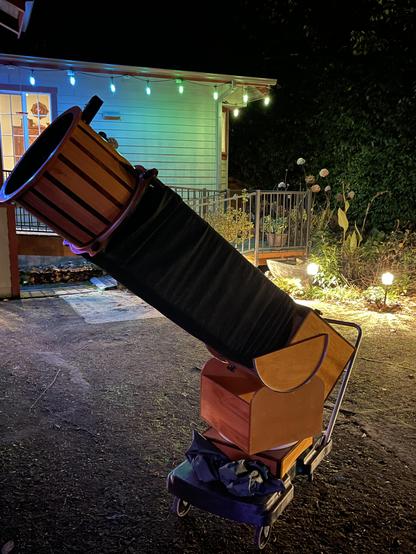
Current bit of precision-ground glass in a tube: 12.5"/320mm f/5 Dobsonian reflector on a cart for easy transport. It breaks down into smaller components so it's possible to take it on a road trip to darker skies.

@dpnash @paul_ipv6 @W6KME @ai6yr Wow, you made that? Do you also have a photo in disassembled state? I've been wondering, when there's light pollution anyway, does a bigger lens help?

@jkanev @paul_ipv6 @W6KME @ai6yr

I didn’t make it myself. I bought it from someone who was a woodworker who’d also gotten into amateur telescope making. No good photos of it though in the disassembled state, unfortunately.

If there is a lot of light pollution, the larger mirror does help: it won’t fish really diffuse faint objects like galaxies out of the murk, but it does make it easier to see fainter stars and clusters of stars. Larger optics also translate into higher optical resolution, so you can see finer details in bright objects like the moon and planets.

@dpnash @paul_ipv6 @W6KME @ai6yr
Some weeks ago, on a clear night, I tried to see the pinwheel galaxy. Took me a while to find the exact spot, but what I saw was exactly dark blue on a dark blue background. I could make out nothing. Not even a faint difference. That was with a six-inch reflector, near a big city. You've probably seen it?

@jkanev @paul_ipv6 @W6KME @ai6yr

I have, from a very dark sky with a 10” scope some years back. With a 6” it should be possible to see all the Messier catalog galaxies, but you’ll need a dark sky to have a reasonable chance at it.

Galaxies are, without a doubt, *the* toughest things to see with significant light pollution. You can snag fairly faint stars by cranking up the magnification a bit, and many nebulas can be made more visible with narrowband color filters, but galaxies are only visible when the sky background light level is low enough.

@jkanev @paul_ipv6 @W6KME @ai6yr

For context, Mr. Messier observed many of the 110 objects in the Messier catalog with a 4”/100 mm refractor. This is a reasonable starting point for seeing them distinctly under a completely dark sky, which he (and pretty much everyone else in the 18th century) had. Keep in mind that in many cases, what he saw was “faint fuzzy blob that looks kind of like a comet”. Seeing details in galaxies (in particular) requires a larger scope along with genuinely dark skies.

@dpnash @jkanev @paul_ipv6 @ai6yr My failure to see it could have many factors-my own eyesight, the quality of my instrument, the darkness of my dark sky. As well, as you say, galaxies simply don't look like pretty spirals in naked eye views.
@W6KME @dpnash @jkanev @paul_ipv6 The telescopes I got to see galaxies through in Death Valley were all big (dunno how big) but it was amazing....