 Innerworld
China tests world's first megawatt-class flying wind turbine
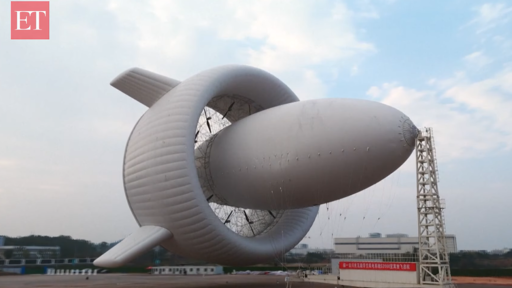
While in the US our brilliant leader is trying to reopen old coal mines.
That being said, there are American companies that have been working on flying wind turbines for quite a while.
 RememberTheApollo_
We have working models. The difference is the Chinese can say “make it happen”, and they do it. In the US they say, “Gimme lots of investment capital and how can I profit massively off of this?” so it goes nowhere quick.
Maybe we should call them “AI power dirigibles” and people will put some money into it.
ZepplAIns
Ugh. Well, Makani was the company I was thinking of. They started in 2006, Google bought them in 2013 and shut it down in 2020. Fucking Google…
 oyzmo
oyzmoHelium is a non-renewable substance which there is a global shortage of. I wonder how much it takes to lift that thing 😅
 paraphrand
 porcoesphino
“Skytanic” was a great episode of Archer. For anyone that hasn’t seen it, the running gag is that Archer thinks the non-flammable helium is going to explode leading to things like this slap
“All of it, obviously!”
No worries, that only happens if there’s a spark, like for instance some static electricity. Shouldn’t be a problem here, surely this thing won’t generate any of that.
Wouldn’t this still need to be tethered to the ground? Would that likely have grounding cables?
That helps against sparks jumping between the balloon and the ground, but things could still get zappy between the individual components of the balloon.
Not necessarily. It’s not about the boom factor alone - hydrogen is a small atom, and so under pressure, most commonly used materials are permeable to it. It leaks through every material. It really takes something as solid as steel pipes for hydrogen atoms to not work their way through and escape. So while hydrogen would be cheaper to produce at scale, it’s also constantly leaking out of any container.
For wind turbines, static electricity and storms would be huge risks as well, so the application of a floating wind turbine would not be ideal.
Even with steel pipes you get problems with hydrogen embrittlement because hydrogen diffuses into the steel and can cause it to crack.
If you’re producing electricity in it, you can always bring some water up and use some of that electricity to extract hydrogen from the water to make up for any leaks.
It really depends how bad the leaking is since that dictates how much weight of water is needed to be brought up and electricity must be used for hydrolysis.
Yeah, that’s what the folks who designed the Hindenburg thought as well.
Nah, it’s perfect!
For an autonomous platform with some sort of safety mechanisms for jettisoning the air bag if a catastrophic failure occurs, hydrogen does in fact sound like a way better and less scarce lifting gas.
 Brave Little Hitachi Wand
I did not know that
I need someone to explain the joke. Waiting 100,000 years for radioactive decay seems to be a bit boring as a punch line.
 Sneezycat
Not once we get fusion reactors up and running, then we’ll be drowning in that sweet sweet helium-4
 Jännät
 ileftredditforthis
People in the UK, mainly the coffin dodgers mind, bitch about how ugly wind turbines are they’d loose their shit about these. They seem to prefer the beautiful and discreet electricity pilots it seems.
Oh no, they don’t like pylons either. They just want coal plants in poor people’s gardens and subterranean power cabling.
 Kokesh
Fly one over the White House, and another over Maralago.
We need better propulsion methods than Helium…
…but we don’t exactly have other lighter than air alternatives.
Well, there’s hydrogen, but that has its own downsides. Like it’s a bit explody, for example.
Not to mention that the flames while combusing are invisible by sight. It’s also really difficult to keep contained and if it leaks it has ~11x the impact of CO2 per this article.
I used to like the idea of hydrogen as an energy medium but all of its attributes combined just make it really infeasible to use except for immediate applications.

A multi-model assessment of the Global Warming Potential of hydrogen - Communications Earth & Environment
The 100-year Global Warming Potential of hydrogen falls in the range 11.6 ± 2.8, according to chemistry-model estimates, through its chemical impact on methane, ozone and stratospheric water vapor. It is therefore important to avoid leakages in a hydrogen economy, to help mitigate climate change.
What about a really big kite?