Let Friction Ring.

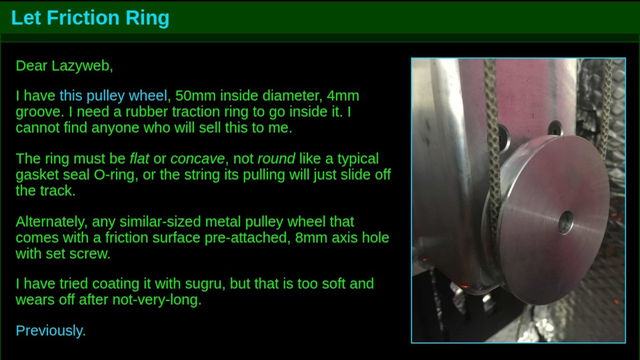
Dear Lazyweb, I have this pulley wheel, 50mm inside diameter, 4mm groove. I need a rubber traction ring to go inside it. I cannot find anyone who will sell this to me. The ring must be flat or concave, not round like a typical...
https://jwz.org/b/yk33

@jwz Hrm, I don't know of anything like that. Couple thoughts:

Is the pulley intended for round belts? If it's just a random hardware store v-belt pulley, there might be some extra friction to be had with a round belt one.

I wonder if the ridges on a timing belt pulley would give enough friction (without shredding the rope). I don't see any near that diameter, but we could cut ridges into a larger plain one.

I see what you mean about using an o-ring, but what about two, sized to fit side by side inside a v-belt pulley? That would leave a little groove between them that the rope could ride in.

@attoparsec No, I'm not re-engineering the entire thing to have a second wheel, come on.

How the fuck am I supposed to know what the pulley was "intended" for?

@jwz What second wheel? I only meant modifying this one, or else a replacement like you indicated openness to in the post. (And was volunteering to help with the mods if needed.)

Is the groove semicircular, such that a round belt would fit snuggly in it with full contact all the way around, or does it have tapering straight sides and a flat bottom?

@attoparsec Oh, I thought you were suggesting sandwiching the cord between two wheels. Sorry.

The groove inside the wheel is flat on the bottom. Basically it's a 50mm x 4mm disc with a pair of 54mm x 1mm disc walls on the outside.

@jwz @attoparsec so maybe two very thin o-rings, such that they sit in the corners on either side and help grip the rounded cord?

Otherwise: a few windings of teflon tape, perhaps, and that will similary squash to fill the sides. Does it reverse direction or only spin one way?

@uep @attoparsec It reverses. Why do you think Teflon would help?
@jwz @attoparsec the tape is soft and deforms easily into crevices (threads, usually), and stringy as it wraps around. Reversing direction may mean it unwinds though. Worth a try perhaps.
@uep Teflon is explicitly used in cases where you want to minimize friction. Here, we want to maximize it.

@glace I think you're conflating this with non-stick pans, which is a different case entirely.

look up teflon lock nuts sometime.

McMaster-Carr

McMaster-Carr is the complete source for your plant with over 700,000 products. 98% of products ordered ship from stock and deliver same or next day.

@uep @glace I was curious so I took the time to look up Teflon locknuts.

I did find a link that referred to them as anti-slip, saying they were less prone to come loose under vibration. However, besides its chemical inertness, by far the most common use case for Teflon in engineering is reducing friction, and even the description of those locknuts listed this as a benefit, making them apparently both low-friction and anti-slip.

I'm not inclined to doubt that there's science behind the design that means that they both can be true, but I would suggest that understanding that science is crucial to knowing in what circumstances a famously low friction material could contribute to increasing friction.