 yizus
yizusCan a reasonable person genuinely believe in ghosts?

He’s wishy washy on the scientific method, not because he doesn’t understand it but because he believes it’s wrong (or at least incomplete)
We’ve spoken about this on several occasions and either his arguments make no sense or I’m genuinely too dumb to get them.
Hi, I’m the friend. I don’t want to reveal too much about my identity here but my science education was actually very thorough (I know that sounds arrogant but I just wanted to defend my honour here). Let’s not get bogged down with personal detail though like that though because ad hominems like this can often cause a conversation to unravel into personal attacks.
Regarding what my friend said about my views on the scientific method: This is a bit of a mischaracterization. I don’t have anything against the scientific method. I just think that the things we have reason to believe is larger than the things that we can provide evidence for scientifically. (Broadly speaking I think this is a fairly standard view of things.)
Another way to out this is this. The question is not ‘ is xyz scientific ’ but ‘do we have reason to believe xyz’’? It turns out that if we can demonstrate something scientifically it does give us reason to believe that thing. But there are some things we have reason to believe that we cannot demonstrate scientifically. For example I have good reason to believe solipsism is false, or that chocolate tastes more like coffee than soap, even though I cannot strictly speaking demonstrate these things scientifically (examples like this often have something to do with the subjectivity of the mind, which cannot be directly measured but is nonetheless very apparent to us).
For the ghost stuff, I think you actually could make a reasonable scientific case for the existence of ghosts (very hot take, I know), but that’s not my primary concern. What I’m worried about is do we have good reason to believe in ghosts? As it happens, I believe the answer to that is yes. The details here might be a bit out of scope for a c/nostupidquestions thread but I’m basing my thoughts here on the book Surviving Death by Leslie Kane . I used to have a similar view as most people in this thread (that ghosts were irrational and unscientific etc) until I read this book and it forced me to change my mind. It’s a great book and I highly recommend it for anyone interested in this topic.

“While exploring the evidence for an afterlife, I witnessed some unbelievable things that are not supposed to be possible in our material world. Yet they were unavoidably and undeniably real. Despite my initial doubt, I came to realize that there are still aspects of Nature which are neither understood or accepted, even though their reality has profound implications for understanding the true breadth of the human psyche and its possible continuity after death.”
The details here might be a bit out of scope for a c/nostupidquestions thread but I’m basing my thoughts here on the book Surviving Death by Leslie Kane.
What was it that convinced you?
“While exploring the evidence for an afterlife, I witnessed some unbelievable things that are not supposed to be possible in our material world. Yet they were unavoidably and undeniably real. Despite my initial doubt, I came to realize that there are still aspects of Nature which are neither understood or accepted, even though their reality has profound implications for understanding the true breadth of the human psyche and its possible continuity after death.”
Basically, there are reliable, repeatable and measurable effects that are best explained by people ‘surviving’ their own death. A good example of this is near death experiences. People come back from having been clinically dead and can tell you things that they shouldn’t know. For example like where items are placed on the roof of the hospital or events that transpired when they had no brain activity. These people would have no way of having knowing this stuff unless they’ve seen it for themselves, which would have been physically impossible. So this makes their own fist-person accounts of what happened (“I was out of my body and literally floating around”) start to seem more credible.
The power of the book is the sheer volume of cases it presents for these sorts of events and other related phenomena. It shows you that events like these do occur reliably and repeatably and are quite literally scientific in that people can and do study them scientifically (and more of this study should occur, but that can only happen if we get past the current social stigma).
The power of the book is that it just inundates you with credible stories (and credible science!) from credible people, all of which is suggestive of the supernatural. It might be possible to talk yourself into dismissing one or two of these cases, but when you have several hundred of them compiled back-to-back-to-back it becomes harder and harder to find the willpower required to muster up a skeptical response. After a while you have to admit “okay, theres something more going on here, and I don’t understand it”. At least, thats what happened to me.
It’s a great book though, and I’m not doing it justice. I highly recommend giving it a read.
Near death experiences are a tricky thing to study. There are physiological explanations for much of it, such as weird brain activity is likely to be interpreted as a weird experience.
These people would have no way of having knowing this stuff unless they’ve seen it for themselves, which would have been physically impossible.
The problem of this argument is confirmation bias. An anecdote of seeing information you couldn’t have seen and being right is going to be more memorable than seeing information and being wrong.
when you have several hundred of them compiled back-to-back-to-back it becomes harder and harder to find the willpower required to muster up a skeptical response
Nah I think statistics can very very easily explain several hundred apparent out-of-body near-death-experiences out of the millions or billions of people who would have had a chance to experience near-death over recent history.
I did some googling of my own and found some studies on the topic from seemingly reputable sources that suggested physiological explanations might not be sufficient to explain the patterns they saw. Several of these had the same first author. I also found plenty of studies suggesting physiological explanations can be sufficient, as well as some specific criticisms of the couple studies that suggested they weren’t sufficient.
It’s interesting for sure that there is a doctor or two who seem to believe in the supernatural. The topic of near death experience seems to be of research interest regardless of any supernatural theories because of what it tells us about the brain.
It seems we will likely arrive at scientific consensus about near death experience in the future. I wouldn’t hold my breath that supernatural theories will survive that process.
events that transpired when they had no brain activity.
I think I saw the case this was talking about during my googling. It said “no suspected brain activity” which is not the same as confirmation of “no brain activity”.
That’s the problem with a book like the one you are describing. It’s deliberately cherry picked, exaggerated, and biased to drive you to a certain conclusion.
I instead urge you to go read scientific papers on the topic, and specifically not just the ones that seem to suggest the outcome you want to hear.
Thanks for your response. If you and I agree on anything it’s that we should do more science to understand this stuff better.
The scientific method involves looking at both the cases where it seems like something happened and the cases where nothing happened (e.g. someone said they had an experience but it clearly didn’t match reality). If you cherry pick just the events that “showed” what you want, that’s confirmation bias.
Confirmation bias is real, but this isn’t it. If I believe that all swans are white , and then I come across a black swan, should I just dismiss that data point because it would confirmation bias (perhaps people would accuse me of wanting this outcome)? No. Ignoring the black swan isn’t the way to go here. It wouldn’t be ridding ourselves of confirmation bias, it would be ridding ourselves of critical data that contradicts our starting hypothesis.
Similarly: even if supernatural stuff that is hard to explain happens in only a percentage of cases, discarding that data isn’t ridding ourselves of confirmation bias; it’s simply choosing to ignore critical data. That’s not good science.
I instead urge you to go read scientific papers on the topic, and specifically not just the ones that seem to suggest the outcome you want to hear.
This is what I started with, so for the longest time I was very skeptical, just like most people in this thread. It is my belief that anyone with an open mind who takes in all the information on this topic (including the studies that suggest supernatural outcomes and those that don’t; the first-hand accounts and the skeptical rebuttals) will inevitably come to the same conclusion that I have. That was my experience, anyway. This is not a conclusion I was looking for; I was really stubbornly against this stuff for the longest time, but I was forced to change my mind.
It’s also worth noting that the book talks about more than just near-death experiences; I just used them as an example.
This can be verified by asking people who have had near-death experiences whether or not they experienced something correct in their near-death experiences. Obviously, such experiences are traumatic, and multiple studies show that people can hallucinate due to the release of various neurotransmitters associated with the same.
We want to calculate the probability that someone manifested as a ghost given that they had an interesting near-death experience. We assume that anyone having a true supernatural experience experiences visions that are absolutely true. For each person, there are two possibilities (we’ll calculate the probability of each later).
The first possibility is that a person, in fact, experienced hallucinations. The second possibility is that a person experienced a ghostly manifestation.
Now, we further give people an objective multiple-choice quiz about the positions of various objects in an environment. To generate this quiz, we ask each person to choose the environment they believe themselves to have manifested in. We verify that they have never been to this environment before and did not have any method of knowing about this environment (e.g., if a subject saw a person going into a room and later gave an exact description of the person in the given room, it will be disregarded). We only test people who believe that they experienced a supernatural event. All options are framed in an equivalent manner and are presented in a randomized order to remove cognitive biases and implement double-blind protocols. We further use questions with non-obvious answers such that they differ from previous implementations (e.g., a vision of a surgery table with an overhead light is obvious, and by itself, not indicative of supernatural phenomena).
If the subject hallucinated, we assume that they have a random chance of predicting the positions of various objects. We now repeat this quiz a large number of times in accordance with the law of large numbers. If, after many repetitions, we find a sufficient deviation from the expected result (e.g., if each question had one correct answer and three incorrect answers, with the observed rate of correct answers being 50% instead of 25%), then we would have evidence supporting the existence of ghosts.
If, however, the results show no sufficient deviation from the expected results, then we would find that the probability of a perceived encounter being supernatural is approximately zero.
In this way, we can use scientific methods to test claims of ghost-like phenomena.
NOTE: If we only focus on the 25% of the cases as mentioned in the above example, we find that we are not focusing on the remaining 75% of the cases. Presenting only 25% of the cases, without giving any thought to the remaining 75% of the cases is an incorrect method of analysis as explained above.
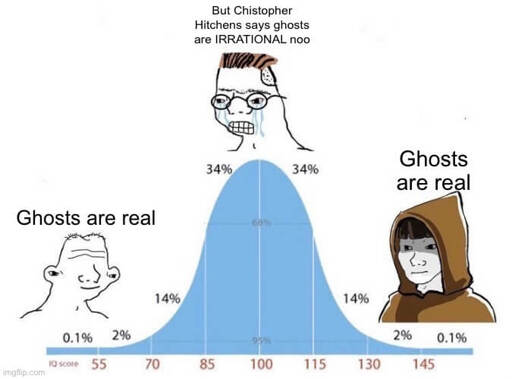
A friend and I are arguing over ghosts. I think it’s akin to astrology, homeopathy and palm reading. He says there’s “convincing “ evidence for its existence. He also took up company time to make a meme to illustrate our relative positions. (See image) (To be fair, I’m also on the clock right now) What do you think?
 actionjbone
 ageedizzle