1/7
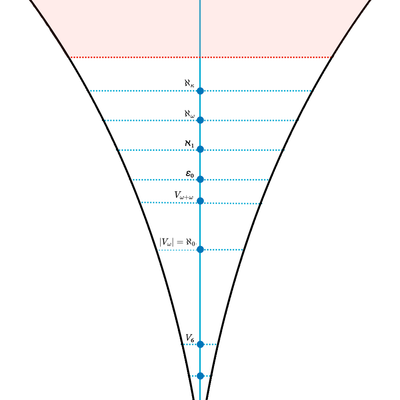
This air-quote #Mathematics unquote article https://www.quantamagazine.org/a-new-bridge-links-the-strange-math-of-infinity-to-computer-science-20251121/ keeps appearing in my feed, and I initially made some comments the first time, debunking it from a #Maths point-of-view, but given how it keeps popping up I think I need to do a more thorough #MathsMonday thread about it

Firstly, the author is a Physics journo, so you can take what he says about #math with a grain of salt (for some reason I see a lot of them doing this overreach, instead of checking with a Mathematician)…

2/7
"the strange infinite ones that other mathematicians ignore" - Mathematicians "ignore" them because there's no such thing

"Set theory deals with the infinite" - no it doesn't. Sets are finite, literally have an end. They have cardinality - the number of elements in the set. You can't have a cardinality of "infinity", nor is it a set if there's no closing bracket (which there can't be if it's infinite)…

@SmartmanApps
I'm not a mathematician, but in multiple mathematics courses I've taken, set theory has been taught including both finite and infinite sets.
If you don't believe Wikipedia, Wolfram MathWorld also discussed both finite and infinite sets.
As you say, an infinite set cannot be defined by enumerating its elements. However, that is not the only way to define a set.
There exist, for instance, infinite sets of the natural numbers, integers, rationals, algebraic numbers, reals, etc.

@brouhaha
"I'm not a mathematician" - I'm a Maths teacher.

"infinite sets. If you don't believe Wikipedia" - you won't find infinite sets in Maths textbooks. Stop looking at Wikipedia for Maths - it can't even get order of operations correct! πŸ˜‚

"infinite sets of the natural numbers" - they're not a set, they're just "the Natural numbers".

@SmartmanApps @brouhaha just chiming in here since I just followed haxadecimal, but there are plenty of textbooks that mention infinite sets.

This even starts implicitly at an early age - here's an example of a textbook which, on page 46, says that the solution to an inequality is "the set of all real numbers x that make the inequality true." So the solution to x < 1 is the set of all real numbers less than 1, and there are certainly infinitely many of those!

https://www.scribd.com/document/536766882/389788543-Edexcel-Pure-Maths-Year-1

But pick your favourite textbook on Group Theory, say - Jordan & Jordan is a good one. On page 41 they give examples of groups (which they define as a certain type of set) are the complex numbers, real numbers, natural numbers and other infinite sets.

Of course, any textbook on set theory will include infinite sets :) E.g. Halmos, Jech, ...

But let us call these things something other than sets. What Cantor showed remains true, whatever you call them: there is a bijection between the natural numbers and the rational numbers, but not between the natural numbers and the real numbers. I assume you don't disagree with that... or do you?

Edexcel Pure Maths Year 1 | PDF

Scribd is the world's largest social reading and publishing site.

Scribd
@ActiveMouse
Apparently SmartmanApps is a finitist. They typically believe that natural numbers exist, but don't consider them to be a set. That lets them have their cake and eat it too, acknowledging that there is no greatest natural number, but defining infinite sets away by claiming that it is not valid to construct a set that cannot be enumerated in full.
@ActiveMouse
Nothing we can say possibly convince a finitist that infinite sets exist. It is effectively a religious belief. Infinite sets offend their sensibilities, so they declare them not to exist.
He also seems to believe that finitism is something accepted by more than an extremely miniscule number of mathematicians.

@brouhaha yes, in my (not overly long, I should say, but long enough) mathematical career I don't think I've ever met an actual finitist. Certainly not one who admitted to it, compared to a great many evident non-finitists. I'm trying to remember how much analysis you can do with actual finitary mathematics, I had an idea it ran out before the intermediate value theorem? In reverse mathematics you need some fragment of second order arithmetic to prove it, meaning a concept of a set of natural numbers but no higher order types or larger cardinalities.

They aren't talking like a finitist though. A finitist would, I think, recognise that they're talking about a philosophical position rather than a mathematical one and grant that no inconsistency has been found in, say, RCA_0, rather than bluntly denying proofs. Indeed, a finitist would agree that ZF- (or some weaker set theory) proves Cantor's theorem, because the theory and the proof can be coded in PA and verified there. a finitist wouldn't say the proof is wrong, instead they'd say it's not talking about anything real. Thing is, I'm not a Platonist so I agree, I just don't think the natural numbers themselves are "real" either.

I see from their other comments linked from their pinned post that they have other misconceptions about mathematics. It would be interesting to see what their views on those really are but they don't seem to be engaging here!

@brouhaha @[email protected]
"Apparently SmartmanApps is a finitist" - never said anything of the sort

"don't consider them to be a set" - they're not

"not valid to construct a set that cannot be enumerated" - hence we use intervals to describe them, see worksheet

"religious belief" - infinite sets is, yes, it's literally impossible to fit an infinite amount of anything into a finite space

"more than an extremely miniscule number of mathematicians" - as is evident from textbooks using intervals

@ActiveMouse @brouhaha
"plenty of textbooks that mention infinite sets" - there were textbooks that used Lennes' order of operations, but they were wrong and faded away

"the solution to x < 1 is the set of all real numbers less than 1" - no, just all real x<1, as per this worksheet I was teaching last week

"there are certainly infinitely many of those!" - which is exactly why it's not a set. πŸ™„ I had a student who used some wrong notations for intervals, but notably he never used set notation

@ActiveMouse @brouhaha
"What Cantor showed remains true" - it was never true, having ignored that numbers are discrete. 0.5(0) with infinite zeroes still takes up half of the interval 0-1 on the number-line. Having infinite decimal places doesn't magically make it infinitesimal in size. The only number which takes up zero space on the number line is zero itself.

@SmartmanApps replied to a bunch of my comments at once then blocked me, just in case you're wondering why there's no more to this thread.

I thought I'd jot down the breadth of his intellectual dishonesty:

* Arguments from authority are not permissible - so my mathematics degrees and teaching experience are unimportant, but he falls back on his job as a teacher at every opportunity to give his comments force.
* "Maths textbooks" are the *ultimate* authority, but the four I mentioned were just ignored.
* Proofs are what's important, but he has never posted anything resembling a proof
* Giving up on a hopeless case of anti-intellectualism is conceding defeat, but replying and immediately blocking is A-OK
* Any direct question will go unanswered. Falsehoods that have been challenged and questioned will be repeated.

This has certainly been a frustrating exchange. Looking at his other comments I worry that he might mislead some people, but on this avenue at least, I feel confident he has been exposed.

@ActiveMouse
"replied to a bunch of my comments" - fact-checked is the words you're looking for

"then blocked me" - well done on being only the second Gaslighter I've ever had to block πŸ™„

"intellectual dishonesty" - says Gaslighter in a case of #EveryAccusationIsAConfession

@ActiveMouse
"Arguments from authority are not permissible" - says Gaslighter in made-up ad hominem. You made up that there's a proof, failed to provide any evidence of it, then made an, also unsubstantiated, appeal to authority claim that most Mathematicians agree with your claim, as I pointed out. Unable to back up either claim, you're now making up that I rejected "arguments from authority", even though you never presented any such thing. The whole exchange is at https://dotnet.social/@SmartmanApps/116158239788138166
πŸ’‘πš‚π—†π–Ίπ—‹π—π—†π–Ίπ—‡ π™°π—‰π—‰π—ŒπŸ“± (@[email protected])

@[email protected] @[email protected] @[email protected] "allows one to prove" - says someone failing to cite any such "proof", because in fact you can only fit a finite amount of things in a finite space https://dotnet.social/@SmartmanApps/115642725878742794 "believed by virtually all mathematicians" - says someone making an appeal to authority argument since there's no such proof. A lot of Mathematicians believe that 8/2(1+3) is "ambiguous", and yet they're easily proven wrong about that with Maths textbooks https://dotnet.social/@SmartmanApps/110897908266416158

dotnet.social

@ActiveMouse
""Maths textbooks" are the *ultimate* authority" - no, proofs are

"the four I mentioned were just ignored" - because proven wrong πŸ™„

"he has never posted anything resembling a proof" - says person revealing they didn't even read the thread they are replying to... again πŸ˜‚

"immediately blocking is A-OK" - have you tried not, you know, gaslighting? πŸ˜‚

"Any direct question will go unanswered" - #EveryAccusationIsAConfession

@ActiveMouse
"Falsehoods that have been challenged and questioned will be repeated" - #EveryAccusationIsAConfession

"Looking at his other comments I worry that he might mislead some people" - says the Gaslighter, ignoring the proofs and textbooks in those comments

"I feel confident he has been exposed" - says person who couldn't provide ANY evidence for ANY of those claims πŸ˜‚

@SmartmanApps is now trying to reply without unblocking me 🀦