 yizus
yizusCan a reasonable person genuinely believe in ghosts?

He’s wishy washy on the scientific method, not because he doesn’t understand it but because he believes it’s wrong (or at least incomplete)
We’ve spoken about this on several occasions and either his arguments make no sense or I’m genuinely too dumb to get them.
Hi, I’m the friend. I don’t want to reveal too much about my identity here but my science education was actually very thorough (I know that sounds arrogant but I just wanted to defend my honour here). Let’s not get bogged down with personal detail though like that though because ad hominems like this can often cause a conversation to unravel into personal attacks.
Regarding what my friend said about my views on the scientific method: This is a bit of a mischaracterization. I don’t have anything against the scientific method. I just think that the things we have reason to believe is larger than the things that we can provide evidence for scientifically. (Broadly speaking I think this is a fairly standard view of things.)
Another way to out this is this. The question is not ‘ is xyz scientific ’ but ‘do we have reason to believe xyz’’? It turns out that if we can demonstrate something scientifically it does give us reason to believe that thing. But there are some things we have reason to believe that we cannot demonstrate scientifically. For example I have good reason to believe solipsism is false, or that chocolate tastes more like coffee than soap, even though I cannot strictly speaking demonstrate these things scientifically (examples like this often have something to do with the subjectivity of the mind, which cannot be directly measured but is nonetheless very apparent to us).
For the ghost stuff, I think you actually could make a reasonable scientific case for the existence of ghosts (very hot take, I know), but that’s not my primary concern. What I’m worried about is do we have good reason to believe in ghosts? As it happens, I believe the answer to that is yes. The details here might be a bit out of scope for a c/nostupidquestions thread but I’m basing my thoughts here on the book Surviving Death by Leslie Kane . I used to have a similar view as most people in this thread (that ghosts were irrational and unscientific etc) until I read this book and it forced me to change my mind. It’s a great book and I highly recommend it for anyone interested in this topic.

“While exploring the evidence for an afterlife, I witnessed some unbelievable things that are not supposed to be possible in our material world. Yet they were unavoidably and undeniably real. Despite my initial doubt, I came to realize that there are still aspects of Nature which are neither understood or accepted, even though their reality has profound implications for understanding the true breadth of the human psyche and its possible continuity after death.”
The details here might be a bit out of scope for a c/nostupidquestions thread but I’m basing my thoughts here on the book Surviving Death by Leslie Kane.
What was it that convinced you?
“While exploring the evidence for an afterlife, I witnessed some unbelievable things that are not supposed to be possible in our material world. Yet they were unavoidably and undeniably real. Despite my initial doubt, I came to realize that there are still aspects of Nature which are neither understood or accepted, even though their reality has profound implications for understanding the true breadth of the human psyche and its possible continuity after death.”
Basically, there are reliable, repeatable and measurable effects that are best explained by people ‘surviving’ their own death. A good example of this is near death experiences. People come back from having been clinically dead and can tell you things that they shouldn’t know. For example like where items are placed on the roof of the hospital or events that transpired when they had no brain activity. These people would have no way of having knowing this stuff unless they’ve seen it for themselves, which would have been physically impossible. So this makes their own fist-person accounts of what happened (“I was out of my body and literally floating around”) start to seem more credible.
The power of the book is the sheer volume of cases it presents for these sorts of events and other related phenomena. It shows you that events like these do occur reliably and repeatably and are quite literally scientific in that people can and do study them scientifically (and more of this study should occur, but that can only happen if we get past the current social stigma).
The power of the book is that it just inundates you with credible stories (and credible science!) from credible people, all of which is suggestive of the supernatural. It might be possible to talk yourself into dismissing one or two of these cases, but when you have several hundred of them compiled back-to-back-to-back it becomes harder and harder to find the willpower required to muster up a skeptical response. After a while you have to admit “okay, theres something more going on here, and I don’t understand it”. At least, thats what happened to me.
It’s a great book though, and I’m not doing it justice. I highly recommend giving it a read.
Thanks for explaining. To be honest I’m still not sure why that convinced you. If you wrote a book with a few hundred, even a few thousand anecdotes about people levitating I would still believe in gravity.
The power of the book is that it just inundates you with credible stories (and credible science!) from credible people
That is the part I doubt the most. Because if that was true, if this so called credible science in your book wasn’t misinterpreted or simply faked, the scientists responsible would have gotten a nobel price and world wide recognition. But they didn’t. If ghosts (or near death experiences, for that matter) were measurable in a repeatable or otherwise credible way it would be done on a wide scale. Scientists basically live for the chance to be the one who challenges a paradigm - and this one would shake everything we know about the material world, every scientific discipline, religions even.
There’s simply no good reason for such “credible science” to go unnoticed. There is at least one very good reason for faking it: It makes money.
I would still believe in gravity.
I believe in helium balloons too. Does that mean I don’t believe in gravity?
Because if that was true, if this so called credible science in your book wasn’t misinterpreted or simply faked, the scientists responsible would have gotten a nobel price and world wide recognition
Why do you assume that these scientists would get nobel prizes? Science is still a cultural phenomenon and people have their prejudices. Stigmas exist (as this thread amply reveals). Einstein didn’t even get a nobel prize for special relativity because it was considered too radical at the time.
There’s simply no good reason for such “credible science” to go unnoticed.
And why do you assume this science has gone ‘unnoticed’? We’re talking about it, aren’t we? People have spent their lives studying it, and an entire university department at Princeton is devoted to studying these sorts of things. This sort of stuff is frequently brought up and debated in reputable journals such as the Journal of Consciousness Studies (which recently devoted an entire issue to debating the topic of near death experiences iirc). That doesn’t sound very unnoticed to me. Controversial? Sure. But not unnoticed.
To be honest I’m still not sure why that convinced you.
Well then you should read the book. Like I said I’m not doing it justice. If you’re actually interested in this topic, and not just interested in taking cheap shots on Lemmy, then read the book.
I believe in helium balloons too. Does that mean I don’t believe in gravity?
Physics can explain helium balloons really well. There’s no mystery here. And they’re certainly not disproving gravity.
Einstein didn’t even get a nobel prize for special relativity because it was considered too radical at the time.
Einstein had no easily repeated experiments to show off. You’re claiming ghosts are measurable in a repeatable way - simple enough to be explained in a book for laypeople . At least after the third or fourth study with robust methodology the scientific community would be talking about nothing else. And I know that because I am surrounded but the kind of reaearchers you’re thinking of when you say “scientists”. They’re a bunch of nerds, they love that stuff. And they research ominous stuff all the time, a biology professor here spent 3 years studying healing crystals in drinking water. Disappointingly they found nothing.
And why do you assume this science has gone ‘unnoticed’? We’re talking about it, aren’t we?
Well to be fair we’re talking about a claim that such research exist, which is miles off from discussing actual research, which would be done by scientists in order to validate it’s operationalisation and discuss their findings.
The thing is: extraordinary claims require extraordinary evidence. A book simply isn’t that. It’s way too easily faked, isn’t subject to the scientific method, peer review, any form of control or critical oversight and at the end of the day profits not from the truth but from being sold. And you are here doing advertising for them, so it seems like they are succeeding at that.
I’m not trying to persuade you. I believe that would be hard to do at this point. What I’m trying to say here: It’s not unreasonable to think that you, and everyone else being convinced by a very entertaining and captivating book outside of the actual scientific method, are unreasonable.
One book simply shouldn’t be this convincing.
The thing is: extraordinary claims require extraordinary evidence. A book simply isn’t that. It’s way too easily faked, isn’t subject to the scientific method, peer review, any form of control or critical oversight
Okay, I revise my request. Please just read the books bibliography and read the peer-reviewed research that it cites.
Out of curiosity I just checked if I could find it. I couldn’t, which isn’t surprising - a book isn’t a scientific publication, so sources are rarely of great interest.
But in general: It would take hours, maybe days of work to cross reference the sources of a whole book with what the author claims they prove. Obviously I won’t do that. How many papers from the bibliography have you read? If you own the book, at least you should have easy access to it’s sources.
I am familiar with the sources, yes.
I’m not sure what you’re looking for here. Do you want me to send you links to some of the research from the bibliography? If so then I can do that when I get home from work
I’m not sure what you’re looking for here.
I’m trying to show you that your case isn’t convincing.
If your book could logically prove something, or at least argue convincingly (logically!) in favor of it, maybe it would in fact be interesting. Then you could repeat the arguments here (and elsewhere, and scientists would be doing just that) and we’d actually have some kind of discussion with something to gain for both of us. Anecdotes are, scientifically speaking, basically worthless. At best they’re used to create hypotheses, never to test them or to prove something. And even a great sum of them simply aren’t science.
And I’m sorry to say but this very much reminds me of conspiracy theories, e.g. flat earth theory, were science is really clear about something while a few laypeople on youtube think to themselves “I bet all those researchers just didn’t think of this, which to me on the other hand is completely obvious”.
Your claim is absolutely extraordinary. You would have to present an absolutely powerful, convincing logical argument in order to even begin to support it. “Someone claimed it happened to them” simply isn’t that, no matter how well it’s written.
If your book could logically prove something, or at least argue convincingly (logically!) in favor of it, maybe it would in fact be interesting. Then you could repeat the arguments here
…
You would have to present an absolutely powerful, convincing logical argument
You seem to be mistaking a logical arguments for an empirical argument (you don’t “prove” things in science the same way you prove things in math or logic). I’m making an empirical argument, not a logical argument. But in order for an empirical argument to be convincing you need to actually look at the data. This seems to be something that you’re very adverse to doing. You don’t want to read the book. You don’t want to review its bibliography. And you turned down my offer for me to literally send you sources here in this chat for us to discuss. So I really don’t know how else I can help you at this point. If you’re really so sure that you can prove (logically?) that this data is not worth looking at then there is really nothing further for us to talk about.
And I’m sorry to say but this very much reminds me of conspiracy theories, e.g. flat earth theory,
Who’s the one literally refusing to look at the data here? Me or you?
Anecdotes are, scientifically speaking, basically worthless
My patience with you here is running thin. I offering to send you peer-reviewed research and now you’re dismissing it all wholesale as just anecdotes? Note that (a) this is simply false and (b) case studies are an important part of all research in psychology and medicine (which are the subject matters we are dealing with here). I don’t have the patience to get into the weeds on this with you, so if you’re actually interested and not just trying to save face then please refer to this comment I made here.
Please do not respond to this message unless you have something actually intelligent to contribute to the conversation.
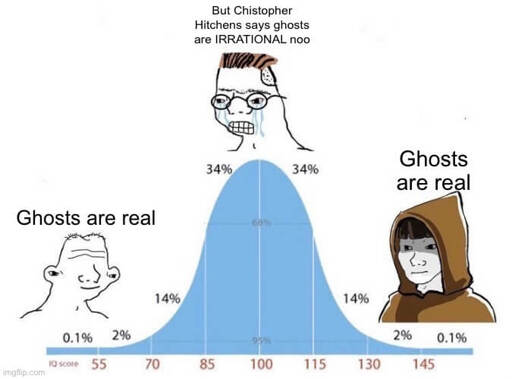
A friend and I are arguing over ghosts. I think it’s akin to astrology, homeopathy and palm reading. He says there’s “convincing “ evidence for its existence. He also took up company time to make a meme to illustrate our relative positions. (See image) (To be fair, I’m also on the clock right now) What do you think?
 actionjbone
 ageedizzle