 Petrikas
I don't usually praise Y takes, but this one is rather excellent.
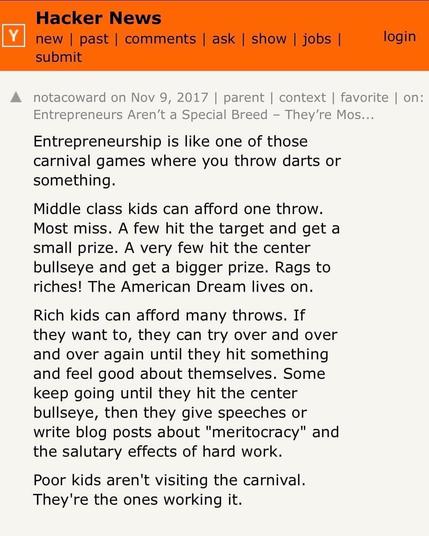
@em_and_future_cats Easy to remedy — just invent a time machine, and make sure that Reagan won't have become the POTUS.
(It's not a retroactive advice if it begins with "invent a time machine", you see.)
@em_and_future_cats Basically, for it to not be this way, economic slack needs to be generally distributed throughout a society, readily available for people interested in starting a business. Some forms of this have, with varying caveats, been the case for many subsets of many societies throughout much of the history. In the modern global Western society, an approximation of this used to be the case for relatively broad 'middle classes' of people (modulo excluding several marginalised groups of people, sometimes even if otherwise considere 'middle class').
However, a combination of the fashionability of Taylorism, the rise of Ayn Rand's odes to egotism, the rise of ridiculous economic theories more Austrian than Hayek's or Friedman's, many managers coming to see Jack Welch as a "hero", and, eventually, Reagan's access to power led to a widespread reconfiguration of the global Western economy in a way that directs economic slack to become aggressively extracted and collected to sillionaires.
While modern scientists have some idea of how to delay such a state of affairs from arising, it's unclear how, once it has arisen, it can be fixed. In previous history, events such as the Paris Revolution have, in effect, fixed similar dysfunctions, for some time (but they tend to come back), in ways that are rather unpleasant, and that most people would, at least for now, prefer to not get repeated.
Many current sillionaires and people who identify with such seem to believe that, indirectly due to this state of affairs, a "turning" involving a large-scale calamity, is in our near future, and some people believe in working towards directing the mass death of such an event towards non-sillionaires so that sillionaires would be spared.
Interestingly, a majority of the people believing in the importance of saving the sillionaires at the cost of other humans' lives are merely silly, but not sillionaires themselves.
@em_and_future_cats Game theory wise, preventing aggressive concentration of economic slack is a metastable state. It can be maintained indefinitely with relatively little effort; however, once it has collapsed, restoring it has the shape of a massively multiplayer prisoner's dilemma. These are some hard games.
 Em & future cats 🇺🇦🐈🏳️🌈
 Riley S. Faelan