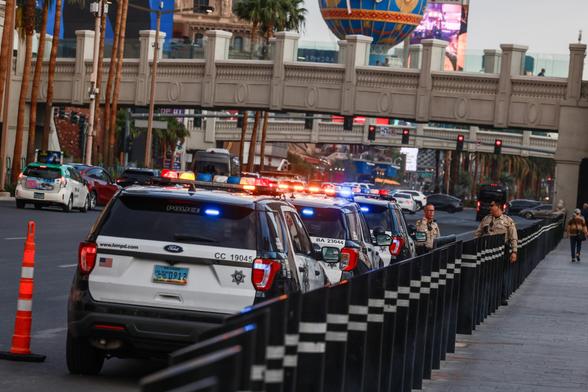
Vegas police are big users of license plate readers. Public has little input because it's a gift.

The Las Vegas Metropolitan Police Department quietly entered an agreement in 2023 with Flock Security, an automated license plate reader company that uses cameras to collect vehicle information and cross-reference it with police databases. Unlike many of the other police departments around the country that use the cameras in their police work, Metro funds the project with donor money funneled into a private foundation.

The Nevada Independent

I think the money is a red herring here.

In Oak Park, Illinois, we ran into a rhyming version of this problem: the only control we had about what technology OPPD deployed was a spending limit ($15K, if I'm remembering right), above which they had to ask the board for an appropriation. Our pilot deployment of Flock cameras easily went underneath that limit.

I'm not reflexively anti-ALPR camera. I don't like them, but I do local politics and know what my neighbors think, and a pretty significant chunk of my neighbors --- in what is likely one of the top 10 bluest municipalities in the United States (we're the most progressive in Chicagoland, which is saying something) --- want these cameras as a response to violent crime.

But I do believe you have to run a legit process to get them deployed.

OPPD was surprised when, after attempting to graduate their pilot to a broader deployment, a minor fracas erupted at the board. I'm on Oak Park's information systems commission and, with the help of a trustee and after talking to the Board president, got "what the hell do we do about the cameras" assigned to my commission. In conjunction with our police oversight commission (but, really, just us on the nerd commission), we:

* Got General Orders put in place for Flock usage that limited it exclusively to violent crime.

* Set up a monthly usage report regime that allowed the Village to get effectiveness metrics that prevented further rollout and ultimately got the cameras shut down.

* Presented to the board and got enacted an ACLU CCOPS ordinance, which requires board approval for anything broadly construed as "surveillance technology" for policing, whether you spend $1, $100,000, or $0 on it.

Especially if you're in a suburb, where the most important units of governance are responsive to like 15,000-50,000 people, this stuff is all pretty doable if you engage in local politics. It's much trickier if you're within the city limits of a major metro (we're adjacent to Chicago, and by rights should be a part of it), but still.

Why is the money a red herring? Just like in Oak Park, the police in Vegas are required to follow a democratic process for large purchases, and they were only able to avoid that with the money.

> Metro funds the project with donor money funneled into a private foundation. It’s an arrangement that allows Metro to avoid soliciting public comment on the surveillance technology

It doesn't matter whether the cameras are a good idea or not, the police should not be able to use a "donation" (from a guy who's going to profit from the donated equipment) to pretend they haven't done anything the public needs to know about.

The money is the main issue here, without it the public would have had a chance to discuss all the things you're talking about, and maybe reject them or put in some limitations. I would object to any secret arrangement like this, even if it was something completely innocuous like pencils for schools. There's no reason for significant acquisitions to be secret, and even if the government is acquiring something good and necessary, I don't want public services to be dependent on the generosity of some random dude without public discussion.

The large purchase has nothing to do with the actual problem! In Oak Park, OPPD rolled ALPR cameras out without bending a single rule because Flock structured a pilot deployment for them that came in under the purchase threshold. You aren't OK with that (and I'm not either) and it has nothing to do with the money.

Ok maybe this is just a semantic issue, but I'm still not understanding your argument that money has nothing to do with it. In your case, instead of having the founder donate the cameras, the company itself essentially donated them, I assume for a limited time. How is that not a money issue? When you said "a minor fracas erupted at the board", why did the board have a say at that point? Was it because the police now had to spend money, triggering public oversight?

It seems like the main problem you identified in your original comment is "I do believe you have to run a legit process to get them deployed." What is currently preventing this from happening? The only barrier I'm seeing is Ben Horowitz and Flock finding creative ways to temporarily let their customers not pay for their services.

I don't know how to more clearly say that the purchasing thresholds for police departments are not the actual issue with ALPR deployment. What you need is affirmative consent from the board/council before they're deployed, regardless of cost. If you rely on cost thresholds, ALPR vendors will make arrangements to get deployed in ways that fit under those thresholds. That's exactly what happened to us.

I think maybe one thing that's happening here is that people thing literally the only possible control against unwanted ALPR deployment is expenditure rules. But this is a story about one way a large metro got around expenditure rules. Meanwhile: there are model ordinances you can adopt that completely moot the price/gift issue. Pass them!

The point of my comment is "here is something you can do besides yelling on message boards about how much you don't like surveillance".

I think proactively passing a model ordinance is a good idea, but installing cameras is obviously not the only objectionable thing a police department can do. It isn't practical to make them get public approval for every acquisition regardless of cost, and it also isn't practical to brainstorm every possible bad thing they might ever try in the future and pass ordinances covering all of them.

I agree that the concrete bad thing that happened here is that cameras were installed without public consent. You are responding by saying "well the public should have predicted that and passed an ordinance before the police had a chance to try it". I am saying the police should be forced to consult the public when they make any significant acquisition, in any area, not just surveillance.

Perhaps the cost threshold could be amended to apply to the value of the good or services received, not the amount paid for them.

You also are not addressing the issue of government dependency on a private individual. Let's say Vegas has a public debate and decides they are in favor of cameras with no restrictions. Great, so is it now ok that Horowitz is donating them? No, it's still bad, because he might decide to stop being generous at any time, and then what happens? Vegas either suddenly loses an important service they depend on, or is forced to immediately pay whatever exorbitant price Flock/Horowitz comes up with.

ACLU CCOPS covers all surveillance technology, broadly construed; it is not simply an anti-camera ordinance. The whole point of it is to codify what things require consent.

Does it cover AI tools or things like predictive policing? What about heavy weapons and equipment? What if some guy decides to donate a bunch of tanks and rocket launchers? Drones? Personnel? Maybe a billionaire feels unsafe and donates $100 million for the police to hire hundreds of new cops to patrol the streets. Chemical weapons? "Education" from an extremist organization? Buildings? Maybe a "donor" could manipulate police presence by giving them land for police stations in specific areas. How about those high-pitched alarms that most adults can't hear, so that kids stay out of our donor's favorite part of town? Free high-powered legal defense for cops accused of crimes?

Do you understand what I'm saying? How is any community supposed to prevent every possible violation before it happens? Read through the history of police misconduct in this country and I'm sure you'll find some creative things you never would have thought of.

Yes and yes. Donation doesn't change anything; it's deployment that trips the threshold. If you care about heavy weaponry, add that to your ordinance (it's not hard) but the concern on this thread is surveillance.