 Greg Whitehead
 ruud de rooij
The 19 ways to split a 2x2x2 cube into 2 equal tetracubes.
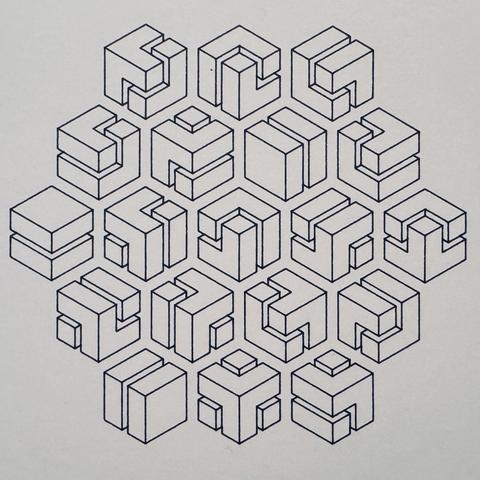
@ruuddotorg Could it be that some of them are the same, but the overall results is rotated?
It looks like the top left one, the one at the rightest right and the one in the center of the bottom line are the same. 👀
@meduz @ruuddotorg
:+1:
If you fully account for mirroring and rotational symmetry, only 3 ways remain I think
@ruuddotorg @RedRobyn @swoonie @meduz
I am trying to understand the rules...
The bottom middle one does not seem to have a rotated twin anywhere, but the bottom left one appears 3 times at different rotations. Why is this?
@ruuddotorg if you allow disconnected tetracubes you get 28 more possibilities, I think, made by three disconnected-tetracube-within-2x2-cube shapes:
(1) a 2 cube line and another parallel 2 cube line diagonally opposite it. 3 orientations (one per axis).
(2) three cubes in an L shape plus a disconnected cube diagonally opposite the corner of the L. 8 (choices of corner) * 3 (orientations of L) = 24 orientations, I think.
(3) four disconnected cubes. 1 orientation, I think.
@ruuddotorg argh, I think you have to divide the 24 orientations for (2) by some symmetry factor. I'm guessing in half but need to double-check...
EDIT: yeah, I think it's 12. you can generate them uniquely by starting with 2 pancakes (3 options) and then choosing one of the four corners in in the plane of their orientation to swap between the two pancakes. 3 * 4 = 12.
if this is right, that's 12+3+1 = 16 disconnected tetracube decompositions.
@ruuddotorg Reminds me of Piet Hein's Soma Cube!

@ruuddotorg Oh I've played with these shapes before!
Here's some experiments I made trying to organize these shapes. Note that my project excluded the "snake" shapes.
(The second picture is a flat representation of the first one, with top and bottom layers of each shape as two 2x2 pixels bitmaps.)


Could they be arranged in a sensible order in which the three with simple halves are 120 degrees apart?

Hey, that came out nice!
 meduz'
 The Tiller 🌈
 Robyn
Robyn Phosphenes
 Tikitu
 Mark Gritter
 Marty
Marty rntz
rntz Rue Mohr
 Jim Spath
 Andy Alderwick
 xanna
xanna Starxxon
 Franko
 Orion Ussner kidder
 John Carlsen 🇺🇸🇳🇱🇪🇺
 Sjoerd Visscher
 Martin Grider
 groff 🇺🇦
 Mister Dave
 🐙ptoothfish🐙
 Negative12DollarBill
 Florine