 Quilotoa
How far back in time can you understand English? This site goes back by centuries allowing you to test yourself.

 _haha_oh_wow_
I did better than I thought I would but by 1300 it was starting to get confusing.
And that’s just the reading part. Phonetic changes will make the spoken word unintelligible a bit ways before that.
Good thing I’m not a time traveler.
That was great, thanks for sharing! The þorn guy around Lemmy might learn from it a few more ways to be archaically misunderstood.
You mean Sân?
 joelfromaus
Yes, fâþer?
 Tetragrade
the porn guy
This was fun! Anyone know about the ſ character? How come in the 1600s it only sometimes seemed to take the place of s?
It’s purely stylistic, but here are the rules - https://en.wikipedia.org/wiki/Long_s#Rules

It looks almost like the old german “S”.
 5ibelius9insterberg
Some of the rules for the use of the long s from en.wikipedia.org/wiki/Long_s
Long s was always used (ſong, ſubſtitute), except:
- Upper-case letters are always the round S; there is no upper-case long s.
- A round s was always used at the end of a word ending with ⟨s⟩: his, complains, ſucceſs
- However, long s was maintained in abbreviations such as ſ. for ſubſtantive(substantive), and Geneſ. for Geneſis(Genesis).
- Before an apostrophe (indicating an omitted letter), a round s was used: us’d and clos’d.
- Before or after an f, a round s was used: offset, ſatisfaction.
It was often used for “f” as well, specifically in print to save money.
Towards the end of the article, they explain the same thing was done with using “y” to replace the letters that make the “th” sound (ð and þ) so instead of “the” or “ðe” you got “ye”
I muddled through the 1200s with context clues, and was still catching words in the 1100s, but gave up on the 1000s. It was too brutally yuele.
I would love to find an audio version to see how far I could get on spoken word alone. Being from the Appalachians, I’ve always been told our dialect is older.
Here is a similar thing in audio monologue:
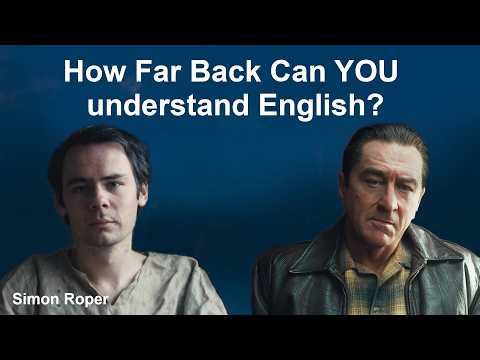
From Old English to Modern American English in One Monologue
1700 got a little hard and 1600 was mostly nonsense
Around 1200, I start having a little trouble, but I can still read most of it fairly well. 1100 is when I start to lose a lot of it, struggling through. 1000 is what I remember from trying to write papers on this stuff in University wherein I’d use translated copies side by side.
Maybe I can go back further than some others because I’m so damned old. 🤣
1300 was the end for me, at least reading at a reasonable pace. I might have squeezed out another century or two, parsing together context and other clues, but that is only through the benefit of knowing the story being told.
 __反いじめ戦隊
www.youtube.com/channel/UC4a9LfdavRlVMaSSWFdIciA
Rob words YouTube channel is amazing!

RobWords
Word facts and language fun. This is a channel for lovers and learners of English. It'll tell you where the words we use come from and why we say the things we say. YouTube sponsorships: [email protected] Rob's Agent: Antony Topping [email protected]
How far north of London can you go and still understand English?
 RebekahWSD
Dear lord I did poorly lol. And I use to read some middle English books for school!
 🌞 Alexander Daychilde 🌞
I got back to 1300 alright, but not 1200. But I had a bit of an odd upbringing - our houshold library for some reason had lots of British fiction from the 1700s/1800s and so I got a jump in obscure vocabulary. heh
This is all quite interesting, but did the farmer really offer the traveler his lusty hens?
No, þou ſtupid idiot, he proffered his luſty hens.^[:)]
About to 1400, then it starts to look more like Dutch or something. A few hundred years more and it starts to look like Danish or something. I bet it’s harder to understand verbally.
 Someonelol
Yeah same. I wonder how related were English and Dutch around that time period. It seems like the latter is still somewhere in that time period in speech and grammar style.

Talking to a Frisian farmer in Friesland with Old English
At a certain point it feels like reading math
It was a good thread here too: lemmy.world/post/43447694
I guess the nature of the fediverse means that some post duplication is necessary for exposure coverage, lol, so who am I to accuse a repost of not suitably linking the source.

 mlg
mlgJust reading text isn’t really a fair representation of the English language as you go back to beyond the 14th century. The grammar remains pretty similar if you sound it out and most vocab is similar (or can be figured out by context clues).
The non-standardized spelling and premodern characters make it feel alien but it’s mostly someone with a heavy accent using phonetics to write [approximately] what they’re sounding like. I bet most people wouldn’t struggle if the text was massaged a bit.
 OriginEnergySux
gets to 1500s “I get the gist, I reckon I could do this”
gets to 1400s
It’s easy if you know the rules - the fs that are s’s, the fact v and u were pretty much interchangeable and that prior to 1700 spelling was largely vibe driven
Yeah but i mean actually talking to someone lol. The reading I get but talking it in a convo? I reckon 1500s i just might barely be passable
I parse the first line of the 1400’s “But the man would me not abandon there, nor suffer me to pass forth. I might not flee, for his companions, of whom there were a great number, beset me about and held me fast that I should not escape.”
So…if you’ve read a pompous fantasy hack in your teens (and honestly who hasn’t) you’ll get by.
also the word douȝti suggests there’s a chunk of scots in there.
1300s I can understand.
1200s I can make out the odd word.
In my a-level English lessons we did a term on the Canterbury Tales and Middle English so we had to learn how to read it.
 Donebrach
 manigordo
It’s called class and style
As a person that is native Icelandic speaker, took Danish in school and speak Dutch it was really fun. I whish they kept going so it becomes more like Icelandic again.
Technically it’s more like Old Norse
Exactly, Icelandic is basically old norse with a spelling skin and different vocabulary. Most people take an least one class which involves reading old norse like Hávamál. en.wikipedia.org/wiki/Hávamál?wprov=sfla1
