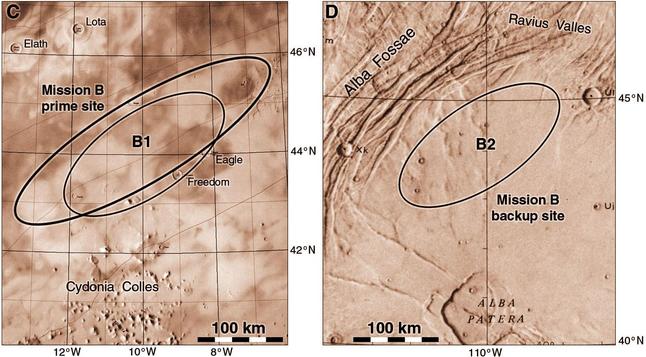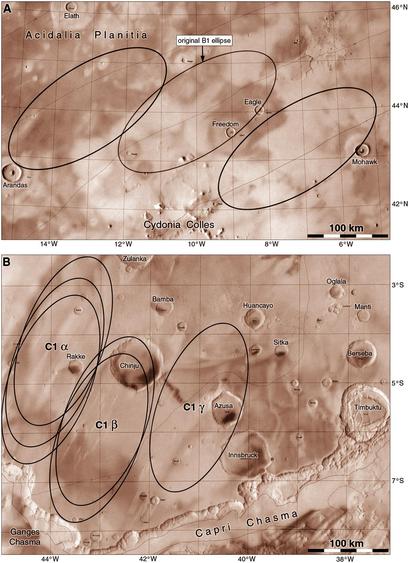
Last September I started a thread on Viking 1 which began with the Viking site selection process. Here we will pick up the story for Viking 2. Viking sites were chosen initially using Mariner 9 images and elevation data, and the final stage of that process produced these two sites for Viking 2, a prime site (B1) and a backup (B2). B1 is Cydonia and its most famous inhabitant lives in those hills (Cydonia Colles). B2 is a low volcanic rise now called Alba Mons.
#mars #maps #viking2
Viking Orbiter 1 took images to certify its potential landing sites, and then to look for a better one. After VL1 landed the orbiter could spend a bit of time looking at Viking 2 sites. B1 and B2 were at 44 north, hoping for more water than the VL1 latitude, but it was too far north for Earth-based radar to estimate surface roughness. At this stage new ellipses were already being considered for Viking 2 as we will see next.
#mars #viking2
Here we see sites considered by the Landing Site Staff on 17 July 1976, just before Viking 1 landed. C ellipses on the plateau above Capri Chasma had radar data and might be safe, but were they interesting?. New B ellipses might be smoother than B1 but more imaging would be needed. The landing site team were already tired after intensive work on Viking 1, but there was still much to do. The V2 latitude had to be decided before the second orbiter reached Mars on 7 August.
#maps #mars #viking2
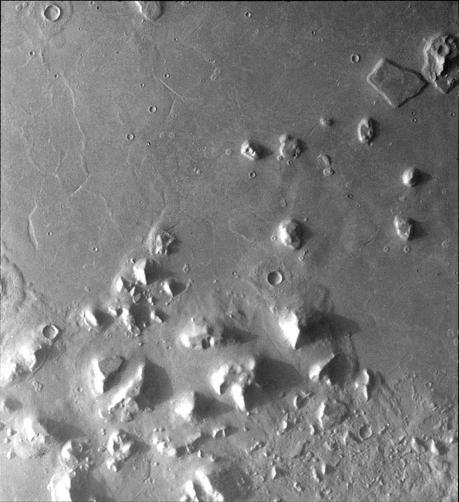
The images forming the background of those maps are USGS shaded relief drawings based on Mariner 9 images. Drawings made by supremely skilled artists using airbrushes. Viking gave much better pictures, so what did those Viking images look like? Here is a Viking Orbiter 1 image of Cydonia covering part of Cydonia Colles, south of the B1 ellipse. Above centre is a little hill with a face. Let the fun begin! Otherwise the area is interesting but with too many hazards.
#mars #viking2
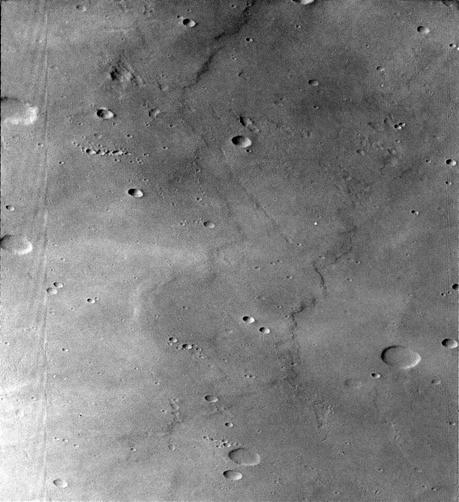
Is Capri any better? Here is another Orbiter 1 image in the C1 Beta (middle) ellipse on the map posted yesterday. This is a safer landing site but too boring to excite the mission scientists. The driving factor in choosing a site was evidence of water - there is no evidence here. At Cydonia the plains were thought to be sediments deposited by water flowing from huge channels further south. This early survey was not encouraging.
#mars #viking2
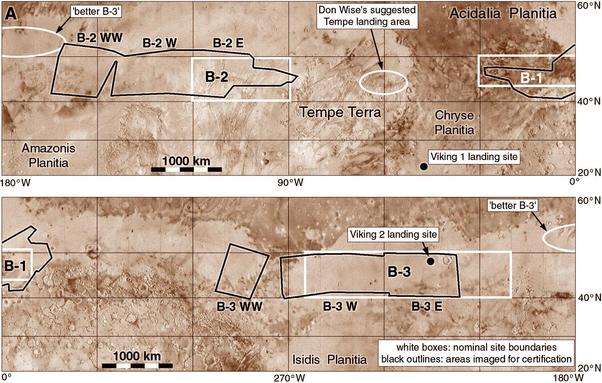
Viking 2 needed much more data to help find a good site. The northern latitudes were seen less well by Mariner 9 so new Viking images were essential. The 44 degrees north region was chosen over the southern latitude band and the images started to pour in. Much of the latitude band all around the planet was searched as shown here. This map shows broad landing areas, any one of which might hold many potential ellipses. They all needed analysis...
#mars #maps #viking2
Geological interpretations and hazard mapping were essential to find a safe site. This put an enormous strain on the landing site team who worked under pressure of having to land no later than early September 1976 so a 'primary mission' of reasonable length could be completed before conjunction in late November. Around conjunction Mars is behind or very close to the Sun and communication is curtailed. The stakes were very high and time was short.
#mars #viking2
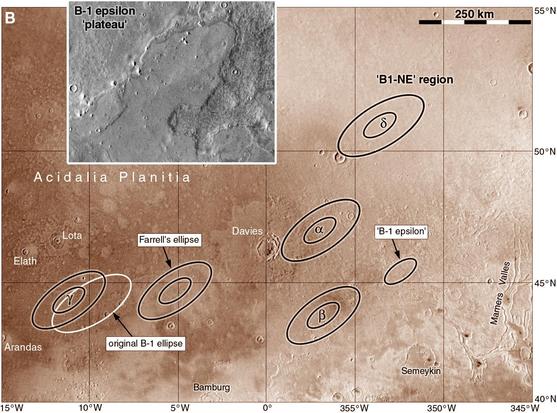
Let's take a look at some Viking 2 candidate sites after all this imaging. Here is the B1 region. New ellipses are shown with an outer ellipse (99% chance of landing within it) and a smaller inner ellipse (50% chance of landing within it). The outer ellipse was 130 by 50 km, the inner one 52 by 20 km. None of them were safe enough. The only possible site in B1 was that little Epsilon ellipse, a 50% ellipse which just about fits on a smooth plateau shown in an inset image.
#mars #maps #viking2

At a meeting on 16 August 1976 (a few days before the Viking 1 landing) Hal Masursky said the B1 site was 'semi-catastrophic'. Next we will check out the B2 region. But it's not going to be good news.

EDIT: What??? Nobody picked me up on that mistake - VL1 landed on 20 July 1976, so that meeting was well after the landing. Let's pretend I didn't say it.
#mars #viking2

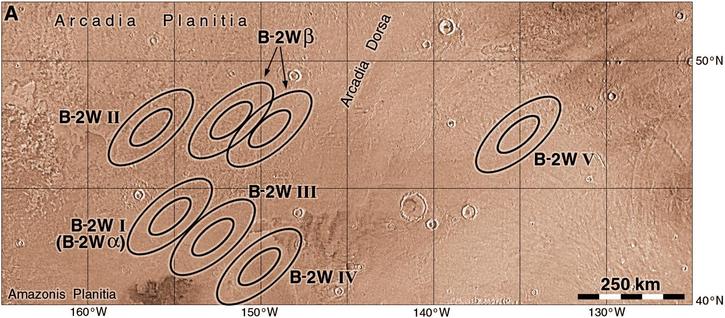
Here is a map of Viking 2 site B2 and you can see several ellipses were investigated. On 17 August 1976 JPL's Gentry Lee ruled them all out. None were smooth enough. What follows is - to me - quite extraordinary. The landing site group decided to go for B3 even though there were no useful images of it yet. If that failed they would take a chance on B1-epsilon, that little plateau seen earlier. This was a very tense time.
#mars #maps #viking2