 GregoryP
 Gro-Tsen
Here's a mathematical fact which I find amazingly counter-intuitive:
There exists a polytope (=the convex hull of a finite set) in ℝ⁴ which is not combinatorially equivalent to one with rational vertex coordinates (=the convex hull of a finite subset of ℚ⁴)!
🤯
•1/4
 Mark Dominus
@gro-tsen.bsky.social What prevents one from perturbing the vertices to points with rational coordinates by sufficiently small amounts that the topology is unaffected?
 Oscar Cunningham
@mjd @gro-tsen.bsky.social If you perturb the vertices of a quadrilateral, how do you guarantee that they remain coplanar? In fact I'm not surprised that this doesn't hold in 4 dimensions so much as I'm surprised that it does hold in 3 dimensions.
 Simon Tatham
@OscarCunningham @mjd @gro-tsen.bsky.social ... I think I begin to see. If you have a face of degree > 3, then perturbing its vertices might leave it nonplanar. My knee-jerk answer is to instead perturb the face normals instead of the vertices. But that's only doing the same thing in duality, so you have the flip-side problem that a _vertex_ of degree > 3 might separate into two vertices.
So if you had a solid in which all faces had degree 4 or more, and so did all vertices, you might manage to arrange that either kind of perturbation destroyed one or the other.
Except that that doesn't work in 3 dimensions, because those constraints are incompatible with Euler's formula.
But in four dimensions, Euler's formula isn't quite the same. So presumably the answer is that it _does_ permit the analogous lower bounds to coexist?
@simontatham @mjd @gro-tsen.bsky.social What if a polyhedron has some vertices of degree 3 and some of degree > 3, and likewise for faces? I don't see why we could find a perturbation that works in that case.
@gro-tsen.bsky.social Are any examples known? Or if not, is there a lower bound on the number of vertices required?
 Gro-Tsen (temp account)
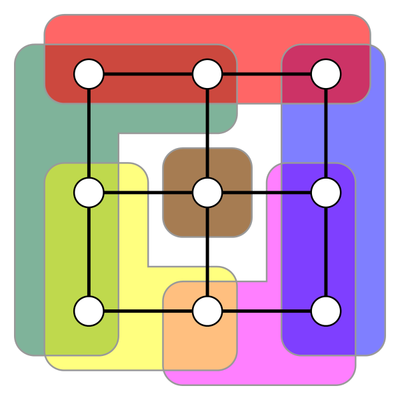
@mjd @gro-tsen.bsky.social There seems to be an explicit construction with 33 vertices (theorem 9.2.1 in Richter-Gebert's book), but I admit I've only glanced at it.
 0xDE
0xDE@gro_tsen_test @mjd @gro-tsen.bsky.social Moritz Firsching has enumerated 274148 combinatorial types of 9-vertex 4-polytopes and found rational coordinates for all of them, so any irrational 4-polytope needs at least 10 vertices: https://arxiv.org/abs/1803.05205 . There is still a big gap between 10 and 33, though.

The complete enumeration of 4-polytopes and 3-spheres with nine vertices
We describe an algorithm to enumerate polytopes. This algorithm is then implemented to give a complete classification of combinatorial spheres of dimension 3 with 9 vertices and decide polytopality of those spheres. In particular, we completely enumerate all combinatorial types of 4-dimensional polytopes with 9 vertices. It is shown that all of those combinatorial types are rational: They can be realized with rational coordinates. We find 316014 combinatorial spheres on 9 vertices. Of those, 274148 can be realized as the boundary complex of a four-dimensional polytope and the remaining 41866 are non-polytopal.
 jcreed
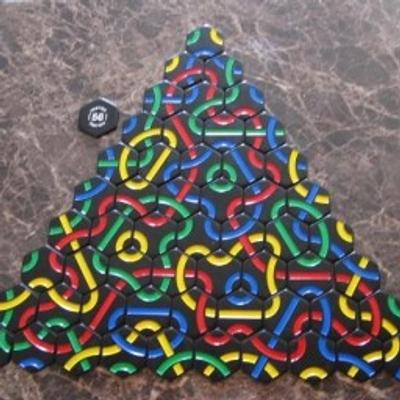
@gro-tsen.bsky.social I found this very strange, too... https://en.wikipedia.org/wiki/Perles_configuration "In polyhedral combinatorics" seems to be the referent in case you want to dig into it

 domotorp
@jcreed @gro-tsen.bsky.social Nice! I find this believable, and after this I can also believe the result about the polytope.
@domotorp @gro-tsen.bsky.social can you say more about why you find it intuitive? I guess given polytope faces that *aren't* simplices I can't move vertices independently to the nearest rational point without necessarily "breaking" a face... but the rationals are dense! Surely there's so many rationals around to choose from! :)
 mauvedeity
@gro-tsen.bsky.social you lost me at “:”.
 Moritz Firsching
@gro-tsen.bsky.social
All 4-polytopes with up to 9 vertices can be realised with rational coordinates, see
https://firsching.ch/papers/j006-enumeration-of-4-polytopes.html
I think the smallest explicitly known example of a 4-polytope that cannot be realised with rational coordinates has 33 vertices (unless I missed some more recent development). So it is an open question what the smallest number of vertices of a non-realisable 4-polytope is!
The complete enumeration of 4-polytopes and 3-spheres with nine vertices
We describe an algorithm to enumerate polytopes. This algorithm is then implemented to give a complete classification of combinatorial spheres of dimension 3 with 9 vertices and decide polytopality of those spheres. In particular, we completely enumerate all combinatorial types of 4-dimensional polytopes with 9 vertices. It is shown that all of those combinatorial types are rational: They can be realized with rational coordinates. We find 316014 combinatorial spheres on 9 vertices. Of those, 274148 can be realized as the boundary complex of a four-dimensional polytope and the remaining 41866 are non-polytopal.