
nonplused by this passage as I am.)

Well. So far as I understand it, “this principle of numeric organization” — this fractal, nested way of assembling people, whether in militaries or labor formations, and divvying them up into functional groups — has to do with enabling a hierarchical practice of command and control. You don’t, and can’t, command a single formation of 10,000 — but you *can* issue orders to five divisional COs, who direct their battalion commanders, and so on down the chain.

And in this way, the whole unwieldy mass begins to move, with relative swiftness and cohesion. The whole thing depends on “the chain of command.”

What D&G want us to accept, though, is that this whole organizational logic was captured by the State from *nomads* who dispose of their available number “vortically,” in smooth space. How do they intend to convince us of this seemingly rather stark reversal?

With an appeal to history, evidently! “It was the Hyksos, conquering nomads, who brought it to Egypt; and when Moses applied it to his people in exodus, it was on the advice of his nomad father-in-law, Jethro the Cinite, and was done is [sic] such a way as to constitute a war machine, the elements of which are described in the _Book of Numbers_.”

The Britannica tells us that the Hyksos were “a dynasty of Palestinian origin that ruled northern Egypt as the 15th dynasty” (the word “Hyksos” itself

was “in fact probably an Egyptian term for ‘rulers of foreign lands’ [heqa-khase].”) And, per the same source, they did indeed bring with them to their project of rule in Egypt military-organizational technologies founded on the horse, chariot and compound bow. So far, D&G’s account bears out.

As for Jethro’s advice to Moses, the Biblical account is in Exodus 18, verses 13-26. Here’s the King James version, which I obviously prefer:

“17 And Moses' father in law said unto him,

“The thing that thou doest is not good.

18 Thou wilt surely wear away, both thou, and this people that is with thee: for this thing is too heavy for thee; thou art not able to perform it thyself alone.

19 Hearken now unto my voice, I will give thee counsel, and God shall be with thee: Be thou for the people to God-ward, that thou mayest bring the causes unto God:

20 And thou shalt teach them ordinances & laws, and shalt shew them the way wherein they must walk, & the work that they must do.”

“21 Moreover thou shalt provide out of all the people able men, such as fear God, men of truth, hating covetousness; and place such over them, to be rulers of thousands, and rulers of hundreds, rulers of fifties, and rulers of tens:

22 And let them judge the people at all seasons: and it shall be, that every great matter they shall bring unto thee, but every small matter they shall judge: so shall it be easier for thyself, & they shall bear the burden with thee.

23 If thou shalt do this thing,

“and God command thee so, then thou shalt be able to endure, and all this people shall also go to their place in peace.

24 So Moses hearkened to the voice of his father in law, and did all that he had said.

25 And Moses chose able men out of all Israel, and made them heads over the people, rulers of thousands, rulers of hundreds, rulers of fifties, and rulers of tens.

26 And they judged the people at all seasons: the hard causes they brought unto Moses,

“but *every small matter they judged themselves*” [emphasis added].

What is this other than a perfectly concrete account of the delegation of authority? Indeed, of the *distribution* of decision power to the lowest possible echelon? There’s a suppleness and agility to this way of doing things that — per Jethro’s word-for-word advice — doesn’t merely make a formation organized in this way “able to endure,” but gives it a massively improved ability to sweep the horizon for emergent situations,

and devise countertactics intended to help it maintain initiative and advantage. (Indeed, doctrinally, this reliance on pushing decision authority down to the corps of noncommissioned officers, i.e. corporals and sergeants, is ultimately derived from the Prussian von Steuben’s “Blue Book,” and it’s what distinguishes the US Army from its nominally stodgier and more micromanaged Soviet and post-Soviet competitors.)

So Jethro’s advice to Moses represents the moment at which a nomadic or minor

lineage injects its immanent diagram of organization into the State structure emerging among the people of the Law.

Now Jethro is *not* Hyksos, true. But he is a Cinite, or Kenite: a non-Israelite, of a people whose name etymologically connotes their origin as a band of itinerant metalsmiths (!). As an embodied carrier of pragmatic nomad mētis, Jethro is a line of flight by way of which this practice of distributed delegation makes of the Israelites for the first time a war machine.

That’s a ton to get our heads around, so let’s hold there for now, and return to this set of questions tomorrow.

For now, as always, notes:

- Here’s the whole Exodus 18, if you want to get a sense of the context in which this conversation is supposed to have happened:
https://www.biblegateway.com/passage/?search=Exodus%2018&version=KJV

- Here’s Britannica on the Hyksos:
https://www.britannica.com/topic/Hyksos-Egyptian-dynasty

Bible Gateway passage: Exodus 18 - King James Version

When Jethro, the priest of Midian, Moses' father in law, heard of all that God had done for Moses, and for Israel his people, and that the LORD had brought Israel out of Egypt; Then Jethro, Moses' father in law, took Zipporah, Moses' wife, after he had sent her back, And her two sons; of which the name of the one was Gershom; for he said, I have been an alien in a strange land: And the name of the other was Eliezer; for the God of my father, said he, was mine help, and delivered me from the sword of Pharaoh: And Jethro, Moses' father in law, came with his sons and his wife unto Moses into the wilderness, where he encamped at the mount of God:

Bible Gateway

- Here’s “Regulations for the Order and Discipline of the Troops of the United States,” better known as the “Blue Book” of Friedrich Wilhelm Ludolf Gerhard Augustin Steuben of Prussia, Baron von Steuben. https://ig.army.mil/Portals/101/Documents/IG%20History/Von-Steuben-Blue-Book.pdf

- And here’s an April 1989 CIA overview of the contrasting Soviet doctrinal approach to military organization, so you can get a sense of what *non*-delegation looks like in practice:
https://www.cia.gov/readingroom/docs/DOC_0000499601.pdf

See you tomorrow for more “Nomadology”!

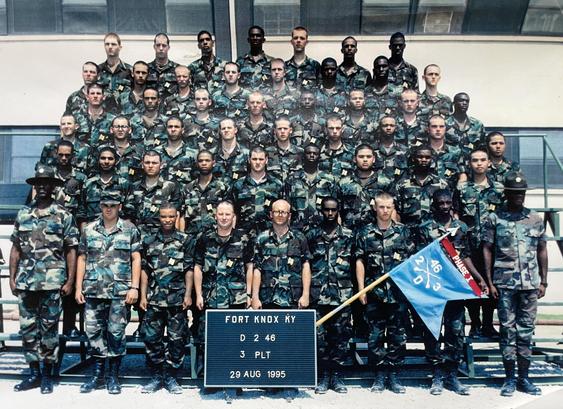
Oh, and as a little illustration of the deterritorializing (and reterritorializing!) power of Number, here’s a picture of the third platoon of Delta Company, 2/46 Inf, during Basic Training at Ft Knox, KY, in August 1995. A war machine we were not. See if you can spot ys tly!
And apropos of what we were discussing awhile back, on haecceities and the navigation of smooth space, here’s piece on the neuroscience of becoming a Marshallese ri meto, or person of the sea: https://www.nytimes.com/2025/11/18/science/neuroscience-brain-navigation-marshall-islands.html
A Voyage Into the Art of Finding One’s Way at Sea

Scientists and Indigenous sailors in the Marshall Islands are studying seafaring and the human brain.

The New York Times
When we last saw D&G, they were telling us of the connection they perceived between the Number and the war machine. And they were using Number as something more than a synonym for “multiplicity” or “multitude”: they’d identified a specific organizational technology that was developed among nomads, eventually captured by the State, which was the fractal system of units of a given order of magnitude of numeric strength nested within larger ones, for a few successive, cascading echelons of command.
I think we can dismiss their assertion that “the *nomos* is fundamentally numerical, arithmetic,” on the logic that “arithmetic and algebra arise in a strongly nomad-influenced world.” Not only is this a weak confoundment of correlation with causation, but it’s a case of them trying to have their cake and eat it too. (If “Indo-Arab arithmetism” arises out of the nomad’s experience of the smooth space of the desert, how does mastery of the smooth space of the sea somehow avoid conditioning its

counterpart “Greek geometrism”?)

But what follows feels like it’s on somewhat firmer ground, not merely logically but anthropologically. They set out their argument by noting that historically there have been “three major types of human organization: *lineal*, *territorial*, and *numerical*” (emphasis in original). The lineal is a more or less straightforward matter of descent, cosanguinity and matrimonial alliance; such “lineages are essentially segments in action,” which “meld and divide, and

“vary according [sic] the ancestor considered, the tasks and the circumstances.” Neither number nor territoriality, of course, are absent from the question of lineage — “The earth is before all else the matter upon which the dynamic of lineages is inscribed, and the number, a means of inscription” — but this type of organization seems to suffice for pre-State societies.

“Everything changes” with the coming of the State, though (and remember, we mustn’t fall into the trap of understanding this

as a developmental or evolutionary matter). With the State, “the territorial principle becomes dominant.” By the same token, though, “[o]ne could also speak of deterritorialization, since the earth becomes an object, instead of being an active material element in combination with lineage.”

I’m frankly not sure about this latter assertion — i.e. that the earth constitutes an agential determining factor in all lineal relations — though I can certainly see it operating in some, or even many. There

will be a specific relation with the land at the root of many decisions to settle in a given place and initiate a lineage there: sure. But invariably? That’s a more complicated matter. Let’s accept this for the sake of argument, though, because the contrast with what the State makes of the land is vivid and illustrative.

The State, after all, is concerned with lineation, with the striation of territory, with the assertion of (both collective and private) property rights. And what is property

other than “precisely the deterritorialized relation between the human being and the earth.” There’s a shimmering, alternating-aspects-of-a-Necker-cube quality to this compound assertion: we’ve learned to associate “deterritorialization” with the figure of the nomad, and the State with the opposite tendency, but if there is anything we can say lifts a place away from itself it is its definition in State law as the abstraction we call “real estate.” This constitutes a potent reminder that, for

all a shallow Deleuzianism might ascribe a positive value to deterritorialization, the only thing we can validly say about it when compared to territorialization is that it opens onto an alternate set of affordances, operations and possibilities, “not better, but different.”

Ready for another whiplash reversal? The State may deterritorialize the land by subjecting it to the inscription of abstract property relations, but what “moves to the forefront” w/its coming is nevertheless *territorial*,

“in the sense that all the segments, whether of lineage, land or number, are taken up by *an astronomical space or a geometrical extension* that overcodes them” (emphasis in orginal), though “not in the same way in the archaic imperial State and in modern States.”

I’m somewhat sympathetic to those who might want to hurl the book against the nearest wall at this point. Is the State territorial in its effects, or deterritorial? And now that you’ve opened up the question of historical variation

between States, are all States of a similar historical epoch similar, or is there a degree of variation between their coeval practices? I can see that there might be real analytic value to be found in suppressing societies’ actual degree of variation in space and time, and therefore rendering them somewhat schematic, *if* there’s insight that emerges from the exercise. But it certainly flies in the face of the idea that we should be “following” the traits and haecceities of each given social

grouping, and in any event it doesn’t work quite so well as a technique for the generation of insight when you only permit yourself local consistency. Or so it seems to me.

But sure, let’s accept that, while *property* may be a deterritorializing operation — and that the State has an intimate and indeed definitional relation with property — the State itself is a fundamentally territorializing order, as D&G have heretofore defined that term. We’ll see what that implies...tomorrow.

We’re back onto somewhat firmer ground with the assertion that “[a]rithmetic, the number, have always had a decisive role in the State apparatus” and that this was the case “even as early as the [presumably Roman?] imperial bureaucracy, with the three conjoined operations of the census, taxation and election.” We know that, throughout recorded time, numeration wherever it appears is closely linked to the will to control, so this feels like a fairly uncontroversial stake to place in the ground.

And if this was true of empire from classical antiquity through the age of steam, it is triply so for the modern State, “which in developing utilized all the calculation techniques that were springing up at the border between mathematical science and social technology.”

There’s a vaguely Foucauldian flavor here, of calculational and statistical techniques being applied to the management of whole populations — one thinks of Gompertz and Quetelet and Guillard, and then the roughly simultaneous

appearance of the Hollerith machine and modern demographics.

And thus, D&G tell us, “the number has always served to gain mastery over matter, to control its variations and movements, in other words to submit” these things — very much including “the ultimate matter constituted by the human population” — “to the spatio-temporal framework of the State.” Again, we should be thinking of state-istics.

It feels like a special case of Idealism, this notion of flows of matter, energy, information and

people pushed hither and yon around the ecumenon by manipulations of nothing more concrete than number. And it’s true: you don’t have the Atlantic slave trade or the Holocaust without continuous, task-driven innovation in tabulation, double-entry accounting, risk assessment and modeling. Number here seems agential — and quite malevolently so, at that.

But here they make a curious assertion: “We do not believe that the conditions of independence or autonomy of the Number are to be found

“in the State, even though all the factors of its development are present.” What I take them to be arguing here is that there is something about the structurating properties of Number that precedes or exceeds the order of State. And so far in this book, things which are exterior to the State apparatus in this way are generally figured to belong to the war machine. Let’s see if that turns out to be the case here.

“The *Numbering Number* [emphasis in original, and Massumi furnishes the gloss

‘Nombre nombrant’], in other words autonomous arithmetic organization, implies neither a superior degree of abstraction nor very large quantities. It relates only to conditions of possibility constituted by nomadism, and to conditions of effectuation constituted by the war machine.”

Got that? It may well be with the State that the problems imposed by very large quantities or particularly high degrees of abstraction appear...but the autocatalytic, self-organizing capacity of Number, the number

that numbers, indeed arises in and from the outside.

This, at first blush, might seem to be another one of those definitional games of bait & switch D&G so often play, where they define something as “royal” or “minor” at will, as it benefits them locally, and then say much the opposite somewhere else in the text. But here it feels like they’re onto something: Number as a strange attractor, lying only partially across human conceptual grids, and uncannily pulling the systems we devise toward it.

That, it seems to me, is a true, icy glimpse of the thought from outside. Perhaps the State itself is epiphenomenal, this thought seems to say: a mere dance of iron filings tugged into shape by the occult movements of something unseen, something with too many or too few dimensions to intersect our world in any way we’re capable of recognizing.

This gives me a better sense of what they mean by Numbering Number, OK, but once granted that the question becomes what they intend for us to do with it.

That’s a question we’ll leave for tomorrow. For now: notes!

- The “Gompertz curve” is a mathematical function devised by London actuary Benjamin Gompertz in 1825. Here’s a 1995 paper about its use in predictive domography. https://pubmed.ncbi.nlm.nih.gov/8867525

- We have the 19th century Belgian statistician Lambert Adolphe Jacques Quetelet to thank for the notion of a “body mass index.” Here’s Quetelet on the question of obesity and the notion of “the average man”: https://pubmed.ncbi.nlm.nih.gov/17890752/

The Gompertz equation as a predictive tool in demography - PubMed

The Gompertz demographic model describes rates of aging and age-independent mortality with the parameters alpha and A, respectively. Estimates of these parameters have traditionally been based on the assumption that mortality rates are constant over short to moderate time periods. This assumption is …

PubMed

- Human statistics as an independent field of inquiry comes into its own with the Belgian statistician Achille Guillard, and his 1855 “Elements of Human Statistics or Comparative Demography.” Here’s a contemporary overview of the way in which Guillard’s demography began to influence policy: https://www.jstor.org/stable/jj.13473644

- The go-to source for accounting & the Atlantic slave trade is Caitlin Rosenthal’s 2018 “Accounting for Slavery: Masters and Management,” which is here: https://annas-archive.org/md5/86e571cafea309d9d259f0816b373966

Demography and the Making of the Modern World: Public Policies and Demographic Forces on JSTOR

John Rennie Short critically explores the implications ofdemographic change from a social and economic perspective andconsiders what this means for public polic...

- Similarly, the canonical source on the Nazi use of the most advanced available data-processing techniques in prosecuting the Final Solution to the Jewish Question is Edwin Black’s “IBM and the Holocaust,” available in full here: https://monoskop.org/images/b/bf/Black_Edwin_IBM_and_the_Holocaust_The_Strategic_Alliance_Between_Nazi_Germany_and_Americas_Most_Powerful_Corporation.pdf

I’ll see you right here for more of that tasty Nombre nombrant tomorrow.

So, #nomadology fans, when we left off our inquiry in mid-November we were just getting into the question of the “nombre nombrant,” the “Numbering number,” and trying to get our heads around what Deleuze & Guattari meant us to understand by their use of the term.

And we’ve been told that this mysterious thing “relates only to conditions of possibility constituted by nomadism, and to conditions of effectuation constituted by the war machine.”

But in every other way, the term seems to invoke processes that would appear to belong *entirely* to the State as D&G have asked us to conceive of it. It’s an apparatus of ordering, capture and legibility, that counts in order to govern, enumerates to classify, rank and fix identity. It’s *metricization as power*.

But these properties are anathema to the war machine as we’ve been given to understand it!

So if the Numbering Number indeed “relates to the conditions of possibility constituted by nomadism,” maybe we have to turn the proposition before us inside-out in order to grasp the point D&G are trying to make: yes, the Numbering Number relates to the conditions of possibility constituted by nomadism *for its Other*, i.e. for the State apparatus.

It’s a bit of a stretch, maybe, but frankly, this is the only way I can make sense of this passage. (Either that, or what is of course always the alternative possibility: that I haven’t understood them. Other sources suggest that the Numbering Number is linked to the production of differences and becomings, which I have a far easier time connecting to the figure of nomad thought, but a harder time finding justification for in the text.)

So let’s read on, and maybe this gets clearer?

We’re back in the context of smooth space, and how it may be occupied, where we are told that the Nombre nombrant appears “as soon as one distributes something in space, instead of dividing up space or distributing space itself. The number becomes a subject.”

Here, maybe, is a place where a command of French would be genuinely helpful, because it seems to me that what D&G mean for “Nombre nombrant” to convey is something contained in Massumi’s English translation *along with its diametric opposite*.

We’re in Necker-cube territory again! In English, “the Numbering Number” can be read *both* as “the number which numbers” *and* as “the number caught in the process of numbering itself,” “the number becoming number.”

The distinction feels closely cognate with the one Spinoza makes between “natura naturans,” active and autonomous nature considered in the continuous process of naturing, and “natura naturata,” nature-as-product.

And this really helps, because now it’s much easier to see how the Numbering Number *as the number in the process of numbering*, doin’ the numbering thing, is something one could think of as belonging to the order of the smooth, the nomadic and the war machine. Now it’s much easier to

grasp the point of this sequence. (It’s frustrating to run up against the limits of one’s own language that way, but then there’s something salutary and instructive about that, too.)

Let’s leave things there for today? And in the meantime, we can enjoy this exploration of the vortical qualities of number in its occupation of space:

https://www.youtube.com/watch?v=mTr_HS_O4Ek

See you for further adventures in #nomadology tomorrow!

Sesame Street: Pinball Animation Countdown Compilation

YouTube