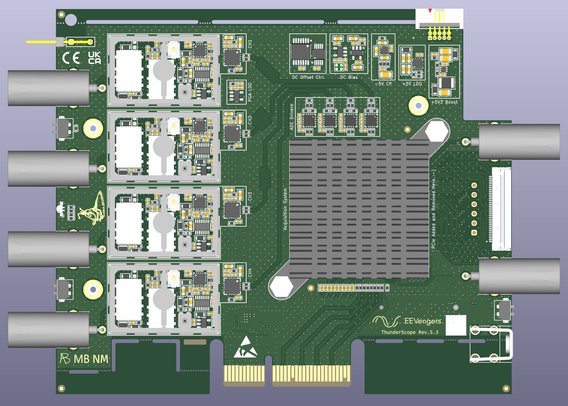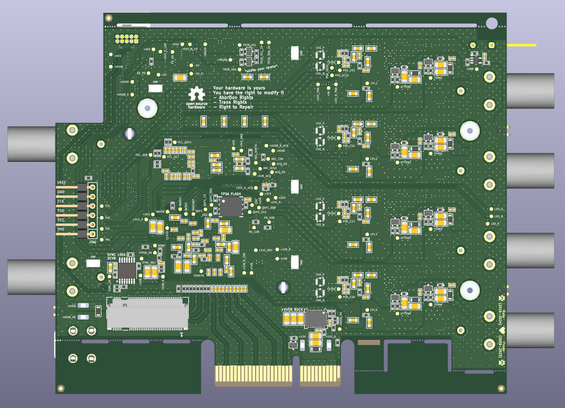
Just finished the last bit of polish on the (hopefully final) revision of ThunderScope!

I'd appreciate some extra eyes on it If anyone has the time and the interest

https://github.com/EEVengers/ThunderScope/tree/Rev5.3/Hardware/KiCad/Thunderscope_Rev5.3

ThunderScope/Hardware/KiCad/Thunderscope_Rev5.3 at Rev5.3 · EEVengers/ThunderScope

ThunderScope GitHub Repo. Contribute to EEVengers/ThunderScope development by creating an account on GitHub.

GitHub
I'm so proud of how this thing looks, and what it stands for (you'll have to look into the design files to catch all of the easter eggs :3)

@aleksorsist gorgeous board!

only detail that made me raise an eyebrow is that those top side diffpair meanders from ch1, ch2, and ch3 look pretty tightly packed, so I'd worry a little about elevated ISI if the meander length reaches >10% of a wavelength.

@gsuberland makes sense, I haven't actually heard this rule of thumb before, so thanks for the heads-up! These signals have a 500MHz analog bandwidth so it should be well under that threshold, but I will keep this in mind for digital stuff, those sharp edges really don't mess around
@aleksorsist yeah the issue with having meander lane spacing roughly equal to pair spacing is that you get a similar coupling coefficient from P to P and N to N when they fold back past themselves. if your wavelength gets short enough that the distance is no longer lumped then you get "skipping" where the propagating wavefront induces a signal in the adjacent forward segment, and a similar issue with reverse propagation in the prior segment, which degrades S11 and S21, and causes ISI.

@aleksorsist of course if the distance is lumped then each adjacent segment is essentially at equipotential so nothing gets induced and it isn't a problem.

(this is less impactful when your height to refplane is much smaller than the trace to trace spacing, since the fields mostly couple to the refplane and far less between the P/N traces)

@aleksorsist this is one of the reasons why zigzag (or rounded zigzag) meanders are often preferred over harepin or trombone meanders on really fast stuff; there's no "fast path" for signals to couple over and shortcut ahead. but there's a trade-off with board area.

(the other reason is it gives you some natural immunity to fiber weave effects messing up your intrapair skew)

@gsuberland that's really neat, I've yet to have to design anything fast enough to really need to worry about this effect or weave but I'm hoping I'll get there soon!

@aleksorsist :D

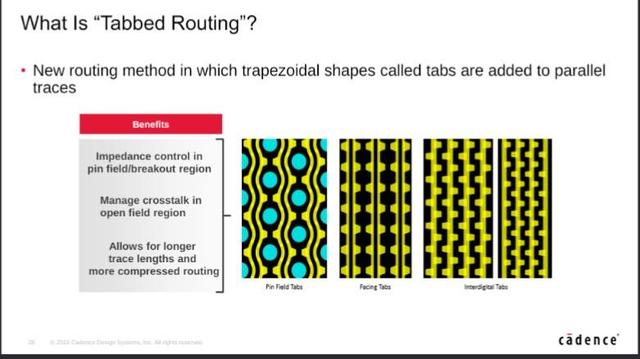
another fun one to look up in this area is interdigital and tabbed routing. they're primarily used during BGA fanout to balance impedance and avoid phase skew between the P & N traces in curved areas. for really fast stuff you can't just pay attention to overall intrapair timing skew, you also have to consider the phase skew at all points along the trace. matching phase with single-sided trombone meanders takes up too much space, so tabs/digits get used to speed up the slow leg.

@gsuberland very neat, kinda similar to the patterns and shapes used for really high frequency RF (which this pretty much *is*)
@aleksorsist yup, all the same principles of distributed element filters apply!
@aleksorsist @gsuberland If you would like a visual representation of these principles. There is a video demonstrating this in Simbeor at around 8:40 https://www.youtube.com/watch?v=OQx3habvfgM
Crosstalk in microstrip lines and how to reduce it

YouTube