I know that this is a citation but I can't help but read it as "Friendships are about a mutual concern for one another *side-eye* ARISTOTLE."
quote is from this article
https://link.springer.com/article/10.1007/s11023-025-09757-6 which is good as far as it goes, but I think the authors fall prey to the same misleading "conceptual borrowing" that they decry by attributing intentionality to "chatbots" in any way. e.g., in the case where a person uses chatgpt to generate an apology to someone, "the algorithm" is not "apologizing" on behalf of that person—instead we have a text that *results from* a computational tool, which was itself made by people with intentionality

Losing Our Voice? Generative AI and the Degradation of Human Expression - Minds and Machines
This paper examines the implications of generative AI (GenAI) emulating human expression, i.e. human communication and human creative expression. While Gen
more specifically, I think an apology "generated with gen AI" fails not because it's written "by an algorithm" (i.e., a non-person entity who is not the apologizer), but because it's essentially co-written by the people who made the tool, whose *stated purpose* is to make it possible to generate things that look authentic but are not, using statistical prediction. this feels like splitting hairs, i guess, but i think it's important to trace that part of the authorship
likewise, the authors write "authorship requires the ability to take accountability for the work. This requirement excludes GenAI." this is only true if you understand "GenAI" as the agent in question, somehow, instead of the people who made the gen AI tool, who *absolutely* can be held accountable for the work. gen ai art sucks not because it has "no author" but because it's co-created by the people who made the gen ai software/model, who have sucky opinions about art
i'm just saying that it's weird to propose "the algorithm" or "the chatbot" as an "author" when we already have a perfectly good paradigm for dealing with artifacts that result from the use of particular tools (computational or not), which is to trace the material and historical underpinnings of the tool—who created it and why—and how the tool is deployed by particular individuals. works for gen AI as well as it works for a word processor or a chain saw or whatever imo
(but allison, you might say, surely the effect of any one individual who contributed to gen AI software or training data is too diffuse to matter or be traced! to which i say horsèd-shit. if we can make celebrities out of gen AI CEOs and pay gen AI engineers nine-figure salaries and literally make a database of people who are owed money because their books were included in the training data, we can talk concretely about individual agency on the part of gen AI tool creators)
 allison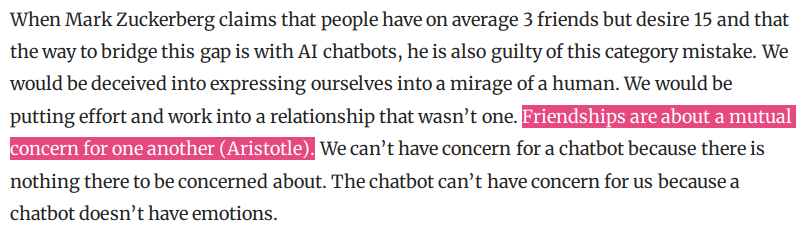
 chris martens
 Lea
Lea Eli the Bearded