 fossilesque
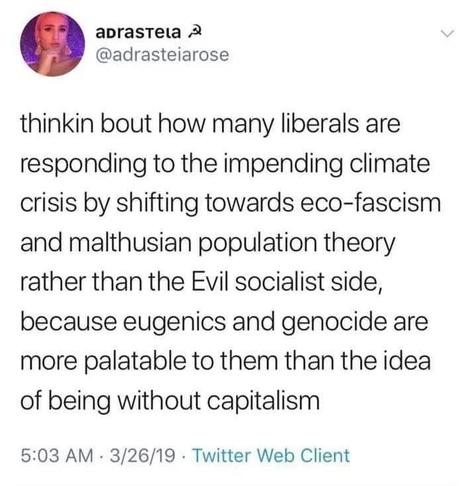
all my homies hate eco-fascists
Sorry if this is the wrong place to ask. Double checked the rules and it doesn’t look like I’m violating any, but please point me in the right direction if there’s a better place for my questions. I genuinely am unclear and want to learn.
In this context, what are eco-facsists? And then how does that and Malthusian Population Theory inherently relate to Capitalism?
When I imagine Malthusian Population issues, I normally think of it as a left-wing / anticapitalist talking point. Assuming I’m missing the mark on that, what’s the Socialist proposed solution and/or explanation or why that’s not an issue? (Racked my brain for a better wording for that last sentence, but couldn’t think of one on the fly. Please pardon my ignorance if there’s a different phrasing I should have used).
See and that feels like baby steps towards some flavor of eco authoritarianism (which I suppose I may be conflating with eco-fascism; to me, those both seem bad and in comparable measures).
You seem to be proposing that there is a system (ecologic + economic) that allows for humans to live sustainably at our current-ish population while being mostly free to live their lives with their communities as they see fit and at (at least) a modest level of prosperity.
If there is such a system that doesn’t lean into authoritarianism, I’m unfamiliar with it.
I think it will be difficult to ensure all three of those points (current population + non-authoritarian government + modest living conditions). While I agree Capitalism and Liberalism aren’t doing good on maintaining those three point (gods, are they doing so bad on those three points), I’m unclear what the Leftist suggestions are to fix them.
If you/others here have points that could fill in my gaps of understanding, be interested to hear them. (I worry I’m going to be taken as a Liberal infiltrator, but I feel I know little of the more concrete aspects of Leftist politics and am trying to learn).
For example, the government makes a top down decision to heavily invest in cheap or entirely free public transport, invest heavily in cycling infrastructure, ensures urban planning means that (where possible) you’re never more than a short bicycle ride away from a supermarket (so called 5 minute cities), does its best to ensure it’s affordable to live near your work, bans cars from city centres (with obvious exceptions), increases taxation on fuel, and increases taxation on new vehicles.
Perfectly feasible, because it’s been done in plenty of countries and cities. Vastly better for the environment and much more efficient too, because the population isn’t wasting so much time and money driving from point A to B. People are invariably much happier too, because they get more exercise, waste less of their lives in traffic, aren’t wasting money on car ownership, and suffer less from the effects of air and noise pollution.
The polar opposite of the US, where the car industry had and still has a disproportionate influence on politics, and very unpopular there in large part because of propaganda, which has given Americans the illusion of choice; they have been invariably been robbed of the choice to live near their work or spend less time in traffic, but instead get to choose which overpriced car they are forced to buy due to corporate influenced government rule.
Largely agree with what you’re saying. I do strongly wish US mass transit didn’t make me feel like I needed a shower the moment I stepped off it (which has been my experience with state run rail systems).
But I’d don’t see the policy changes you lay out as inherently opposed to a liberal state. Yeah, its less capitalist than the current (US) system, but it seems those are talking points and policies often pushed by the American left/Democratic Party (and if I understand correctly that’s typically what’s referred to as the Liberals by communities like this).
Am.i kissing something in that?
In theory they aren’t.
But in practice supposedly liberal states’ governments often become captured by corporate interests or the idea that everything has to make a profit, so much so that it’s impossible to make sensible (and once realised popular) decisions on public transport and the like.
Just look at relatively progressive Germany, where the car industry’s influence on governments on both sides of the aisle has hindered investment in public transport and cycle infrastructure.
Or look at a map of UK railways before and after the Beeching cuts. Crucial train lines were destroyed, often those connecting mayor cities, because railway profits were deemed more important than the public good. The remaining lines and infrastructure are to this day overstretched and over capacity, because a government in the 60s believed a little too much in the free market, and this has caused lasting damage to the economy and housing affordability.
There was a lot wrong with the USSR and eastern bloc, and their environmental record was often deplorable, but it’s no coincidence that the one of the things they did often do right is cheap and good public transport.
 DahGangalang
 Cruxifux