
🌿 Join us to learn about the newly published “The diversity of Ficus” in @AnnBot by Simon Segar and co-authors. (1/10)

👉 https://doi.org/qkmt

#PlantScience #Botany #Ficus #FigTrees #PlantEvolution #AoBpapers
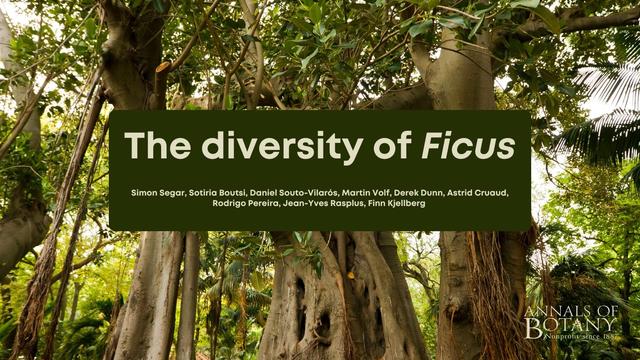
The fig is not a fruit but a specialized inflorescence whose enclosed, urn-shaped structure and synchronized flowers enable an exclusive partnership with fig wasps, an evolutionary key to the success of Ficus. (2/10)
Despite Ficus global distribution and complex history, fig taxonomy shows a remarkable congruence between traditional morphological classifications and modern phylogenomic reconstructions, with only a few deep-branching lineages still debated. (3/10)
Fig architecture resolves seed–wasp conflict by specializing flowers into seed and nursery roles, stabilizing the mutualism while preserving seed production. (4/10)
In Ficus, extreme specialization with agaonid wasps, reinforced by fig architecture and protogyny, has driven stable co-diversification and unusually high diversification compared with other nursery mutualisms. (5/10)
Long-distance pollen and seed dispersal fuels fig diversification: tiny wasps move pollen far, and small seeds spread widely, enabling colonization while maintaining isolation. (6/10)
Low extinction, shifts in growth form, sexual-system lability and climate change shaped fig diversification, with transitions between monoecy and dioecy enabling niche expansion rather than faster speciation. (7/10)
Ancestral active pollination boosts seed set and protects wasp larvae, but repeated losses show it is not essential. Together with fig size and plant architecture, these traits control pollinator sharing, gene flow and diversification in figs. (8/10)
Ant defence, heat regulation for wasp larvae, water use, and plant physiology all influence where and how figs develop. Fig position links mutualisms, stress tolerance and defence into one integrated strategy. (9/10)

Efficient dispersal by tiny, host-specific wasps lets figs colonize new habitats and diversify while staying reproductively isolated. Co-evolution matters, but flexibility, geography and ecology also shape fig diversity. (10/10)

👉 https://doi.org/qkmt

#PlantScience #Botany

The diversity of Ficus

AbstractBackground. The influence of Ficus extends beyond its numbers (887 species), and fig trees are often keystone species in their habitats. Ficus fill

OUP Academic